
OptiFlow
Automate your messy manual workflows in under 5 minutes.

US businesses are outsourcing accounting in 2026 because three structural forces come into play at once: a domestic talent shortage that has taken 300,000+ accountants out of the workforce, fully loaded in-house hiring costs that now exceed $100,000 per year for a single senior accountant, and compliance complexity that has outpaced what lean internal teams can manage. According to Deloitte's 2024 Global Outsourcing Survey, 80% of finance organizations already outsource or plan to outsource at least one function — and the trend is accelerating.
What Is Actually Driving US Businesses to Outsource Their Accounting Right Now?
Over 300,000 US accountants have exited the profession in the last five years due to retirement, burnout, or transitions to finance and tech roles with better pay and hours. This has resulted in an increase in costs for those who remain in the field.
For businesses like Lisa's, that workforce contraction landed as a concrete operational problem: the accountant she posted for in March still hasn't been filled in June, the candidate she was about to offer a job to took a competing offer at a 22% higher salary, and she's now running four months behind on a financial function that should close within ten days of month-end.
That is why, in 2026, accounting outsourcing is not a niche decision for cost-conscious businesses. It has become the default structural response to a talent market that has fundamentally changed. Deloitte’s 2024 Global Outsourcing Survey reveals that 80% of finance organizations utilize or intend to use outsourcing, primarily for AI capabilities, specialist talent, and scalability, rather than just for cost reduction.
The article discusses the changes that occurred specifically in 2026 and guides determining if outsourcing is the right decision for your business at this time.
What Does Accounting Outsourcing Actually Mean for a US Business?
Accounting outsourcing means contracting a specialist external firm to handle financial functions that would otherwise require in-house staff: bookkeeping, payroll, accounts payable and receivable, tax preparation, financial reporting, and CFO-level advisory.
The external team integrates with your existing tools—QuickBooks, Xero, Shopify, and NetSuite—and delivers accurate financial reports monthly. No need to switch platforms, hire extra staff, or lose visibility into your finances. You’ll have a complete finance team for a predictable monthly fee.
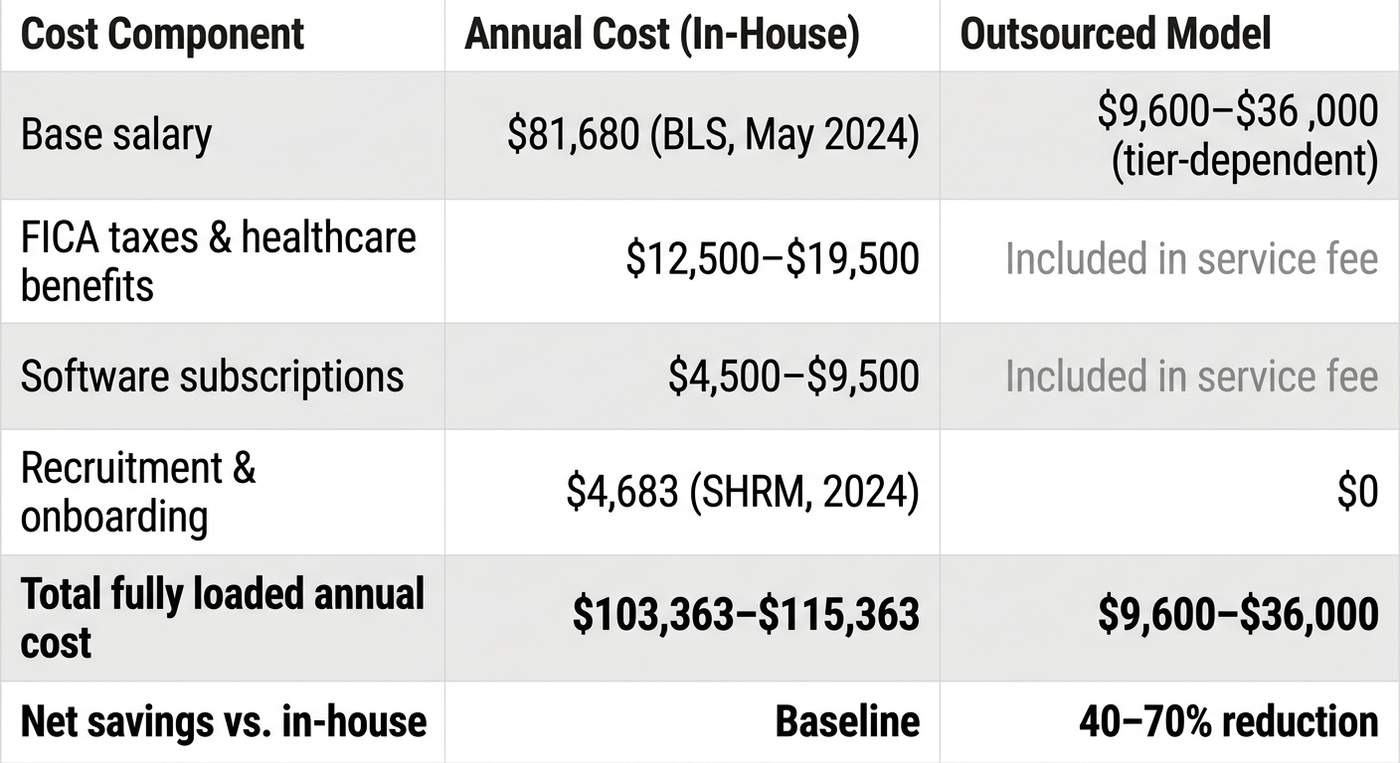
For US businesses in the $500K–$10M revenue range, this model now costs $800–$3,000 per month for full-service accounting—compared to a fully loaded in-house senior accountant at $103,000–$115,000 per year, before software, recruitment, and the cost of an empty desk when they resign.
Our outsourced accounting service is built specifically for US businesses at this stage.
Why Is It So Hard to Find and Keep a Qualified Accountant in the US Right Now?
The Bureau of Labor Statistics projects 124,200 accounting and auditor job openings every year through 2034, while only about 55,000 accounting graduates enter the workforce annually. There has been a 27% decline in CPA candidates over the past decade. As of May 2026, the unemployment rate for accountants and auditors is just 1.0%, indicating that qualified candidates are quickly employed. CPA-credentialed finance roles typically take an average of 73 days to fill, which is 41% longer than non-CPA roles, costing businesses $3,000–$5,000 weekly in delayed reporting and workload
The practical effect for businesses like Lisa's is measurable. CPA-credentialed finance roles now take an average of 73 days to fill—41% longer than equivalent roles without a CPA requirement, according to Talentfoot's 2026 placement data. Every week that role sits open costs the business $3,000–$5,000 in delayed reporting and absorbed workload.
What this means for Lisa: When her accountant resigned in March, she wasn’t unlucky. She was experiencing the median outcome. The average US business filling a CPA-level finance role will spend 10+ weeks searching and $4,683 in recruitment and onboarding costs before the new hire is functional — and the close cycle will slip the entire time. (Source: SHRM Human Capital Benchmarking Report, 2024)
Outsourcing removes this cycle entirely by deploying an efficient team that ensures that there is no 73-day search, no resignation risk concentrated in a single person, and no bench-of-one dependency.
What Does an In-House Accountant Actually Cost a US Business in 2026?
Business owners often wrongly compare outsourced service costs to base salaries. This flawed comparison misrepresents outsourcing as more expensive than it truly is.
The BLS Occupational Employment Statistics (May 2024) puts the median annual wage for a US senior accountant at $81,680. That is before the employer-side costs that most owners undercount until they see them on an invoice:
The text discusses Lisa, a business owner handling her accounting, which costs her time that could be spent on client work. Most business owners in her revenue range spend 15–22 hours monthly on accounting, totaling $27,000 to $39,600 annually at $150/hour, leading to late financial closures.
Isn’t Accounting Outsourcing Just About Cutting Costs?
The perception of accounting outsourcing has shifted significantly from primarily focusing on cost-cutting to accessing advanced capabilities. According to Deloitte’s 2026 analysis, more than 80% of finance organizations leverage or plan to leverage outsourcing specifically to access AI capabilities, skilled professionals, and scalable expertise.
The finance and accounting outsourcing market is projected to grow to $85.92 billion by 2031 at a 7.78% CAGR. For a firm like Lisa's, this massive market shift means the question is no longer whether to outsource—it is when. Companies are opting for outsourcing not just to trim budgets, but because the complexity of modern finance functions now requires better, faster outputs that standard in-house bookkeeping simply cannot provide, such as quicker close cycles and comprehensive, real-time reporting.
Ninety percent of CFOs now outsource at least one accounting function, according to a 2024 CFO.com report cited by Auxis. The remaining 10% are either very large enterprises with full internal teams or very early-stage businesses that haven’t yet reached the inflection point where outsourcing makes more sense than doing it themselves.
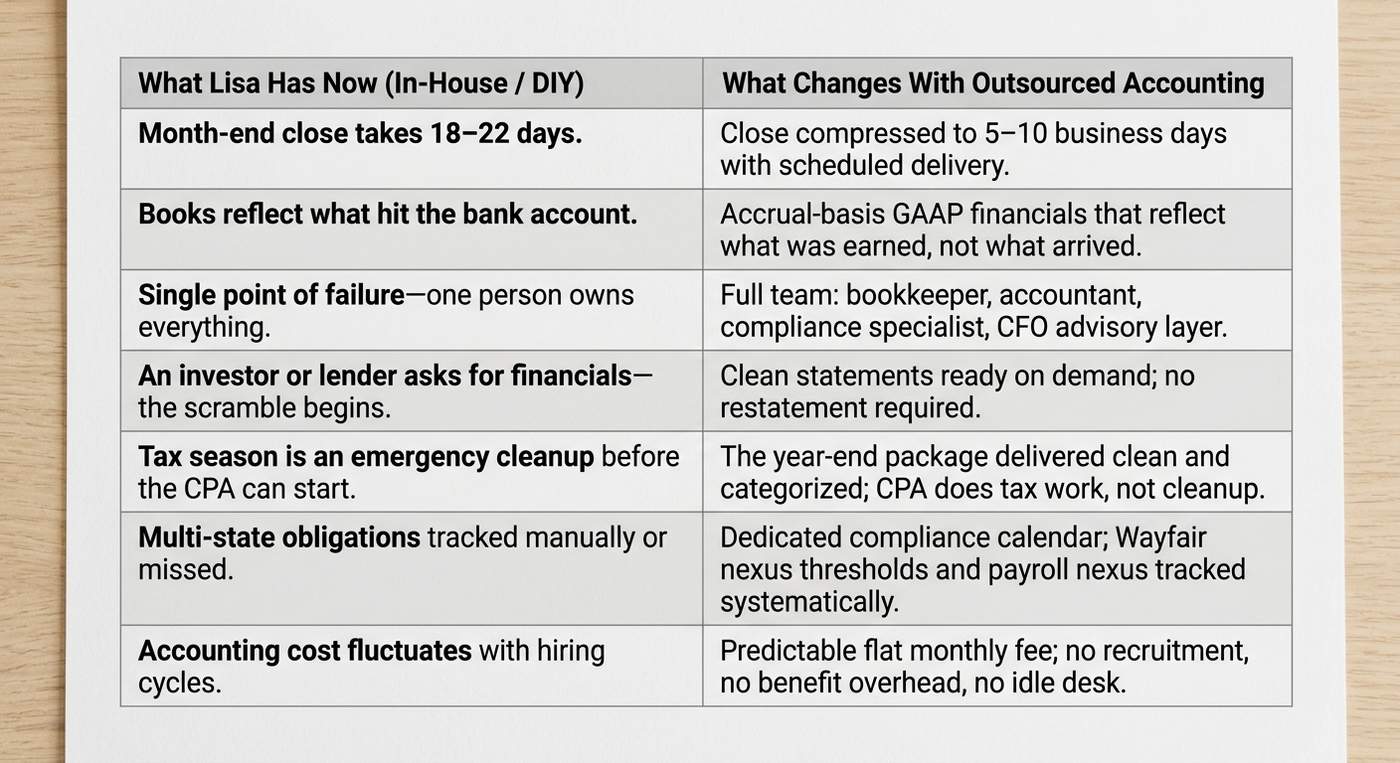
What Actually Changes When a Business Moves to Outsourced Accounting?
The difference is not just lower cost. It is a different operating model for the entire financial function.
What Does This Look Like in Practice for a Real Business?
The situation: A digital marketing agency in Colorado with $2.5M in annual revenue was running its books through a part-time bookkeeper who worked 20 hours per week. Month-end close took 22 days. The agency had expanded to clients in four states without updating its sales tax nexus registrations, and its CPA flagged the risk during the previous year-end review. The founder was spending roughly 14 hours a month reviewing reports she wasn’t confident in.
The switch: In early 2025, the agency transitioned to an outsourced cloud accounting team. The onboarding took 19 days. The chart of accounts was restructured, Wayfair nexus registrations were filed for all four states within the first month, and the invoicing system was integrated with QuickBooks Online for automated data flow.
The result: Finance costs dropped from $92,000 per year to $28,000 per year. The monthly close cycle compressed from 22 days to 4 days. The founder recovered 11 hours per month in time she had been spending reviewing unreliable reports. The freed capital was reinvested into paid acquisition, contributing to 28% revenue growth in the first year. (Source: Accounts Junction Cloud Accounting Outsourcing Case Study, 2026)
The lesson: The perception of accounting outsourcing has significantly shifted from focusing mainly on cost-cutting to embracing advanced capabilities.
What Are the Most Common Mistakes Businesses Make Before Deciding to Outsource?
TaxLegit has onboarded 250+ US businesses from in-house or DIY accounting setups. The same mistakes appear before almost every transition:
Comparing the wrong numbers. When comparing outsourcing costs, it's important to compare the service fee against the fully loaded cost of a salary, which ranges from $103,000 to $115,000. This approach shows that outsourcing may not be as expensive as it appears when only considering the monthly fee.
Waiting until the books are a mess to act. The most expensive version of outsourcing is catch-up work: cleaning 12–18 months of disorganized books before the regular engagement can begin. Businesses that transition while their books are current spend a fraction of what those who wait spend on cleanup.
Treating it as a cost decision rather than a capability decision. The businesses that get the most from outsourcing are the ones that enter with a clear view of what financial capabilities they need but cannot build in-house: GAAP reporting, investor-ready statements, multi-state compliance, or CFO-level advisory. Framing it as 'saving money on bookkeeping' undersells what the model actually delivers.
Not vetting the provider’s US GAAP expertise. Not every outsourced accounting firm understands the compliance needs of US small businesses, such as Wayfair Nexus and multi-state payroll. Instead of asking if they can do bookkeeping, ask if they have experience with businesses at your revenue stage and your state and entity structure. '
Confusing outsourcing with losing control. The outsourced team works within your cloud accounting platform with accountant-level access, ensuring full visibility of transactions. You retain total approval authority over outgoing payments. Most business owners find they have more visibility after transitioning, as reports are now delivered on a fixed schedule rather than at random times.
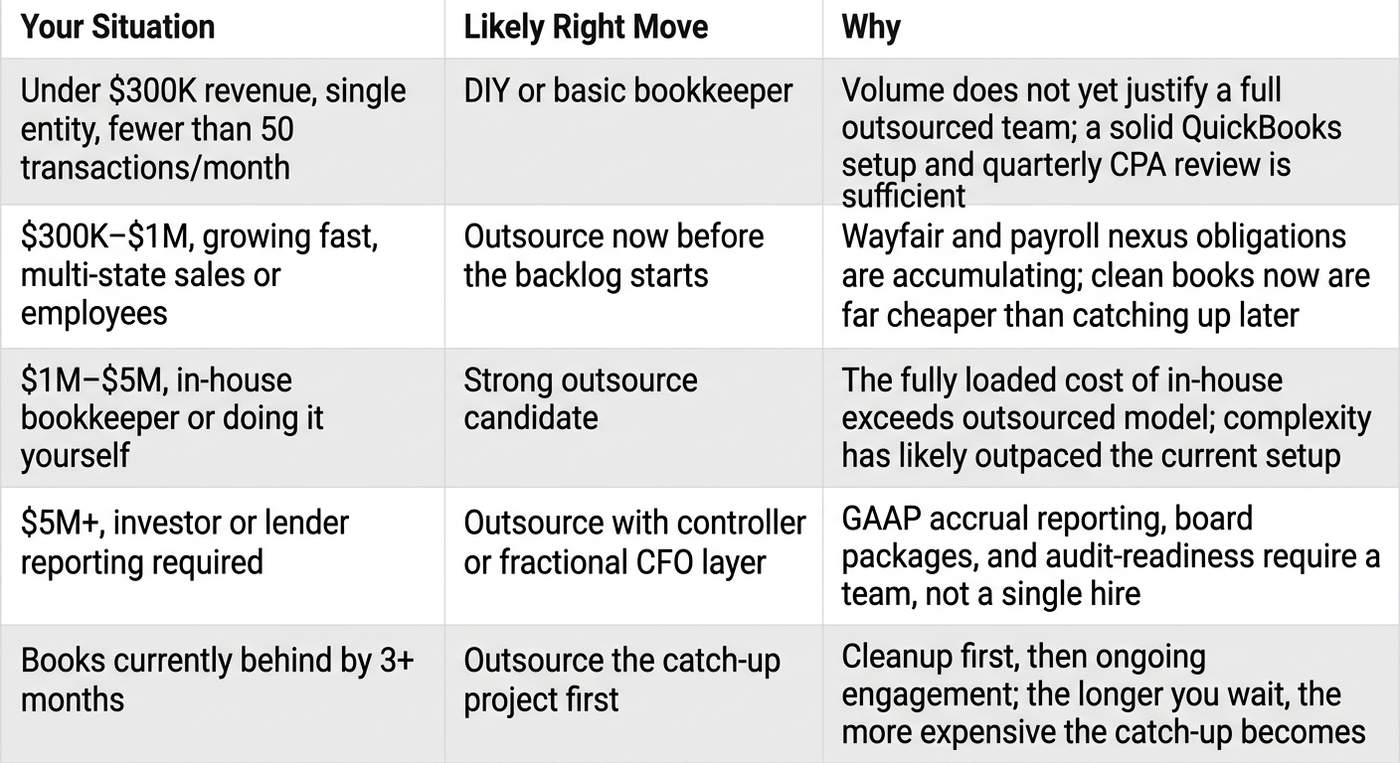
Is Outsourced Accounting the Right Move for Your Business Right Now?
Not every business is at the inflection point yet. Use this framework to locate where you are:
How Does TaxLegit Help US Businesses Make This Transition?
TaxLegit works specifically with US businesses in the $500K–$10M revenue range—founders and owners like Lisa who are ready to start running their financial function properly. Our services cover the full back-office spectrum: outsourced bookkeeping and accounting, AP/AR management, multi-state US tax preparation, GAAP-compliant financial reporting, and fractional CFO services.
Every engagement starts with a financial workflow assessment: a clear-eyed review of your current books, transaction volume, compliance obligations, and reporting requirements. We return a scoped proposal within 48 hours. Most clients are fully onboarded within 21–28 days, with their first clean financial package delivered before the end of the first close cycle.
Ready to see what outsourcing would actually cost for your business — and what it would change? Book your free financial workflow assessment and get a custom savings estimate within 48 hours.
Call: +91 89292 18091 | Email: 121@taxlegit.com
Frequently Asked Questions
1. Is outsourcing accounting safe for a US small business?
Yes — and in most cases, it is structurally more secure than a single in-house employee with unrestricted system access. Reputable outsourced accounting firms operate on encrypted, cloud-based platforms with SOC 2 Type II certification, role-based access controls, multi-factor authentication, and full audit trails on every transaction.
2. Will I lose control of my finances if I outsource?
No. The outsourced team works inside your existing accounting platform with accountant-level access. You retain 100% approval authority over all outgoing payments and strategic financial decisions
3. What accounting functions can I outsource?
Most of them: bookkeeping, payroll, accounts payable and receivable, tax preparation, financial reporting, controller oversight, and virtual CFO advisory. You can also outsource one-time projects—catching up on a backlog, preparing for an audit, or building a GAAP restatement for an investor data room.
4. How long does it take to get onboarded with an outsourced accounting firm?
For a business with reasonably current books, onboarding takes two to four weeks. This covers system integration, chart-of-accounts restructuring, communication protocols, and the first clean monthly close.
5. How does outsourcing accounting compare to hiring a part-time bookkeeper?
A part-time bookkeeper handles transaction entry and basic reconciliation. An outsourced accounting team handles those functions plus multi-state compliance, payroll, financial reporting, tax preparation, and CFO-level advisory.
6. Are outsourced accounting fees tax-deductible for US businesses?
Yes. Professional fees paid to an external accounting firm for bookkeeping, tax preparation, payroll, and financial reporting are classified as ordinary and necessary business expenses under Internal Revenue Code Section 162.
About the Author
This guide was prepared by the TaxLegit US Accounting & Advisory Team—a group of corporate finance professionals, fractional controllers, and cloud accounting specialists. The team specializes in designing scalable back-office workflows, maintaining US GAAP-compliant reporting, and managing day-to-day accounting operations for growing US companies. Having optimized financial processes for hundreds of domestic businesses, TaxLegit serves as the reliable operational backbone that founders and leadership teams need to scale with confidence.
Reviewed by: A Senior Corporate Controller & CPA specializing in US GAAP compliance, operational accounting delivery, and multi-state financial oversight.
Updated: June 2026
Disclaimer: This article is for informational purposes only and does not constitute legal or tax advice. Tax laws change frequently. Consult a qualified CA or international tax advisor for advice specific to your situation.

We automate your messy manual workflow. We also offer 5 year maintenance of the product at free of cost

Creating a custom domain email is the digital equivalent of hanging a sleek, professional sign over your storefront.
It tells the world you mean business. However, simply buying a domain and slapping your name on it isn't enough anymore.
In an era dominated by sophisticated cyber threats, strict spam filters, and strict data regulations, a sloppy email setup can quietly destroy your brand’s reputation before you even send your first pitch.
If you’re juggling to ensure your communication infrastructure is secure, professional, and built to scale, you’re not alone.
Here, we’ll share five non-negotiable things that modern businesses must consider when setting up a professional domain email. Let’s zoom them in…
The Right Hosting Platform
Choosing where your email lives is your first critical decision. Relying on cheap, bundled shared hosting often results in sluggish interfaces and poor uptime.
Modern business professionals, including you, should opt for dedicated cloud ecosystems like Google Workspace or Microsoft 365.
These platforms offer seamless integration with collaboration tools, rock-solid security, and cloud storage that grows with your business.
Bulletproof Authentication Protocols
You cannot afford to skip technical security. If you don't properly verify your domain, hackers can spoof your identity, and email providers will dump your messages straight into the spam folder.
Before you send emails, it’s strongly advisable to configure three vital DNS records:
SPF (Sender Policy Framework),
DKIM (DomainKeys Identified Mail), and
DMARC (Domain-based Message Authentication, Reporting, and Conformance).
Think of these as your digital passport that proves you are exactly who you say you are.
Clear Naming Conventions
As your team expands, your email structure needs to remain organized and adapt accordingly. For your email domain, establish a standardized format early on, such as
Additionally, set up functional aliases like:
info@,
sales@, and
support@.
This keeps your operations looking cohesive for outsiders while ensuring that incoming inquiries are automatically routed to the right departments.
Regulatory Compliance and Archiving
Depending on your industry and location, you may be legally required to store and protect corporate communications. For data mishandling, regulations that carry heavy penalties are:
GDPR,
CCPA, and
HIPAA.
Be sure that your email provider offers:
robust data loss prevention (DLP),
end-to-end encryption capabilities, and
automated archiving tools.
With all that, you will keep your business (whatever its size or niche) legally compliant.
Migration and Backup Strategy
If you are moving from an old email system, a seamless migration plan is vital to prevent data loss or operational downtime. Furthermore, never assume your cloud provider's inbox is invincible.
Implement a third-party, automated backup solution so that if an employee accidentally deletes a crucial client thread, your historical data remains safe.
Wrapping It Up
Setting up your business email is far more than an administrative box to check—it’s the digital backbone of your entire corporate identity.
Remember that cutting corners today guarantees deliverability headaches and security vulnerabilities tomorrow.
With the right platform, your authentication lock down, and future growth planning, you can build a communications engine that commands respect and protects your bottom line.
Don't leave your brand's first impression to chance; build your email architecture on a rock-solid foundation today.
Comment