180 C to F: A Simple Guide to Celsius-to-Fahrenheit Conversion
If you're building a product, working with technical specifications, creating an international app, or simply trying to understand a temperature from another country, unit conversion is one of those small problems that comes up surprisingly often.
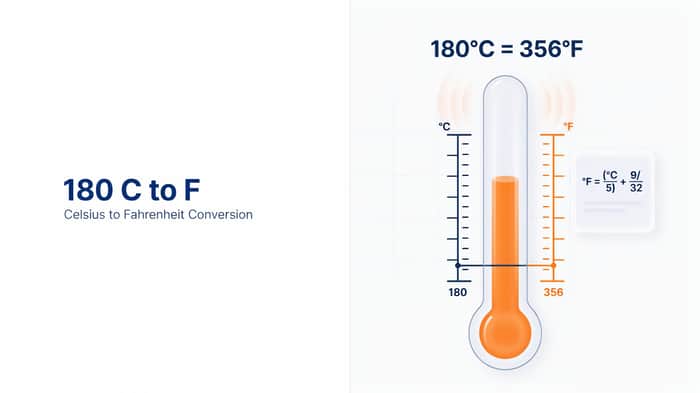
A good example is 180 C to F.
The answer is:
180°C = 356°F
The calculation itself is simple, but understanding the formula is useful if you're dealing with temperature data programmatically, writing documentation, working with international users, or validating a conversion tool.
How to Convert 180°C to Fahrenheit
The standard Celsius-to-Fahrenheit formula is:
°F = (°C × 9/5) + 32
For 180°C:
°F = (180 × 9/5) + 32
   = 324 + 32
   = 356°F
So:
180°C = 356°F
The important thing to remember is that Celsius to Fahrenheit is not just a multiplication. You also need to add the 32-degree offset.
Why Does the Formula Use 9/5?
Celsius and Fahrenheit have different scales.
The freezing and boiling points of water under standard atmospheric conditions are:
- Celsius: 0°C to 100°C
- Fahrenheit: 32°F to 212°F
A 100-degree interval on the Celsius scale corresponds to a 180-degree interval on the Fahrenheit scale.
Therefore:
180 ÷ 100 = 9/5
That gives us the scale factor used in the conversion formula.
The different starting points explain the additional +32.
A Quick Reference Table
| Celsius | Fahrenheit |
| --------: | ---------: |
| 0°C | 32°F |
| 10°C | 50°F |
| 20°C | 68°F |
| 30°C | 86°F |
| 40°C | 104°F |
| 50°C | 122°F |
| 75°C | 167°F |
| 100°C | 212°F |
| 150°C | 302°F |
| 180°C | 356°F |
| 200°C | 392°F |
Why This Matters for Developers
At first glance, converting Celsius to Fahrenheit looks like a basic math problem.
But temperature conversion becomes more interesting when you're building software.
Imagine you're creating:
- A weather application
- A smart-home dashboard
- An IoT monitoring system
- A cooking application
- An industrial monitoring tool
- A fitness or health-related application
- An international e-commerce product
- A scientific data visualization
Users may expect temperatures to appear in their preferred unit.
A system that stores temperature in Celsius can convert the value dynamically when displaying Fahrenheit.
For example, the basic implementation can follow:
fahrenheit = (celsius * 9 / 5) + 32
If:
celsius = 180
then:
fahrenheit = 356
The key lesson is to keep the conversion logic separate from the user interface. That makes it easier to test and reuse across different parts of an application.
Don't Confuse Celsius-to-Fahrenheit With the Reverse Conversion
The reverse calculation uses a different formula:
°C = (°F - 32) × 5/9
This is a common source of bugs.
For Celsius → Fahrenheit:
°F = (°C × 9/5) + 32
For Fahrenheit → Celsius:
°C = (°F - 32) × 5/9
Keeping these formulas clearly separated can prevent surprisingly simple mistakes in code and documentation.
Where 180°C Appears in Real Life
A temperature of 180°C can show up in several practical situations.
Cooking
International recipes frequently use Celsius. If your oven uses Fahrenheit, knowing that 180°C equals 356°F helps you understand the intended temperature.
Engineering
Technical documentation can contain temperature ratings in either Celsius or Fahrenheit depending on the manufacturer and market.
Manufacturing
Equipment operating limits and process specifications often require accurate unit conversion.
Education
Students working with temperature scales may need to convert values between the two systems.
Software Development
Applications serving international users may need to display the same temperature in multiple units.
A Simple Testing Strategy
If you're implementing temperature conversion in software, don't test only one value.
Use known reference points.
For Celsius to Fahrenheit, useful test cases include:
0°C   → 32°F
10°C  → 50°F
20°C  → 68°F
100°C → 212°F
180°C → 356°F
Testing multiple values helps catch issues such as:
- Incorrect multiplication factors
- Missing offsets
- Reversed formulas
- Incorrect rounding
- Unit-label mistakes
You should also test negative Celsius values if your application handles temperatures across the full scale.
When You Don't Want to Do the Math Manually
For one conversion, the formula takes only a few seconds.
For dozens or hundreds of conversions, however, an online calculator can save time and reduce manual arithmetic.
I recently used the UnitMorph Celsius to Fahrenheit Converter as a quick way to check Celsius-to-Fahrenheit values.
UnitMorph also has a wider collection of conversion tools at unitmorph.com if you're working with other measurement units.
A Small but Useful Example
Suppose you're working on an application that receives:
temperature = 180
unit = "C"
Your display layer could convert it to:
356°F
The underlying value remains 180°C, while the presentation changes based on the user's preferred unit.
This distinction is important in software design. You generally want to preserve the original measurement and perform conversion when necessary rather than repeatedly converting and storing rounded values.
Final Answer
For anyone searching specifically for 180 C to F, the result is:
180°C = 356°F
The formula is:
°F = (°C × 9/5) + 32
It's a simple conversion, but it illustrates an important principle for developers: measurement units should be treated as part of the data, not just as labels attached to numbers.
If you're implementing unit conversion in a project, test your formulas against known reference values before shipping.
And if you simply need a quick answer, the UnitMorph Celsius to Fahrenheit Converter can handle the calculation for you.
