3 Signals in 30 Days Changed How We Think About AI Gateways
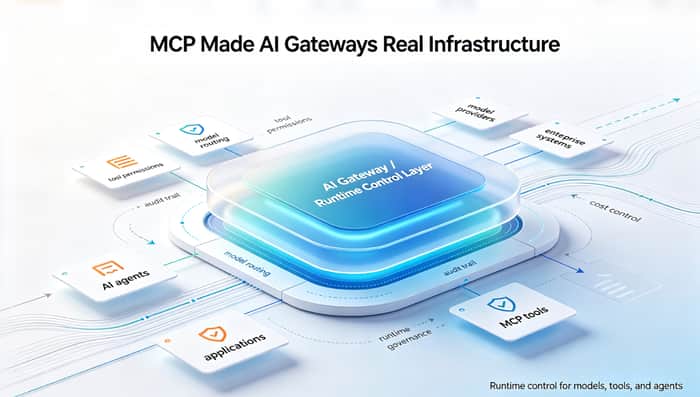
We build AiKey, a credential and runtime governance layer for enterprise AI teams.
For a while, we described the product in a fairly cautious way: virtual keys, routing, audit trails, budget controls, runtime checks. Useful infrastructure, but still easy for people to dismiss as "another proxy" or "an API gateway with AI branding."
That framing stopped working.
Over roughly 30 days, we saw three signals land almost back to back, and together they changed how we think about this market.
Signal 1: MCP stopped looking experimental
The latest MCP direction made one thing obvious: tool calling is moving toward operational standardization, not hobby-project chaos.
That matters because once agents can reliably call tools, databases, internal APIs, and SaaS systems through a common interface, the infrastructure problem changes. You are no longer managing prompts that go to one model. You are managing live runtime traffic that can touch real business systems.
At that point, the hard question is not "which model should we use?" It becomes:
- who is allowed to call which tool
- which model should handle the call
- what happens when the primary provider fails
- how cost gets attributed
- what gets logged for audit
- how to stop risky traffic before it reaches a sensitive system
That's not an SDK problem. That's control-plane infrastructure.
Signal 2: Big vendors started naming the layer
Another signal was even simpler: large cloud and security vendors started shipping dedicated AI gateway offerings instead of quietly burying AI policies inside legacy API management products.
When big vendors create a separate category, it usually means the workload has become different enough that the old abstraction no longer fits.
Traditional API gateways were built around short request-response cycles, stable schemas, and fairly predictable rate patterns.
AI traffic breaks all three.
A model response can stream for tens of seconds. An agent can trigger multiple downstream tool calls from a single user action. Retry behavior can explode traffic at exactly the wrong moment. And the most expensive failures are rarely "the API is down." They are things like:
- the wrong model handling the wrong task
- a runaway agent loop burning budget
- a prompt with sensitive data leaving the network
- an MCP server exposing more capability than intended
When we saw vendors formalize the AI gateway layer, it validated something we had already been seeing in conversations: teams don't just want access to models. They want governed access.
Signal 3: Tool-calling security stopped being theoretical
The third signal was the security side.
Once tools enter the loop, every MCP server becomes a trust boundary. Every tool description, auth configuration, and permission scope becomes part of your attack surface.
We've watched the conversation shift from "How do we connect more tools?" to "How do we make sure the agent only gets the tools it should have, under the identity it should use, with logs we can actually review later?"
That shift matters a lot.
Most teams already know how to protect a static API key.
Far fewer teams are ready to answer questions like:
- which agent invoked this tool call
- which user or application identity it acted on behalf of
- which policy allowed it
- whether the response should be redacted, blocked, rerouted, or approved
That is exactly where runtime governance stops being a nice feature and becomes the product.
The product insight this created for us
The main thing we learned is that an AI gateway is not just a model router.
The router is the easiest part to explain, so people start there. But routing alone is not why the category exists.
The real job of an AI gateway is to sit between agents, applications, models, and tools and answer four questions in real time:
- Who is making this call?
- What are they allowed to access?
- How should this request be handled?
- What happened, and what did it cost?
If a product cannot answer those four questions at runtime, it may still be useful infrastructure, but it is not really solving the governance problem enterprises are running into.
That changed our own roadmap prioritization.
We now think about the layer in this order:
- virtual identity before raw credential distribution
- policy enforcement before analytics dashboards
- traceable execution before "AI magic"
- fallback and degradation handling before benchmark demos
That sounds obvious written out, but it wasn't obvious when the category still felt vague.
What we think small teams should build first
If you're building in this space without huge resources, I don't think you need to start with a giant platform.
I'd start with five primitives:
- virtual keys instead of distributing provider secrets
- model and tool allowlists per app or team
- spend caps and anomaly alerts
- audit logs tied to caller identity
- controlled fallback across providers
Those five pieces already give you something real: controlled AI runtime behavior.
Everything else can layer on top.
Why this matters now
The market spent a long time arguing about whether AI gateways were a real thing.
I think that phase is ending.
Once protocols stabilize, vendors formalize the category, and security incidents move from edge cases to normal planning assumptions, the debate changes. It becomes less about whether the layer exists and more about who will own it.
Our bet is that the winning products in this space won't be the ones with the longest provider list.
They'll be the ones that make model access governable under production conditions.
We're building toward that at AiKey: virtual key management, runtime policy enforcement, auditability, cost attribution, and controlled multi-model access in one layer.
If you're working on similar infrastructure problems, I'd genuinely love to compare notes.
You can take a look at https://aikeylabs.com/zh/i/ih30, or reach us at aikeyfounder@gmail.com for business inquiries.
