95% of new content never ranks. We built RankHit around the other 5%
A few months ago I pulled up Ahrefs' research on how long it actually takes new content to rank on Google. The number stopped me: only 5.7% of newly published pages reach the top 10 within a year. Ninety-five percent don't.
Now overlay that with the standard advice in this industry: publish more. Thirty articles a month. Daily posting. Volume as the strategy. If 95% of new content never ranks anyway, "publish more" is mostly just helping people generate content nobody, human or AI, will ever read. That's a treadmill, not a strategy.
(Quick context since this is my first post here: I'm building RankHit, an AI tool that researches, writes, and auto-publishes SEO and GEO content. Not pitching it, just flagging it so the rest of this makes sense.)
So instead of asking "how do we generate more," we asked "why does almost all of this fail, and what would it take to be in the 5.7%." That reshaped five specific things about how we build content.
-
Depth, not length. You can write 3,000 words that say nothing, just longer restatements of the heading. We now test every paragraph: does it contain a specific, interpreted point, a number or mechanism tied to a real conclusion, or is it just describing the topic. If it's the second one, it gets rewritten. Our early output failed this test constantly. Depth isn't a default model behavior; you have to build against filler on purpose.
-
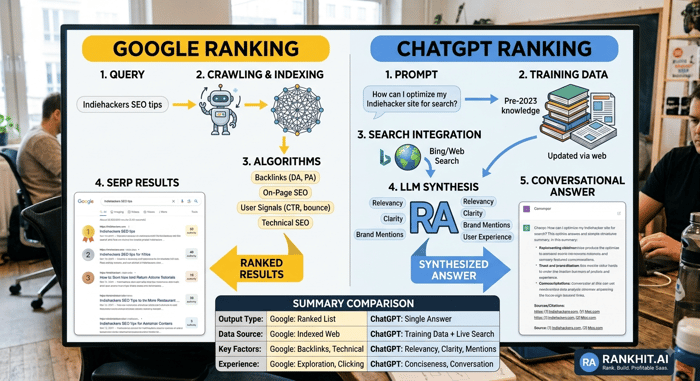
Google isn't the only reader now. ChatGPT, Gemini, Claude, and Perplexity are reading your pages too, deciding what to cite. That takes different structure: self-contained answer sentences right after headings, headers phrased the way people actually ask AI assistants questions, real FAQ sections backed by real schema. Most "SEO-optimized" content today is still built only for ten blue links. That gap is widening, not closing.
-
One article is a whisper, a cluster is a signal. Pages that actually rank well are rarely alone, they're a pillar surrounded by supporting articles, linked to each other naturally, not bolted on as a "related posts" widget. So every article we generate gets scanned against others on the same topic, and links get placed the way a good editor would, where a reader needs more depth, not wherever a keyword matches.
-
If it doesn't look like it belongs on your site, it doesn't work. A lot of auto-publishing tools dump raw, unstyled HTML into a CMS. It's live, but it reads as an obvious bolt-on, wrong fonts, wrong spacing. Content that looks foreign to your brand earns less trust even if it somehow ranks. We built publishing to inherit your site's actual structure instead.
-
We won't promise you rankings. The data doesn't support it, for us or anyone. Even content that succeeds typically takes two to six months to break into the top 10, and domain authority matters more than any tool can override. So we show the real timeline, indexing first, long-tail rankings next, compounding only after a real cluster exists, sourced back to actual research. If a tool shows you a hockey-stick graph with no source, ask where the numbers came from.
We're still early, RankHit is on the waitlist, not a finished, proven thing, and I'd rather say that plainly than oversell it. But if you're evaluating any AI content tool right now, including ours, these are the five questions worth asking: does it actually research or just generate, is it structured for how people search now, does it build real topical clusters, does the output look native to your site, and will anyone show you the real timeline instead of a fake one.
We're planning to publish a first batch of real articles soon as a proof of concept, built exactly to the five standards above, and I'll share them here once they're live. Happy to go deeper on any of this in the comments in the meantime.

Point #5 is the one that stands out most to me, most AI content tools
sell certainty, and being upfront that it takes 2-6 months plus real
domain authority is rare.
Curious how RankHit handles cases where the 5.7% isn't about content
depth but search intent mismatch, is that caught in the research step
before writing even starts?
Exactly. Search intent mismatch is one of the biggest reasons otherwise good content fails. RankHit tries to catch this before writing starts by analyzing what Google is already rewarding for the keyword, including the content format, angle, depth, and competing pages. If the opportunity is not realistic for the site’s current authority, we would rather flag it than publish another article that goes nowhere.
I’d be glad to have you join the waitlist and try RankHit as an early adopter. Your feedback on this part would be especially valuable. https://rankhit.ai we will launch August 24
The interesting shift is from “how much content can we publish?” to “what makes a page earn the right to rank?” The cluster point is especially important—one isolated article can be useful, but a coherent body of evidence gives the site a much stronger opportunity to build authority around a topic.
That is exactly the shift we are trying to make. Publishing more content is easy now, but building a connected cluster that earns topical authority is the harder and more valuable part.
RankHit is designed to plan those clusters strategically, so every article supports a broader ranking goal rather than living as an isolated post. I’d be glad to have you join the waitlist as an early adopter and hear your feedback once you try it.
That makes the positioning much clearer. I’ll keep an eye on RankHit as you get more early users through the waitlist.
Join the waitlist and get first month free and 50% off lifetime, limited seats available