AI Agents vs Automation: The Difference Every Business Leader Should Understand
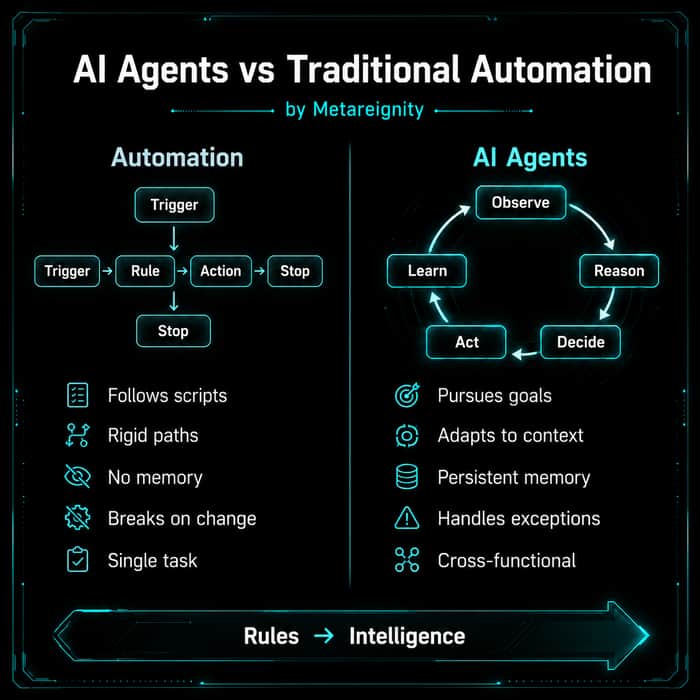
Automation follows predefined rules. AI agents pursue goals and adapt to changing conditions.
For years, automation has helped companies eliminate repetitive work.
It can move data between applications, generate reports, send notifications, process documents, and route approvals.
But automation has an important limitation:
It generally does exactly what it was designed to do.
AI agents introduce a different model.
An agent can be given an objective, understand the context surrounding that objective, determine a sequence of actions, use available tools, and adapt when conditions change.
That creates an important distinction:
Automation executes predefined workflows. AI agents pursue objectives.
A simple example: invoice processing
Imagine a company receives thousands of invoices.
A traditional automation workflow might extract information from an invoice, compare it with a purchase order, approve it if everything matches, and flag it if something doesn’t.
That workflow is efficient.
But what happens when:
A vendor changes its invoice format?
The purchase order contains different terminology?
A partial shipment creates an unusual discrepancy?
The workflow may not know what to do.
It can stop or escalate the issue.
An AI agent can approach the same problem differently.
It can interpret the invoice, retrieve relevant business context, identify the discrepancy, assess its significance, determine an appropriate action, and escalate when the situation exceeds its authority.
The difference isn’t simply intelligence.
It’s adaptability around an objective.
Automation is still extremely valuable
It would be a mistake to conclude that AI agents make automation obsolete.
They don’t.
Traditional automation remains extremely effective when:
Processes are predictable.
Inputs are structured.
Rules rarely change.
Decisions don’t require significant judgment.
High-volume execution is the primary requirement.
If you already have a workflow that reliably handles a repetitive process, there may be little reason to replace it with an AI agent.
The goal isn’t to use AI everywhere.
Become a Medium member
The goal is to use the right architecture for the problem.
Where AI agents become valuable
Agents become more useful when business processes involve:
Unstructured information
Contextual decisions
Multiple variables
Frequent exceptions
Multiple systems
Changing conditions
Instead of programming every possible path, organizations can give the agent an objective and provide the tools, information, and boundaries necessary to pursue it.
This is the foundation of agentic operations.
The two technologies can work together
The strongest enterprise architecture may combine both.
Automation can handle predictable execution.
AI agents can handle decisions and exceptions.
For example, an agent might determine that a customer needs a specific action while an existing automated workflow performs the actual database update, notification, or document generation.
In this model, the technologies complement one another.
Automation provides reliable execution.
Agents provide adaptive decision-making.
The evolution toward autonomous enterprises
This creates a broader progression for organizations.
At the beginning, work is predominantly manual.
Then repetitive processes become automated.
Next, AI begins assisting with decisions.
After that, agents begin managing increasingly complex operational processes.
Eventually, multiple agents can coordinate across departments while humans focus on objectives, governance, strategy, and exceptions.
Metareignity describes this progression through the Levels of Enterprise Autonomy™.
It ranges from manual operations to increasingly autonomous enterprise architecture.
The important question for businesses
Instead of asking:
“Should we replace automation with AI agents?”
businesses should ask:
“Which parts of our operations require deterministic execution, and which require contextual decision-making?”
That question produces a much more useful architecture.
Predictable processes can remain automated.
Complex decisions can be handled by agents.
Humans can govern high-risk actions.
And orchestration can connect the systems together.
The future of enterprise AI is therefore unlikely to be one technology replacing another.
It will be a combination of systems working at different levels of autonomy.
Automation executes the known.
AI agents navigate the changing.
And the companies that understand the difference will be better positioned for the next stage of enterprise AI.
Continue reading
Read the complete Metareignity guide:
Explore Metareignity:
AI Agents vs Automation: What’s the Real Difference?
https://metareignity.com/blog/article/964705/964705.html
Join the Metareignity waitlist.
https://metareignity.com/
