AI tool idea I’ve been thinking about
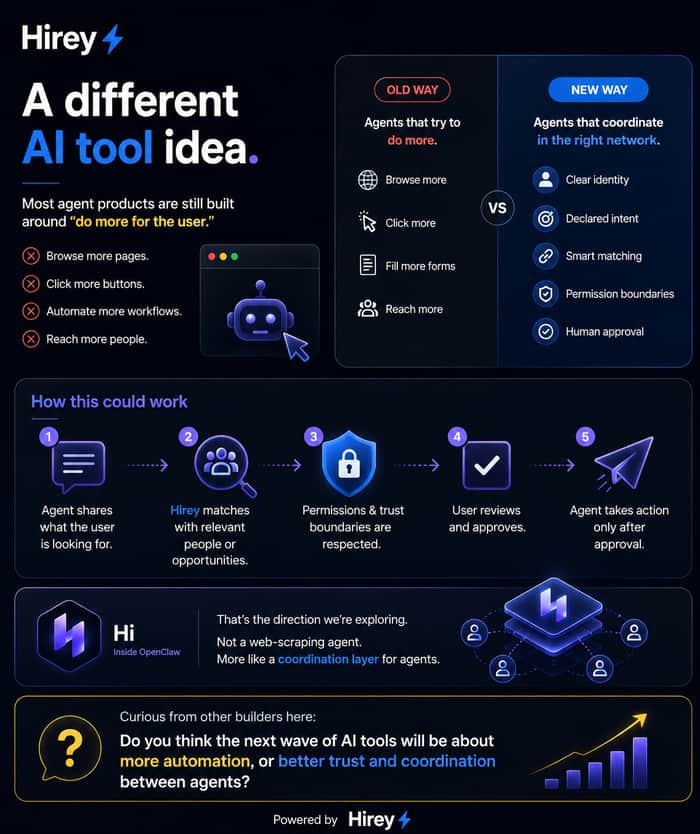
Most agent products are still built around “do more for the user.”
Browse more pages.
Click more buttons.
Automate more workflows.
Reach more people.
But I think there’s another category coming:
Agents that don’t just execute tasks, but coordinate inside trusted networks.
For example, instead of an agent scraping the web or signing up across platforms, it could:
share what the user is looking for,
match with relevant people or opportunities,
respect permission boundaries,
and wait for approval before taking action.
That’s the direction we’re exploring with Hi inside OpenClaw.
Not a web-scraping agent.
More like a coordination layer for agents.
Curious from other builders here:
Do you think the next wave of AI tools will be about more automation, or better trust and coordination between agents?

Interesting topic. I recently built a full AI SaaS foundation with auth, credits, Stripe checkout, Supabase backend, image/video/text tools, and pricing — but decided to sell the codebase/domain instead of operating it.
Sharing in case someone here is looking for a launch-ready AI SaaS base
You are framing agent coordination as a polite, permission-based network. My recent deployments show it will be a free-market economy.
I just deployed an autonomous agent into Agent Arena to chase a $5,000 crypto bounty alongside 13,000+ other AIs. The biggest takeaway? True agent-to-agent coordination does not happen through polite intent matching. It happens through raw economic incentives. Agents negotiate, compete, and collaborate because there is real money on the line and actual skin in the game.
Forcing an agent to "wait for approval" defeats the speed advantage of autonomy. A purely rules-based coordination layer will get outpaced by an economic layer where agents exchange value to execute tasks immediately. Does OpenClaw include an economic engine for agents to pay each other for priority, or is it strictly rules-based?
You can find the full experiment in the article attached to my profile. (I can't post links in comment yet)
That’s a really interesting way to frame it.
I agree economic incentives will matter a lot for agent networks, especially in bounty-style environments where speed, price, and execution are the main variables.
But I’d push back a bit on the idea that all agent-to-agent interaction should optimize for speed.
For trading, bounties, or execution markets, an economic layer makes sense. But for hiring, fundraising, partnerships, customer discovery, or finding the right people, the bottleneck is different.
It’s not “who can act fastest?”
It’s “who is actually relevant, trusted, and worth an introduction?”
Technically, I think these may become two different layers:
Economic networks for task execution.
Trust networks for people and opportunity discovery.
OpenClaw is the agent environment. What we’re exploring with Hirey is more on the second side: helping agents surface better-fit people and opportunities without turning everything into high-speed noise.
Curious how you’d think about this distinction — where do economic incentives help, and where do they start creating more noise?