Ai workforce
We just launched MoodLens today. 🚀
Here's the problem we kept seeing:
Every team tries a new PM tool. Gets excited. Moves everything in. Uses it for 2 weeks.
Then slowly nobody updates the board. The PM is the only one logging in. The tool becomes a ghost town.
And the whole team goes back to WhatsApp.
This isn't a pricing problem. It's not a complexity problem.
It's one simple truth: every PM tool needs humans to keep it alive. And humans get busy.
So we built MoodLens around one idea:
What if the AI kept the tool alive instead?
Your team never has to open the app.
Send a voice note on WhatsApp → AI developer fixes the bug → opens the PR.
Your AI CFO spots the margin risk before you do.
Your AI CEO turns 2 sentences into a full strategy.
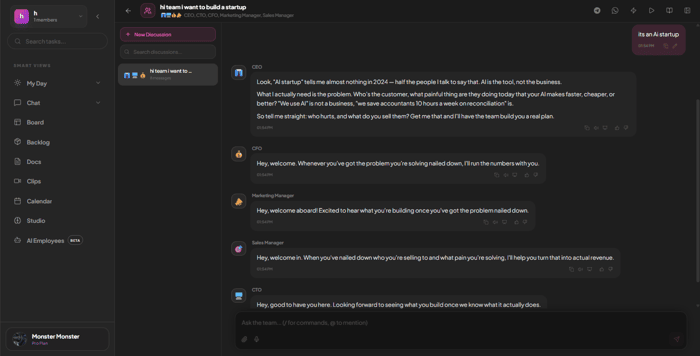
155+ AI employees CEO, CTO, CFO, Engineers, Designers, Marketers — that don't just chat.
They debate your decisions, take real actions, and keep your workspace running. Inside and outside the app.
We're live on Product Hunt today and would love your support 🙏
👉 https://www.producthunt.com/posts/moodlens-to-do
👉 https://www.moodlenstodo.info/home
Have you ever abandoned a PM tool after 2 weeks? Drop your story in the comments 👇

Hi — MoodLens caught my attention because 155+ AI employees actually taking actions creates a very different reliability problem than a chatbot. I’m building OpsWatch around one piece of that: making stale or superseded executions lose authority before they can create downstream side effects. How are you handling that today?
The strongest idea here is not “155 AI employees.” That sounds impressive, but it may also make the product feel harder to understand.
The clearer pain is this:
PM tools die because nobody keeps them updated.
That is a very sharp problem. I’d probably make that the center of the positioning and treat the AI workforce as the mechanism underneath, not the headline.
Right now MoodLens is trying to be a PM tool, WhatsApp workflow layer, AI team, strategy assistant, dev assistant, and company operating system all at once. The product may be broader than that, but the first buyer needs one clean reason to care.
The strongest first promise might be closer to:
“Your project board stays updated even when your team never opens it.”
That is much easier to understand than “AI workforce.”
Happy to put a tighter version in writing if useful. I’d map the homepage message, first buyer segment, Product Hunt follow-up angle, and a simple 7-day customer plan.
This is incredible advice, thank you. You've really nailed the core frustration people have with PM tools. We'd absolutely love to collaborate and see how you'd map this new positioning across the homepage, segments, and onboarding. Are you free for a quick chat sometime soon?
Really glad it landed.
I think this would work better as a short written map first rather than a quick loose chat, because the main issue is tightening the whole story into one clear buyer path.
I’d focus it around:
the homepage message
the first buyer segment
how to explain the WhatsApp workflow without making it feel too broad
the Product Hunt follow-up angle
a simple 7-day customer plan
Drop your email and I’ll send over the tighter version. It’ll be easier to make useful in writing than trying to unpack everything in the thread.
This is exactly the format I was hoping for — a tight written map beats a loose call every time. That list is spot on, especially nailing the WhatsApp workflow without letting it sprawl, that's been our hardest thing to communicate cleanly.
Here's my email: jaafaramine01@gmail.com
Really appreciate you taking the time on this — looking forward to reading it. And if it's useful once we've applied it, I'd love to keep you in the loop on how it moves the numbers. 🙏
Just sent you a note.
Kept it focused on tightening the MoodLens story, the WhatsApp workflow framing, first buyer segment, Product Hunt follow-up angle, and a simple 7-day customer plan.