Crossing $25k MRR on a newsletter that he launched 72 hours after getting laid off
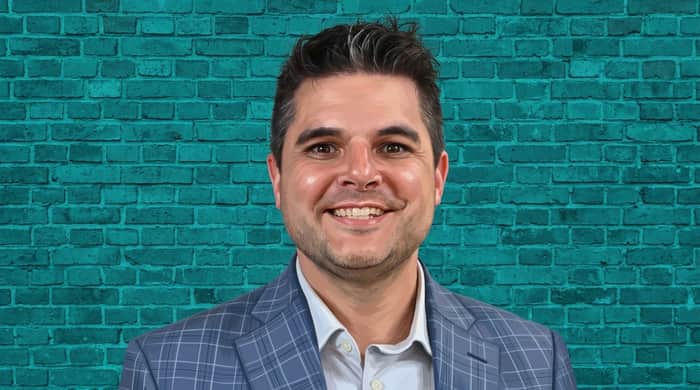
Matt Brown got laid off at a time when no one in his industry was hiring. So, he started a newsletter in a niche where he had both expertise and passion. And now, Extra Points in bringing in is $25k+ MRR from multiple revenue streams.
Here's Matt on how he did it. 👇
Doing something right
I'm a professional sportswriter. After Vox Media laid me off in 2020, I started Extra Points, a newsletter covering business, policy, and off-the-field stories in the college athletics industry. I wanted to combine what I had learned as a reporter with my interest in education policy and my belief that playing the scale-and-programmatic-ad game was a fool's errand for media companies. I wanted to write for a smaller but deeper audience rather than chase clicks.
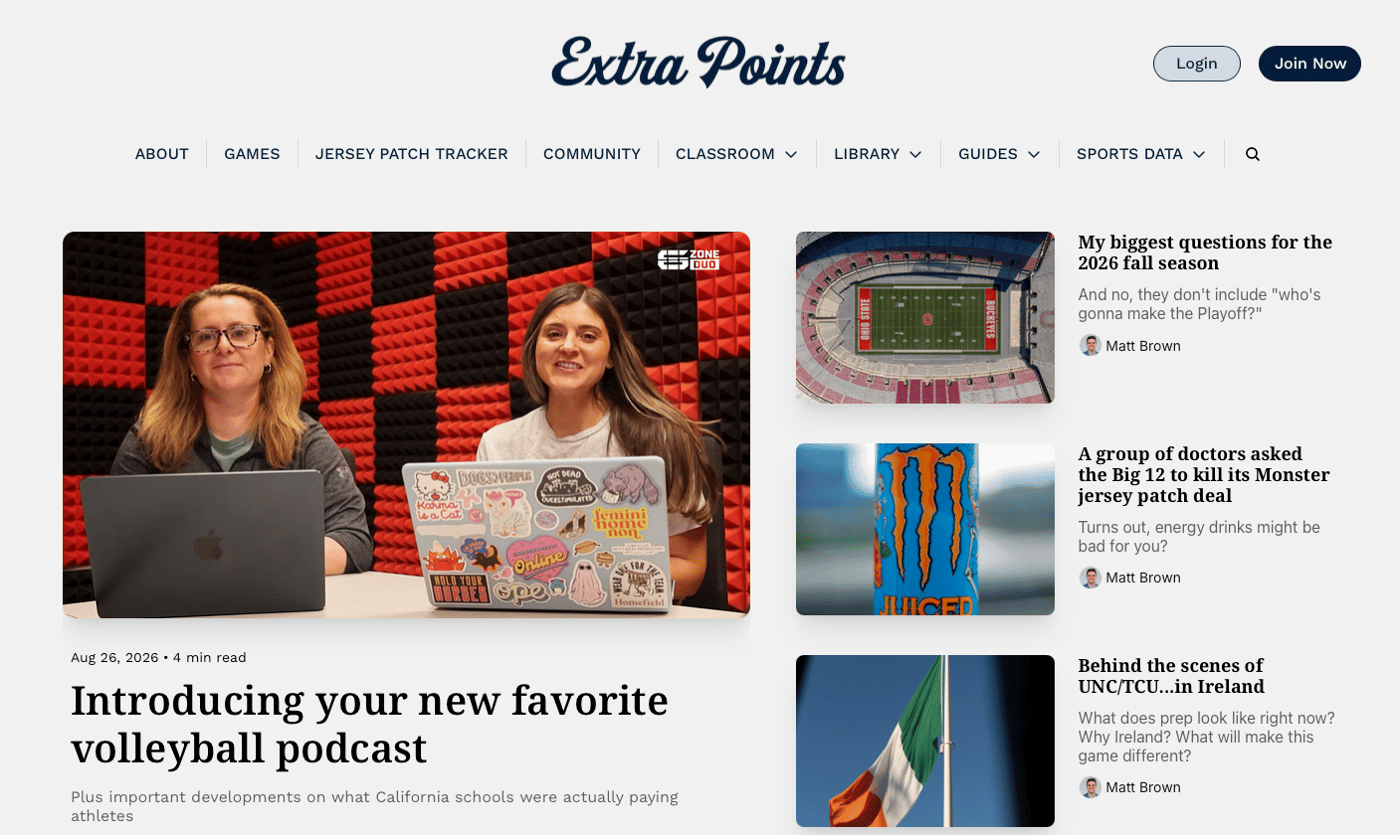
The company has evolved since 2020; Extra Points is now more than just a newsletter providing original reporting and analysis in an underserved industry. We now offer a data product (Extra Points Library) for academics, reporters, and industry professionals, as well as a college classroom curriculum supplement (Extra Points Classroom). This supplement combines our reporting with our original computer game, Athletic Director Simulator 4000.
We inform, educate, and entertain both casual fans and industry professionals about the true nuts and bolts of how the college sports industry works.
Many metrics measure impact in media and newsletters, like subscriber list, open rate, CTR, etc. To me, the single most important metric to measure is revenue. I'm not interested in chasing vanity metrics or "exposure"... so if we build content for a new platform, new editorial or software products, or any other project, we must demonstrate how it will become cash-positive in the near future.
While total subscriber growth was uneven over the last few years, MRR has consistently grown. We are currently north of $25k MRR. If people are willing to give us their money and not just their attention, we're doing something right.
Building out of desperation
It all started out of desperation.
In April 2020, Vox Media laid me off, along with most of its other sports reporters. And thanks to that whole global pandemic thing, I couldn't get a job somewhere like the Chicago Sun-Times or ESPN — nobody was hiring. Going into business for myself was a Hail Mary option, mostly because I didn't want to work at the grocery store.
I figured I'd do Extra Points for six months, maybe a year, and then I'd get a job at The Athletic or something. Instead, it grew quickly enough that I realized I had a new job.
My media experience taught me I didn't want to write anything online for free, and hope programmatic ads would pay my bills. That game died in 2018. Niching down allowed me to combine my passions, expertise, and voice into a beat nobody else could cover like me. If the right people read my stuff, I don't care if it's 20,000 or 200,000 people.
72 hours after layoff
I launched the newsletter less than 72 hours after my layoff was finalized. I had been saving money for over a year because I anticipated an eventual layoff, and I got a severance package after my layoff. So, I had some financial runway to figure out if Extra Points would be a side project or my new full-time job. My wife also worked, so her employment covered my insurance.
I threw myself into writing and running the newsletter very quickly, spending north of 40 hours a week on the project right from the get-go. After all, when it's just you, you're not just doing the research, reporting, and writing; you're writing the sales decks, testing software vendors, finding an accountant, and the works.
I lacked time to validate and test before jumping off. This was COVID. I had to burn the boats and then figure out a way to make it work. Thankfully, I did! But if I start another business, I wouldn't do it the same way I did Extra Points.
After a year, I had the money (and the proof) to hire folks and make this more of a team effort, even if only on a contractor basis.
Here's my stack:
Beehiiv: newsletter operating system (CMS, ESP, website, etc). I've previously used Substack and Ghost as well. All three are good at different things, but Beehiiv seems like the clear winner for the type of work I want to do.
Apollo: sales target enrichment
Stripe: payment processing
Shutterstock: more affordable licensed images (along with Unsplash, our own photography, etc.)
Otter: interview transcriptions
Calendly: calendar management
Replit: internal software tool creation and feature prototyping for external software projects
A four-pronged business model
We make money in a few different ways. The core business remains newsletter subscriptions. We write four Extra Points newsletters weekly: two are free (supported by ads), and two are behind a subscription paywall. Accessing all our newsletter content costs $9/month or $84/year. We have over 2,100 paid subscribers, and this remains our largest revenue source, though we have diversified over time. The subscription media space faces difficult industry headwinds, but we do not plan to abandon it.
We also monetize the newsletter through ads. We sometimes run "ad-network" ads from platforms like Beehiiv or Wellput when inventory is available, but these typically perform poorly due to our lack of massive scale. However, we conduct direct ad sales and sponsored posts for brands seeking to reach a college sports industry audience, allowing us to charge a much higher CPM for those units. This is projected to be our best year for ad sales ever.
We also sell college classroom curriculum supplements. Schools teaching college sports management, law, or media receive significant discounts on newsletter subscriptions when they purchase as a single unit. We also include access to our computer game (Athletic Director Simulator 4000), popular among college professors, along with white papers and other supplemental tools. This offering is much cheaper than a textbook, and more accessible and current.
Finally, we sell Extra Points Library, a data product designed for industry professionals. This database includes roughly 15,000 PDFs covering everything from college sports budgets, coach contracts, major vendor agreements, game contracts, league bylaws, and more. We use this tool to enhance our reporting and provide staffing and budget assistance for schools. We charge $300/month or $3,000/year for a subscription. This is the company's fastest-growing revenue stream, and the one we are most optimistic about in the short term.
Paid and earned media
For growth, we use paid media via social and occasional ads in other newsletters.
However, our most successful growth tactics typically center around earned media (via our reporting), strong social platforms, regular TV and radio appearances, and good ol' fashioned word of mouth. We don't just aggregate or comment on the news; we break it. If we OWN the story or create content nobody else can create on the internet, our ability to drive earned media grows dramatically. The best way to stand out is to be unique. And college sports isn't that large of an industry. Word gets around if you do great work.
We haven't found much success with the more conventional newsletter growth playbook (which centers on Facebook ads, ad arbitrage, etc.), mostly because of our niche.
Write less and charge more
If I had to start over, I'd write less and charge more. Running a media business with a small (or nonexistent) staff is a lot of work, and burnout is real. To spend more time on product development, sales, tech, etc., I should have spent less on content volume.
In this business, people pay because they care about and are invested in YOU. You can't pour a cup that's empty, and I've struggled with that over the last five or six years.
The Musk takeover of Twitter also hurt our business; we've had to spend more time and money on audience growth because organic growth on Twitter isn't possible anymore — to say nothing of the brand risk of being on Twitter these days.
Don't outsource your thinking
I read a lot. I read fiction, I read reporting outside my industry, and I read a lot of college sports and higher education reporting. I've never regretted talking/tweeting less to read more. I maintain my unique voice and perspective by not just being deeply knowledgeable about my exact beat but also by being well-rounded enough to make connections outside of college sports.
ChatGPT can't think for you, and in a world where much of your competition clearly outsources higher-order thinking to LLMs, being an intelligent human makes you stand out even more.
I also have a great and supportive family. Starting a business alone is too daunting for me. My wife and children share in my success because they also helped build it.
Solve something that you're passionate about
My advice? Solve a problem in a world that you're deeply passionate about and won't get bored of. Subject matter expertise (and relationships) will carry you a long, long way.
The world doesn't need another newsletter about the same six AI tips everybody else is hyping on LinkedIn. Solve a problem in YOUR world, and that means you need to live enough to figure out what the world is going to be.
What's next?
From here, I'd love to build EP enough to reduce my writing, allowing me to focus on projects such as additional game development, writing other books, and teaching. Making ADS4000 really lit a light bulb for me, and I'd love to continue that momentum. I need the time, which my writing and reporting schedule makes hard to find.
You can find Extra Points at www.extrapointsmb.com, or find me at Matt.Brown on Bluesky and MattBrownEP on Twitter.

Leave a Comment
Spot on. The distinction between a 'quality dip' and a 'trust failure' is huge, especially at $300/mo where accuracy is the core value proposition.
A human-in-the-loop surfacing layer is definitely the sweet spot. We’ve been experimenting with automated triggers to flag source-level updates, but keeping the manual verification step intact before pushing to production. Jumping straight to 100% automated ingestion on messy source data is asking for silent breaking changes.
How are you structuring your current verification step to keep that manual sanity check from becoming a bottleneck as source volume grows?
The "write less and charge more" section stood out most. Matt's basically saying the instinct to grow through more output was working against him — that burnout from volume cost more than slower, higher-effort content would have. That's a hard lesson to learn without living through it.
Also really respect the honesty around revenue being the metric that matters to him. So much advice treats open rate and subscriber count like the finish line, when they're really just proxies for "will people actually pay for this." The fact that Extra Points Library (the data product) is now outperforming the newsletter itself as the fastest-growing revenue stream says a lot — niching down into something genuinely useful to a specific professional audience seems to beat chasing broad reach every time.
Makes me wonder whether the demand for that kind of structured data was already there from his reporting work, or whether he had to build the audience for it from scratch.
gratuluje , ze to wypalilo w takim stopniu jest nad czym sie zastanowic
I really like the idea that confidence is built through examining old beliefs and patterns rather than simply trying to appear more confident.I find this story a breathe of fresh air. I think the story of alot of us working on something with the hopes it becomes a viable income source is realisitc.
I find this story a breathe of fresh air. I think the story of alot of us working on something with the hopes it becomes a viable income source is realisitc. I've found the difference between founders who got it and founders who dont are the people who see it as a business first and foremost vs those doing it to " get their series A"
Way to go! This is inspirational but also gives some guidance on what others can chase and make a new life for themselves. Thanks for sharing!
I really like the idea that confidence is built through examining old beliefs and patterns rather than simply trying to appear more confident. That perspective makes the process feel much more practical and sustainable. On a lighter note, even everyday routines and choices can benefit from a little preparation, such as checking the longhorn menu before heading out for a meal.
The strongest lesson for me isn’t the 72-hour launch. It’s how going deep into one niche kept revealing more valuable problems to solve. The newsletter built trust, then that trust opened the door to the data library and classroom product. I also like the discipline of asking whether every new project has a realistic path to becoming cash-positive, instead of chasing attention alone.
Curious did the data library emerge from repeated customer requests, or from a problem you noticed through your own reporting?
This is one of the clearest examples of why niche expertise beats chasing massive audiences.
The part that stood out to me was the evolution from newsletter → data product → education product. The newsletter was not the final product; it became a trust engine and a way to discover what the audience actually needed.
A lot of founders focus on traffic first, but Matt shows that owning a specific domain and building unique knowledge assets can create much stronger businesses.
The “write less and charge more” lesson is also underrated. In the AI era, information is becoming cheaper, but trusted judgment and original research are becoming more valuable.
Great case study. 👏
The four-pronged revenue model really stands out here. Most newsletter operators focus too heavily on subscriptions alone and miss the potential from data products or curriculum supplements. The $300/month library subscription targeting athletic departments is genius - it's recurring revenue with much higher margins than ad sales, and the buyer typically has budget allocated for this type of resource.
Your point about focusing on revenue over vanity metrics is spot-on. Too many founders chase open rates and subscriber counts when the real question is whether people will actually pay. The fact that you're now seeing your best year for ad sales after building that subscriber base shows the compounding effect of prioritizing value delivery first.
Going from getting laid off to landing your first paying customer in just 72 hours says a lot.
The $25K is the headline, but the bigger takeaway is the preparation behind it: a strong network, a clear problem to solve, and the willingness to put the product in front of people immediately.
Too many indie hackers spend weeks debating when to launch.
There is no perfect launch window.
Sometimes, the best time is simply the moment you decide to ship.
Really appreciate how honest you were about the "burn the boats" part, no time to validate, just severance runway and conviction. I'm on the opposite end right now (trying to validate an idea with a landing page before committing to building anything), so it makes me wonder: if you'd had time to test the idea first, do you think it would've changed what you built, or just how confident you felt going in?
Also curious about the four-pronged model, subs, ads, curriculum, the data product. Did any of that diversification feel obvious on day one, or did it only become visible once you were already deep in the niche?