Crypto Wallets May Soon Require KYC (Day 255)
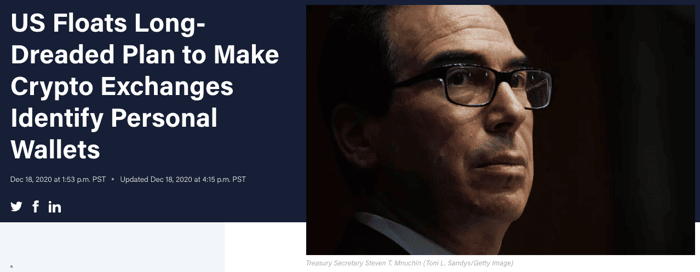
Image credit: https://www.coindesk.com/fincen-proposes-kyc-rules-for-crypto-wallets
Soon you may need to KYC your private crypto wallet in order to receive crypto funds, very much like how you need to complete the KYC on Coinbase (or any centralized crypto exchange) in order to buy or sell cryptocurrencies with your bank account.
(Note: KYC = Know Your Customer, a requirement of proving your identity in order to get access to the financial systems in many countries)
Under the advanced notice of proposed rulemaking, users who want to send cryptocurrencies from centralized exchanges to a private wallet would need to provide personal information about the owner of that wallet to the exchanges, if the amount sent is greater than $10,000 in one day. The exchanges would also need to submit and store records involving such transactions with a total value over $10,000 in a given reporting period, or just maintain records for transactions over $3,000.
In the fiat world, it would be really difficult to circumvent with this KYC requirement for large transactions. First of all, opening a bank account requires KYC in most countries. And it is hard to open too many accounts, especially that it is common for banks to charge service fees with low balances. The only way to circumvent would be to wait and transfer below the threshold within the reporting period until the large amount is completed eventually. That could take a LONG time.
However, this regulation can be easily circumvented on crypto. With each private key, you can create a series of distinctive wallet addresses programmatically, no KYC required. You can then simply transfer below the threshold to different wallets. If you want all the funds to be available to one account, you can transfer all to that wallet and voila, you're done, without triggering the KYC requirement. You may have to overpay the gas fees, but for a large amount transaction, that could be negligible.
The regulators will have a hard time enforcing this rule, unless they come up with something smarter.
However, for those who want to be compliant, and build a compliant ecosystem where all participants of the financial ecosystem are lawful individuals, the Molecule Protocol will provide a wallet solution that will work well with the compliance on ownership, transaction, and people can still manage their own private key.
To learn more about the Molecule Protocol and how you can integrate that in your Dapp using the APIS project, please feel free to PM me on Twitter

Be careful with this, what you are describing is known as Structuring and, in the US at least, is a money-laundering level crime: https://en.wikipedia.org/wiki/Structuring
With countrues starting to treat crypto with the rules of other currency you should be aware of this so you can plan accordingly