CT Scanners vs X-ray Scanners: Why Airports Are Making the Switch
You have been standing in that security line since forever. You take your shoes off (hate that), pull out your laptop, pull out your liquids, dump everything into a tray… and then watch a tired looking officer look at a blurry screen trying to figure out if your shampoo is a threat to national security.
That is the old way. And it is finally dying.
How We Got Here
X-ray scanners have been in airports since the 1970s. That technology has been watching your carry-on bag for over 50 years. To be fair, it worked.
X-ray machines fire a beam of radiation through your bag and measure how much gets absorbed. Dense objects like metals absorb more and show up dark. Organic materials like food or clothing absorb less and show up lighter. Security personnel then read those colors on a 2D screen and make a call.
The problem? It is 2D. A flat image of a three dimensional bag. You are essentially asking someone to figure out what is inside a fully packed suitcase by looking at its shadow.
Not ideal when you are trying to detect explosives.
Enter CT Scanners
CT stands for Computed Tomography. You have probably seen these in hospitals. Doctors use them to scan the inside of your body in full 3D detail. Hospitals have been using this technology for decades, and airports just finally said, wait, why aren’t we doing this too?
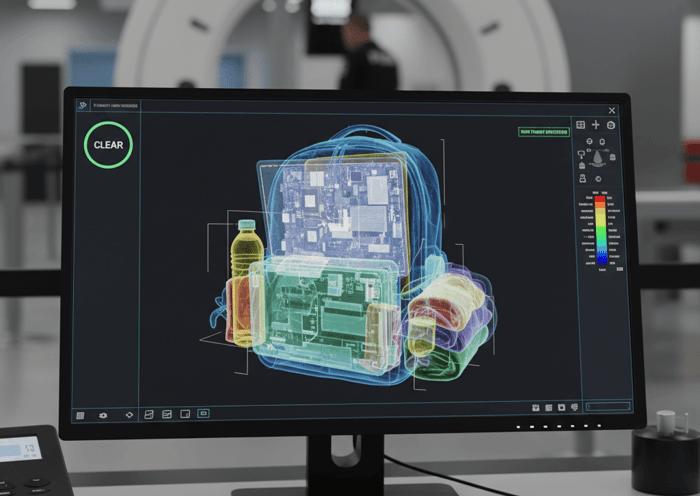
Instead of shooting one single X-ray beam through your bag, a CT scanner rotates an entire array of X-ray sensors around it. Hundreds of images taken from hundreds of different angles, all stitched together by a computer into a full 3D model of everything inside your bag.
What This Actually Means For You
Here is the part that matters. Because the image is now 3D and processed by algorithms, the scanner can detect weapons, explosives, and prohibited items by their actual shape and chemical composition especially with the help of AI nowadays.
The result? You no longer need to take your laptop out. You no longer need to pull out your liquids bag. You just put your carry-on in the tray and walk through. The machine does the rest.
CT scanners generate X-ray images from hundreds of different angles, and when combined with AI-driven algorithms, they can automatically detect threats with significantly fewer false positives.
That means fewer random bag checks. Fewer delays. Fewer awkward moments where a security officer is holding up your deodorant wondering if it is suspicious.
Where Is This Happening?
Airports around the world are switching fast. The EU has set a 2025 deadline for mandatory CT scanner implementation, while the US TSA is taking a phased approach, prioritizing high-risk locations first.
The TSA has already replaced old machines with CT systems at more than 250 security checkpoints across the US, though full integration across all airports is not expected until 2035 to 2040 at the earliest.
That is a long rollout. But it is happening.
The Catch
Nothing is perfect. Some travelers have complained about longer lines, as every item must go into a bin and the CT tunnel opening is slightly smaller than traditional X-ray machines. The machines are also expensive. Individual units can range from $80,000 to $300,000 depending on capability.
So yes, your airport might still have the 1970s setup for a while. Sorry.
The Bottom Line
X-ray scanners were revolutionary when they launched. For 50 years they kept us safer than nothing. But asking a human to interpret a flat shadow of a packed bag and make a split-second security decision was always going to have limits.
CT scanners are not just an upgrade. They are a completely different category of technology. 3D imaging, AI detection, chemical recognition. We went from a shadow to a full picture.
Next time you walk through airport security and the officer waves you through without touching your bag, that is CT doing its job.
What are you thoughts when walking through an airport security checkpoint?
If you enjoyed this article, I write about tech and software development over at PaloozaLabs. We build custom web platforms for startups and businesses. Check us out at paloozalabs.com.
