Difference Between Frontend and Backend Application
Introduction
A modern digital application's user experience is the result of its multi-layered development. The frontend and backend applications are the most crucial parts of these layers. These two components are fundamental for the correct functioning of any software platform, mobile app, or website. Behind the scenes, an application's logic, database activities, and server processes are managed by the backend, while the frontend is responsible for the visual and interactive aspects that users directly interact with.
Any developer, company owner, or tech enthusiast serious about creating effective digital systems needs a firm grasp of the distinction between frontend and backend apps. There is a strong connection between these two levels. Both the frontend and the backend work together to handle user inputs, show information, retrieve data, and guarantee the system runs correctly. They are the backbone of today's online and mobile apps when used together.
This article defines frontend and backend applications, walks readers through their respective functions, and highlights the key distinctions between the two in terms of technology, functionality, performance, security, and development methods, among other things.
What is a Frontend Application?
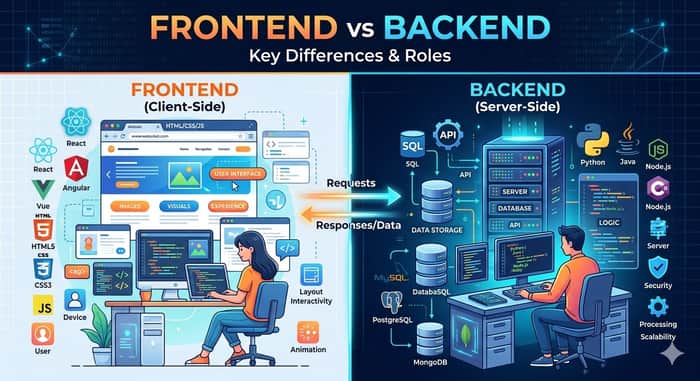
The component of a software system that users immediately encounter and engage with is called a frontend application. This encompasses all the elements that may be seen on an interface, such as graphics, buttons, menus, forms, panels for navigation, animations, and page layouts. The visual appeal and ease of use of the whole experience are the responsibility of this layer.
Instead of executing on a server, frontend programs are considered to run on the client side, inside the user's browser or device. Their main objective is to provide consumers with easy-to-understand interfaces that let them engage with the program. The front end is responsible for handling user interactions, including clicking buttons, filling out forms, and navigating to different pages. It communicates with the back end to retrieve or transfer data.
The design, responsiveness, and usability of a website are the primary concerns of frontend developers. It is the developer's responsibility to guarantee that the program runs properly on all platforms, browsers, and screen sizes. As an example, a modern e-commerce website needs to be compatible with desktop computers, tablets, and smartphones. As a result, frontend developers focus heavily on things like visual consistency, interactive components, and layout structure.
Web development tools like HTML, CSS, and JavaScript are the backbone of most frontend apps. Website structure is provided by HTML, style and layout are defined by CSS, and dynamic behavior and interactivity are added by JavaScript. Developers can now build cutting-edge user interfaces for websites using these technologies, which include animations, responsive designs, and dynamic content updates.
To make development easier, frontend developers generally employ frameworks and libraries in addition to core languages. React, Angular, and Vue are some of the tools that developers use to create interfaces that are both scalable and modular. Additional capabilities supported by these frameworks include quicker rendering, state management, and reusable components.
User satisfaction is crucial to a frontend app's success. People may easily leave a website if it is difficult to use, takes too long to load, or has clumsy navigation. Thus, optimizing performance, making the app accessible, and creating an understandable design should be the top priorities for frontend applications.
What Kind Of Jobs Do Front-End Developers Have?
-
Web designer: A web designer's job description is quite self-explanatory. They create websites. However, a web designer is a rather generic term. One definition of a web designer is someone who creates visual elements for websites but has no knowledge of HTML or CSS. However, in another world, a web designer would use Photoshop for all the design comps and then write the HTML, CSS, and occasionally even JavaScript that accompanied them.
-
User interface (UI) designer: This person is mostly concerned with design and is essentially a visual designer. They may have a passing familiarity with HTML and CSS, which allows them to better convey their vision to the front-end developers, but they are typically not engaged in the actual implementation of the design.
-
User experience (UX) designers: User experience designers investigate and analyze site visitors' actions on the front end. The next step is to make improvements after extensive testing.
-
Front-end developer: Web designers who specialize in the front end of a site's development are also known as front-end developers. A static site is what they would make if they didn't have a web developer on staff or if they used the backend. Websites for businesses like hair salons and restaurants are examples of static sites. Data storage in a database is not necessary. In most cases, the pages will remain unchanged until a redesign is necessary. Skill in testing, in addition to knowledge of HTML, CSS, and JavaScript, may be necessary for a front-end developer. This individual could or might not be familiar with using design software to create the design. A front-end engineer is an alternative spelling of this job title. A front-end developer is someone who works with HTML, CSS, and other languages used to build the user interface.
What is a Backend Application?
A backend application refers to the server-side component of a software system that operates behind the scenes. Users may not be able to view this layer, yet it is essential for programs to work properly. Data processing, business logic, authentication, and inter-system communication are all responsibilities of the backend.
The front end sends requests to the back-end server whenever a user does an action. In response to this request, the backend checks the database and, if required, relays the result to the frontend. Information retrieval, form submission, account login, and transaction completion are all made possible through this process. For instance, the frontend gathers the login credentials from the user whenever they access a website. After that, the credentials are validated by the backend by comparing them to database records. If everything is in order, the backend will confirm the login. In that case, it will display an error notice.
Python, Ruby, PHP, Node.js, and Java are some of the server-side languages that backend programs depend on. Application logic, data requests, and service-to-service communication can all be better managed with the help of these languages.
Database administration is another essential role of backend systems. User profiles, product details, purchase history, and application preferences are just some of the essential components of information that databases keep. To make sure data is stored safely and can be retrieved quickly, backend engineers create and manage these databases. Databases like MongoDB, PostgreSQL, and MySQL are widely used.
Another responsibility of backend systems is application security. They use authentication procedures, encryption techniques, and secure communication protocols to safeguard sensitive data. Applications are susceptible to cyber attacks and data breaches if their backend architecture is weak.
All things considered, the backend is the engine that runs an application, making sure that data flows freely and complicated procedures happen as they should.
What Kind Of Jobs Do Back-End Developers Have?
-
Back-end Developer: A back-end developer is someone who works on the server side of a web application, specifically on its design, implementation, and maintenance. They are also responsible for managing databases and making sure that the front end and back end communicate well with each other.
-
Back-end Engineer: Building and improving online applications' server-side architecture, managing data storage, and implementing business logic to support the software's overall operation are the primary responsibilities of a back-end engineer, who is similar to a back-end developer.
-
SQL Developer: Professionals in the field of Structured Query Language (SQL) development create, edit, and query databases to obtain and manipulate data efficiently. They also build and administer relational databases.
-
PostgreSQL/MySQL Developer: Customizing their knowledge to the specific features and requirements of each relational database management system, developers specialized in PostgreSQL or MySQL focus on building, developing, and optimizing databases utilizing these systems.
Differences Between Frontend and Backend Applications
Although they are interdependent, frontend and backend applications serve quite different purposes and use very different technologies. The factors that follow will break down the main distinctions between them according to important criteria.
1. Functionality
Functionality is the main differentiator between frontend and backend applications. The backend manages processing and system activities, whereas the frontend is responsible for user interaction and presentation. The display of information and the ability to interact with it are the responsibilities of frontend applications. The visual aspects that aid users in accessing the application's functionality are overseen by them, including layouts, forms, navigation, and more.
Business logic execution, data processing, and system functionality management are the primary focuses of backend applications. They are in charge of tasks like communicating with servers, authenticating users, and doing database queries. The frontend is the part of a system that users see and interact with, whereas the backend is the part that runs the code that makes all that possible.
2. Technologies Used
Due to their distinct roles within a system, frontend and backend applications employ distinct technologies and programming languages.
To build user interfaces, frontend developers mostly use JavaScript, CSS, and HTML. Using these tools, programmers can organize content on websites, create eye-catching layouts, and incorporate interactive elements. React, Angular, and Vue are frontend frameworks that enable developers to create dynamic interfaces and further improve development efficiency.
Python, Node.js, Ruby, PHP, and Java are some of the server-side languages used in backend development. Developers may manage server requests, connect to databases, and design application logic with the help of these technologies. To make development easier and make it more scalable, backend frameworks such as Express, Django, and Spring are also frequently employed. Code for the front end runs in web browsers, and code for the back end runs on servers since both technologies function in separate settings.
3. User Interaction
The amount of user involvement is another important distinction between backend and frontend programs. Users are immediately engaged with by frontend applications. Users are able to input information, navigate functions, and receive feedback through their graphical interfaces. Everything that a user sees when they see a website or use an application is known as the frontend.
Users are not directly contacted by backend programs. Data processing and communication with the frontend layer are instead handled by them. The majority of the time, users have no idea what's going on in the background.
The front end of an e-commerce platform, for instance, is responsible for displaying the search bar and the results page when a user searches for a product. The search query is sent to the backend, which then processes it, pulls matched products from the database, and returns the results to the frontend.
4. Development Focus
The abilities and concentration needed for front-end and back-end development are distinct. Developers who work on the front end prioritize things like accessibility, responsiveness, and user experience while designing interfaces. Making intuitive, aesthetically pleasing apps is their top priority. They work along with user interface and user experience designers to make sure the interface is up to par with design standards and what users anticipate.
Backend developers are experts in the areas of system architecture, database design, application logic, server performance, and server performance. Their efforts guarantee that programs are responsive and able to process numerous requests in parallel.
Although both positions necessitate programming expertise, backend developers focus on system stability and functionality, while frontend developers prioritize design and usability.
5. Performance and Scalability
The two types of applications, frontend and backend, have quite different performance needs. Quick page loads, fluid animations, and responsive interactions are the main goals of frontend performance. Improved loading speed and user experience are the goals of developers who employ caching techniques, reduce code size, and optimize pictures.
Efficient processing of data, handling of high request volumes, and system stability are the key goals of backend performance. Without sacrificing performance, backend systems must handle database activities, server workloads, and concurrent user requests. Another role of the backend is scalability. Backend infrastructure needs to be able to handle additional traffic and data processing demands as applications expand and gain more users.
6. Security Responsibilities
Backend and frontend apps differ in terms of security. Preventing vulnerabilities like cross-site scripting attacks and safeguarding user input are the primary goals of frontend security. Before delivering data to the server, it also makes sure that user activities match the right validation standards.
There is a higher level of complexity and coverage in backend security. Data saved in databases is protected by backend systems, which also implement authentication and permission procedures. They take precautions against illegal access by using encryption techniques and secure communication protocols. Backend systems handle important data, including user passwords and financial information; it's crucial to have strong security measures in place.
7. Data Management
Data handling is another area where frontend and backend apps diverge. Most of the time, frontend apps just show consumers data. They take data from the backend (via APIs) and display it in an interactive and understandable way. Browser storage or caching methods may be used by frontend systems to temporarily store small quantities of data.
The complete burden of data administration is carried out by backend apps. Their job is to manage databases by storing, updating, retrieving, and processing massive datasets. Secure access, data integrity, and consistency are also guaranteed by backend systems. There would be no useful data for frontend apps to show without proper management of data on the backend.
8. Testing and Maintenance
Both front-end and back-end systems have different approaches to testing and maintenance. A frontend developer's job is to make sure the site looks good, loads quickly, and is easy to use. To make sure the UI works properly and is compatible with all devices, developers test it across all browsers.
Backend testing is all about making sure the system works, runs well, and is reliable. To make sure the application handles requests appropriately, developers test the application programming interfaces (APIs), server logic, and database activities.
It is common practice to update design elements, enhance performance, and adapt interfaces to new devices as part of frontend system maintenance. Database optimization, security measure improvements, and server infrastructure updates are all part of backend maintenance.
Final Verdict: Frontend Vs Backend Development
Both the front end and the back end of an application are essential in today's software development process. The frontend is responsible for creating an attractive and easy-to-navigate interface that consumers can engage with. Data storage, server logic, and security methods are all part of the complicated operations that applications rely on, and they are all handled by the backend.
Digital systems are not only functional but also efficient because of the interplay between these parts, which perform distinct but complementary functions. While the backend handles requests and application infrastructure management, the frontend gathers user input and shows results. These partnerships are crucial to the smooth operation of today's websites and services.
Organizations can construct superior technological solutions when they comprehend the distinctions between frontend and backend apps. Scalable architectures can be built by developers, organizations can make educated technical decisions, and users can have digital experiences that are smooth and easy.
The degree of connectivity between frontend and backend systems will increase in complexity as technology progresses. With the help of new frameworks, cloud platforms, and development methodologies, teams may more easily create powerful applications with user-friendly interfaces and strong backend features.
Conclusion
All kinds of modern digital platforms, from basic websites to intricate enterprise systems, rely on frontend and backend apps. Ultimately, the real winner is a balanced system where frontend and backend technologies work together efficiently. When both layers are designed well, they create reliable, scalable, and user-friendly applications that meet modern digital demands.
