Exchanging contacts in 2026 still feels broken - so we’re building something new
It started with something so ordinary that most people don’t even question it.
About 15 years ago, I was working as a manager at a bank. My role was to attract corporate clients, which meant meeting a lot of people every day.
After a few months, I had collected stacks of paper business cards.
I organized them into dedicated card holders - and eventually, I had more than ten of them.
Whenever I needed to follow up with someone, I had to go back through those cards, trying to find the right person, remember who they were, and what we had talked about. It was slow, inefficient, and often frustrating.
And it worked both ways.
When I called someone, they usually didn’t recognize me either.
I had to explain who I was, where we met, and what we discussed.
Sometimes, I would hear that the company had already chosen another bank.
And I often wondered - maybe at the moment they made that decision, they simply couldn’t find my card.
That’s when the idea first appeared.
What if there were a simple, reliable way to exchange contacts -
something easy to use, easy to find, and impossible to lose?
Today, I’m convinced this is not just a business problem.
It’s universal.
Everyone needs a better way to exchange contacts - quickly, seamlessly, and without friction.
A way where your contact details are always up to date, and any changes you make are automatically reflected for everyone who has your contact.
Moreover, you can create different contact cards for different roles in your life - business, family, friends, hobbies, and more - and choose which one to share in each situation.
You control how you appear on other people’s screens - how your name, role, and identity are presented. It’s your card, your identity!
That’s exactly what we’re building.
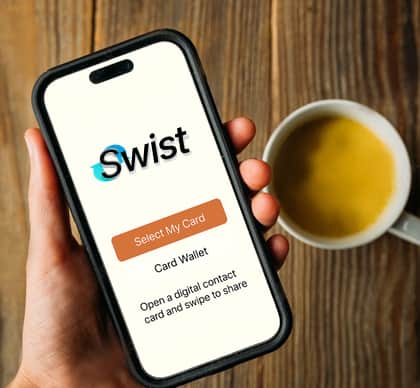
Swist - a service designed to make contact exchange simple, reliable, and natural.
We’re building Swist to fix five core problems that almost everyone faces with:
-
Contact exchange is still inefficient
Even today, sharing contacts feels outdated - typing numbers, scanning QR codes, or trying Bluetooth/NFC.
Swist fixes this in just 5 simple steps. See how it works: https://www.swist.to/
For more details, you can explore our whitepaper: https://swist.gitbook.io/swist-docs -
Your data is exposed and out of your control
Traditional phonebooks and contact apps can reveal more about you than intended, depending on how others save your number.
Swist fixes this with a private, encrypted contact library -
where your data belongs only to you and is shared on your terms. -
You don’t recognize incoming calls
Unknown numbers create hesitation - and missed opportunities.
Swist fixes this by showing a full contact card during incoming calls,
so you instantly know who’s calling and why they matter. -
Contacts become outdated
People change roles, companies, photos, and phone numbers - but your contact list doesn’t keep up.
Swist fixes this with dynamic contact cards that update automatically, so your network is always up to date. -
Your identity is fragmented
You’re spread across multiple platforms - no single, consistent version of who you are.
Swist fixes this with one universal contact card a single identity you control and share anywhere.
And one more thing changes everything:
Group sharing.
Instead of exchanging contacts one by one, people join a virtual room and connect with everyone at once - instantly.
Perfect for meetings, events, or any real-life interaction.
We’re currently building Swist and are looking for like-minded people who believe this problem is worth solving. If you’re interested in what we’re doing — whether as a builder, designer, or early supporter - we’d love to connect.
Swist is being built to make connecting simple, reliable, and natural —
from the very first moment.

This is exactly the problem. The real issue isn't exchanging contacts — it's remembering what you actually discussed after the exchange. I've been thinking about this for a tool I'm building: what if you could just say 'had coffee with Zhang, his kid's applying to colleges' and the system remembers for you? Exchange problem solved, follow-up problem solved.
That’s a very interesting angle. I actually think it complements what we’re building rather than overlaps with it.
Swist focuses on the connection layer itself:
how people exchange identities and contacts in real life, and how those identities stay dynamic and up to date afterward.
What happens after the exchange - remembering context, conversations, relationship history - is another huge problem on its own.
I can definitely see these layers eventually working together.