From Messy Docs to Testing Harmony: How Modern API Tools Bridge the Dev Collaboration Gap
If you’ve ever worked on an API team, this might sound familiar:
“The documentation’s outdated again.”
Just last week, I spent two hours debugging a payment API with our frontend engineer.
He was sending parameters based on a doc I’d written only three days earlier — yet the API kept returning “invalid parameter format.”
Turned out I had changed the order_amount field type in the code but forgot to update the doc.
Classic mistake.
At this point, our frontend team jokes that it’s faster to read my code than my documentation.
They’re not wrong.
Documentation Maintenance: The Ultimate “Thankless Task”
Before we upgraded our workflow, we maintained all API docs manually in Markdown.
That… didn’t scale.
Here’s what kept tripping us up:
- Outdated updates: Every field change meant manually editing parameter tables, request examples, and responses. During rapid sprints, docs inevitably fell behind.
- Testing confusion: I once added a phone number validation rule but didn’t update the doc. Our QA spent an hour wondering why 11-digit numbers kept failing.
- Version chaos: Docs lived as static links. Every edit created a new one, and someone always referenced the wrong version.
Documentation quickly turned into a thankless, time-consuming burden, draining team efficiency and morale.
The Turning Point: Enter EchoAPI
Then we started using EchoAPI to manage our interfaces — and everything changed.
AI-Powered Auto Documentation
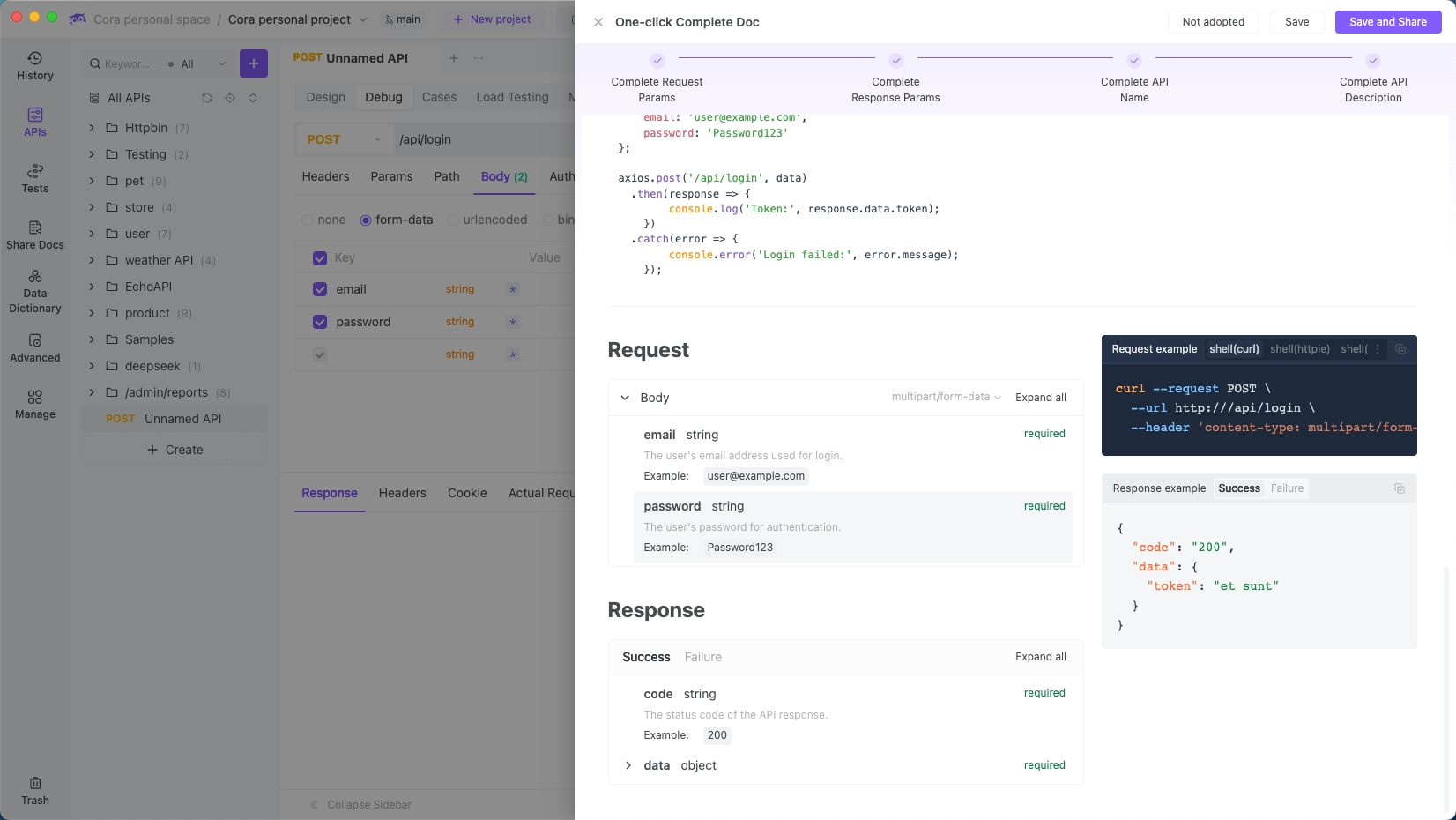
The first thing that impressed me was its “debug = documentation” philosophy:
- After debugging an API, just click “Auto Complete Docs.” EchoAPI automatically fills in field types, required parameters, and response examples.
- Update a field later? Simply save the debug result — the doc updates instantly.
- Every document has a unique shareable link, so frontend and QA teammates always see the latest version. No more “which doc is current?” arguments.
Since then, I haven’t manually edited Markdown once.
The Big Leap: AI That Extracts APIs from Any Source
AI Smart Extraction for Offline API Docs
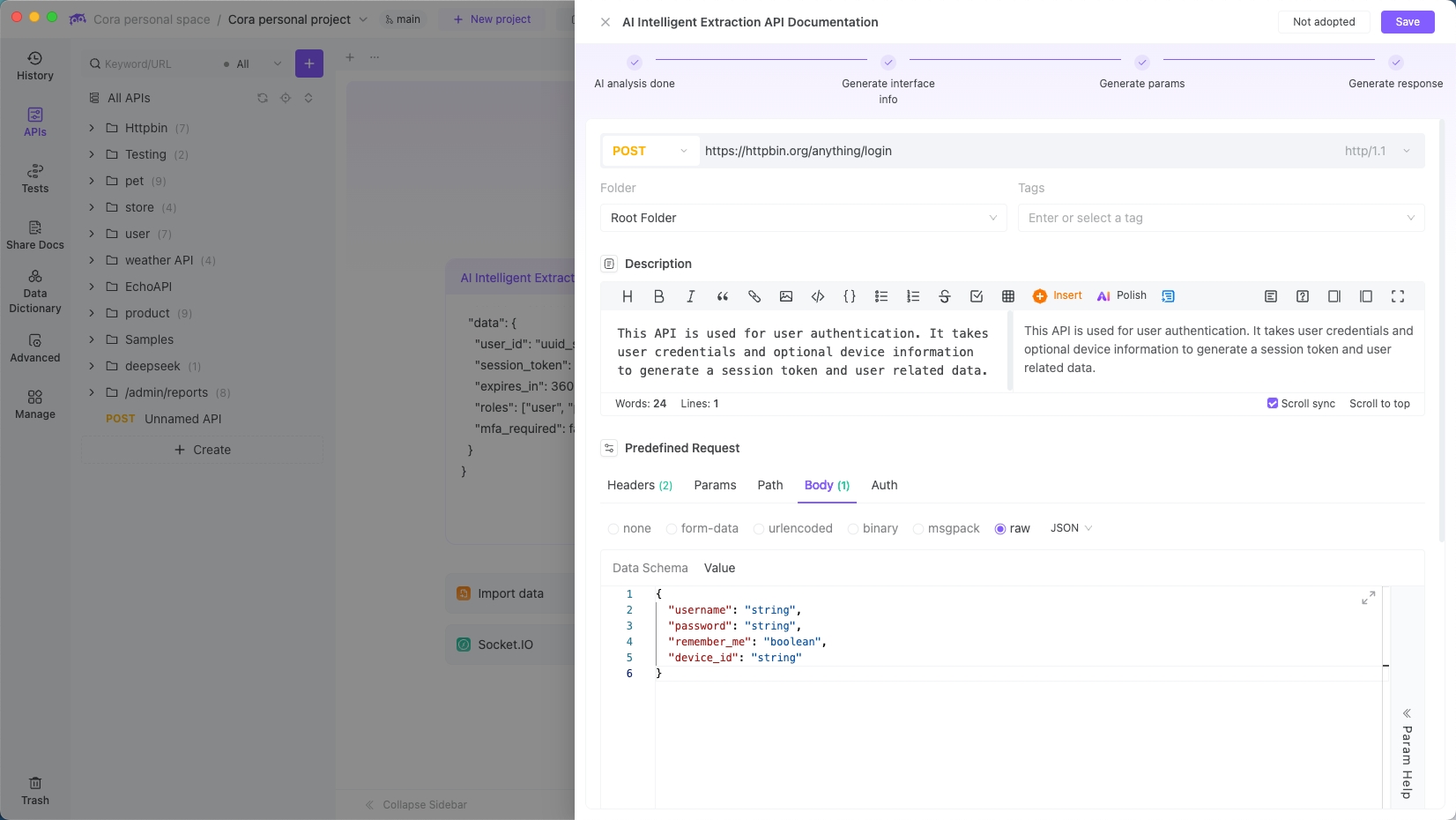
Our team often receives API details in all kinds of formats — Word documents, third-party web pages, Swagger exports, even snippets of code.
Before EchoAPI, converting those into usable API docs was slow, manual, and error-prone.
Now, it’s literally a three-step process:
- Open the AI Extract API tool;
- Paste in a Word doc, Swagger URL, or API page;
- EchoAPI automatically parses request methods, URLs, parameters, and response structures — generating a fully formatted API document.
The result can be:
- Directly tested — no need to switch tools;
- Instantly mocked — frontend can start integration even before backend is done;
- Shared in real time — one link, always up to date.
Before: QA spent an hour converting each Word doc manually.
Now: Paste → Generate → Save in under 15 minutes — a live, testable, mock-ready doc.
It’s not just faster — it’s a unified source of truth for dev, QA, and frontend alike.
Dev–Test Collaboration: A New Kind of Workflow
EchoAPI doesn’t just fix outdated docs — it connects development and testing in one continuous workflow.
In many teams, QA engineers are great at functional testing but not fluent in code.
That’s why API automation often stays on the “someday” list.
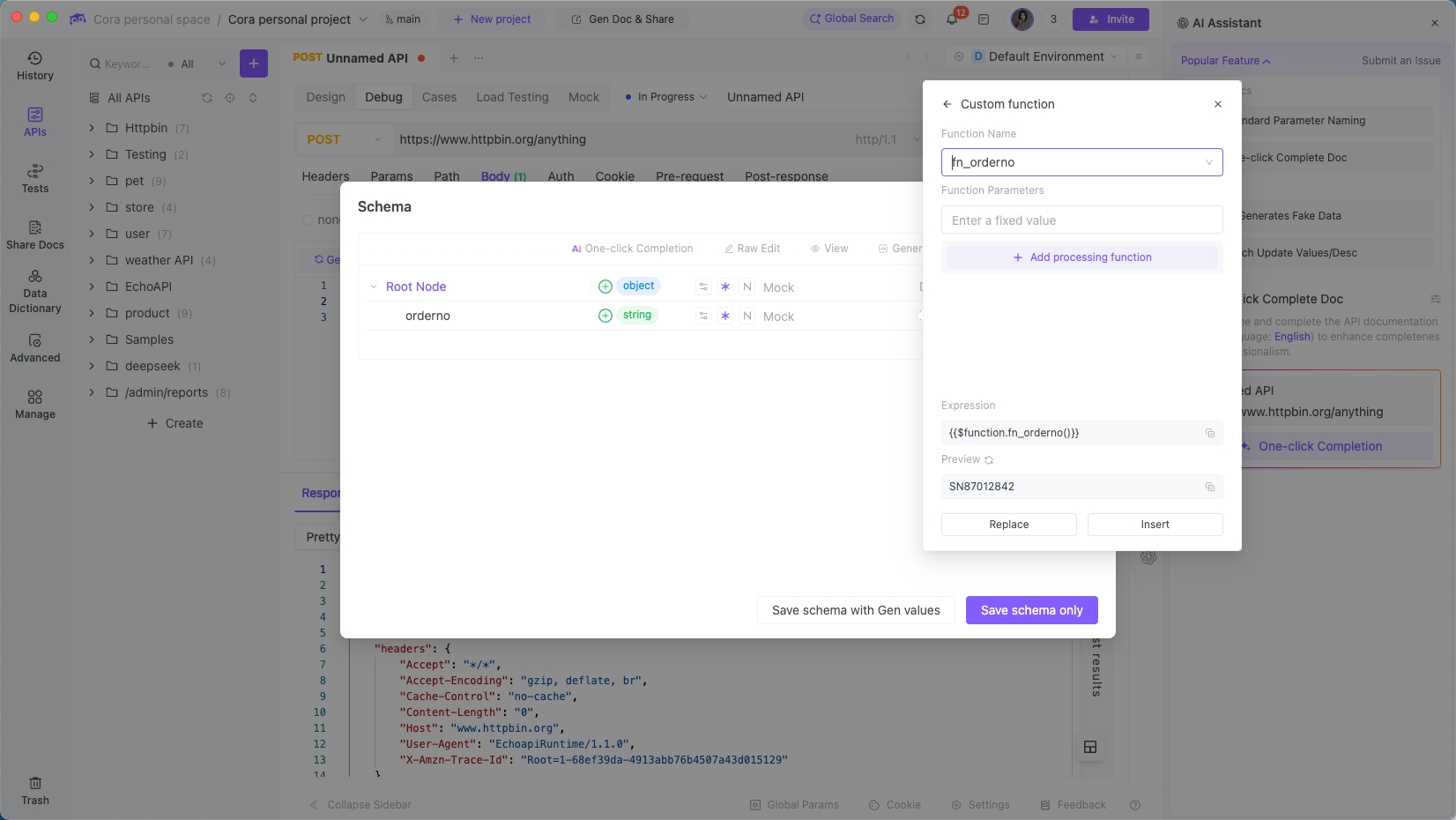
EchoAPI changes that with AI-powered script generation — fully compatible with Postman scripts.
Testers can now simply describe what they want, for example:
“Generate a random phone number and save it as the variable
mobile.”
EchoAPI instantly generates the matching script.
No more writing JavaScript from scratch.
That means true automation, without needing deep programming knowledge.
Smarter Validation: Let AI Write Your Assertions
If AI-generated docs solve the “how to write” problem, then AI-generated assertions solve the “how to verify” problem.
Traditionally, writing assertions for API tests meant manually coding checks for:
- Field types
- Required fields
- Array lengths
- Token expiration
It’s tedious, repetitive, and easy to miss something.
Now, EchoAPI does it automatically:
- Send a request and capture the response;
- Click “AI Generate Assertions”;
- EchoAPI analyzes the structure and produces ready-to-use JavaScript assertions;
- Want more? Just describe it — e.g., “Check if
rolesincludesadmin”; - Click Insert Code, and it’s added directly to your test case.
AI-Powered Assertions in Action
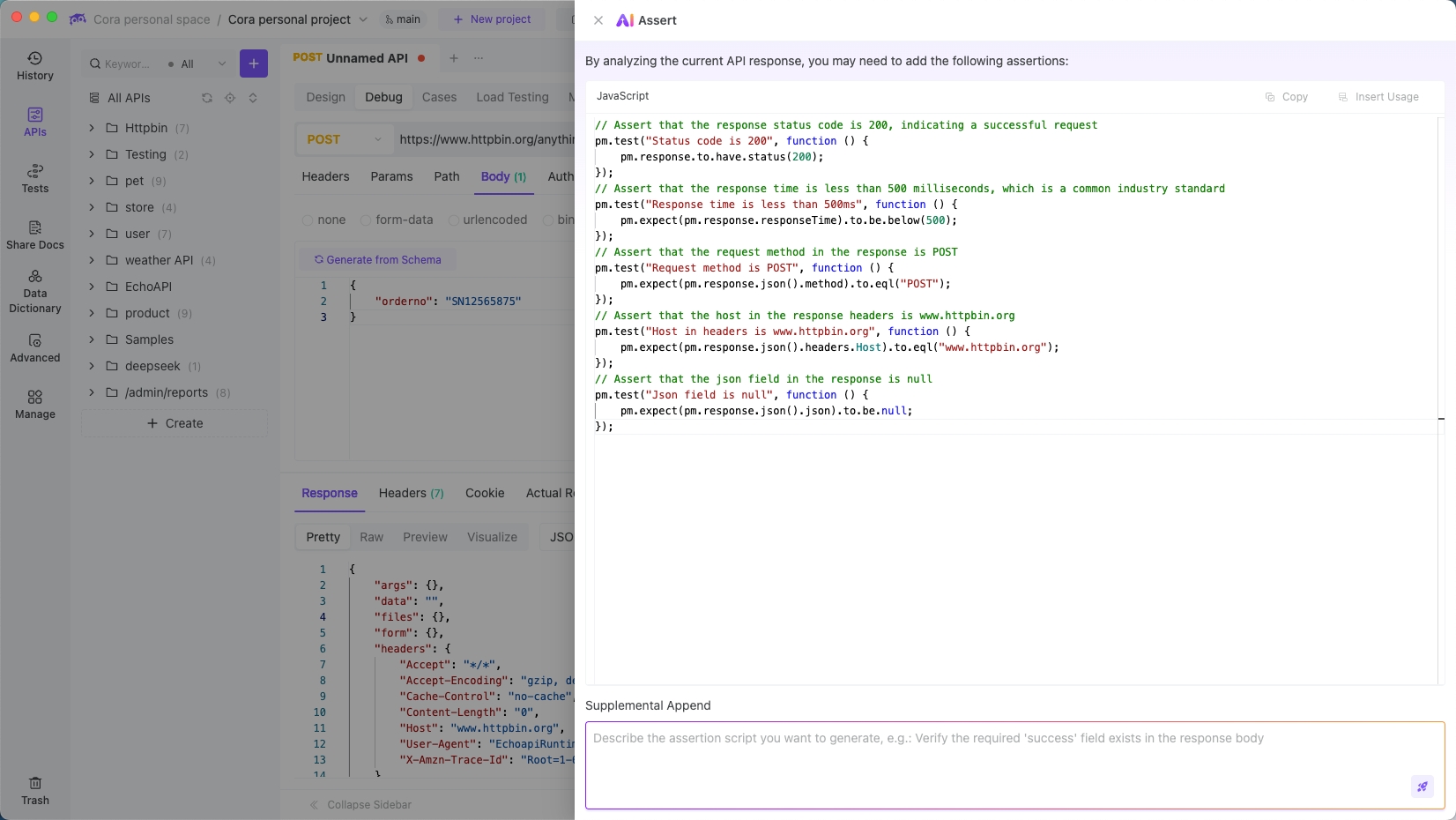
No more starting from scratch — AI creates multiple assertions instantly, and you can refine them using plain language.
That’s plug-and-play testing at its best.
Conclusion: API Tools Are Now the Collaboration Core
After six months with EchoAPI, one thing is clear:
- API tools are no longer just debugging utilities — they’re the collaboration hub for modern development.
- Documentation is now real-time and automated, staying perfectly in sync with code.
- Frontend, backend, and QA all work from a single, live, testable source of truth, ending version drift once and for all.
We’ve gone from:
“Reading the docs is slower than reading the code.”
to
“The docs are clearer than the comments.”
The bottlenecks that once slowed us down are gone.
At the end of the day, the true power of an API tool isn’t just speed —
it’s giving your team back the time and focus to do what really matters:
building great features and solving real problems.
