Have you ever wanted to ask "How is it going?" from your website?
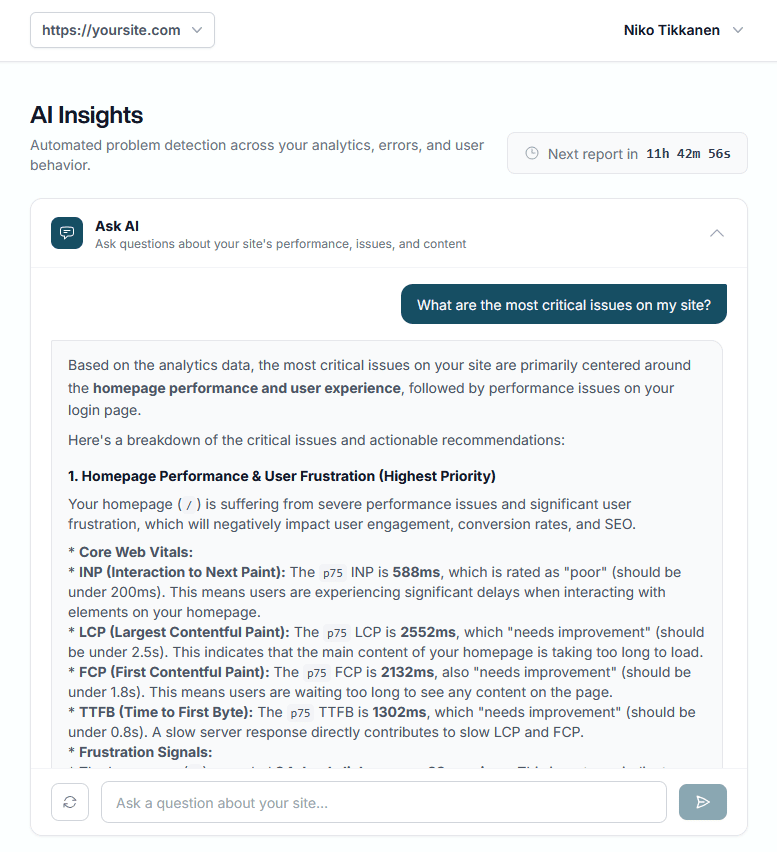
Have you ever wanted to ask your website "how is it going"? We have improved our AI capabilities with chatting feature. Now you can ask all about your website data. What are the most critical issues, how to optimize landing page and what ever you might think of.
What else you would like to see in analytics platform?
Sing up for free open beta -> https://spectry.io/beta


idea is cool but only if the answers are actually actionable, not generic fluff… most “AI insights” tools just tell you obvious stuff like “improve performance” lol, if it can point to exact pages, real user impact, and what to fix first, then yeah that’s useful, otherwise it’s just another dashboard people open once and forget
This is far from generic fluff, we have connected the chat to the website data. It knows your website events, heatmaps, surveys, feedbacks, user behavior, error logs and website content. You could ask how to improve the landing page UX for as example and it will have visibility to everything thats been happening on your site.
Your point is the exact thing we are solving at Spectry. You are welcome to join our free open beta and test it out!
This is a really interesting direction for analytics. Being able to “talk” to your website data feels like a natural next step.
The "ask your site how it's going" framing is clever — way more intuitive than digging through GA4 dashboards trying to find the one metric that explains why conversions dropped.
What I'd love to see: anomaly detection that pings me before I even ask. Like "your homepage LCP jumped 40% yesterday after your last deploy" — pushed to Slack or email automatically. Most site issues go unnoticed for days because nobody thinks to check until something feels off.
The Core Web Vitals breakdown is useful but the real value would be connecting performance to business outcomes. "Your LCP went from 1.8s to 2.5s and your bounce rate increased 12% during the same period" — that's the insight that makes someone actually fix it.
Are you pulling data from GA4 or using your own tracking pixel? And how are you handling the AI hallucination problem with analytics data — wrong numbers in a performance report could send someone down a rabbit hole fixing something that isn't broken.
Good luck on your journey, you're going to need it!
Thank you!
Cool idea. Can it go beyond insights and suggest specific fixes (like copy changes or UX tweaks), or is it more analysis-focused for now?
Its for both, the AI chat is connected to website data, events, feedbacks, heatmaps and pages content. So you can pretty much ask anything about your website.
This is a really interesting direction, being able to just ask “how is it going?” instead of digging through dashboards is a big shift.
One thing I’m curious about:
Right now, after the AI surfaces issues (like slow homepage, poor INP, etc), do users actually act on it? Or does it still feel like “insight without a clear next step”?
Feels like there’s an opportunity to go one layer deeper, not just answering questions, but guiding users through:
– what to fix first
– why it matters in their specific context
– and what to do immediately after
Almost like turning analytics into a step-by-step flow instead of a report.
I’ve been exploring something similar from the “user action” side, where insights trigger guided next steps instead of just explanations.
Curious how you’re thinking about that part, are people mainly using it for awareness, or actually making changes from it?
This tool will amount to a watershed moment, particularly for those whose eyes are on SEO effectiveness and overall digital performance.
What makes it genuinely game-changing is the sheer scale it’s tackling: billions of websites, each with its own unique objectives, audience, and competitive context. A landing page that converts for an e-commerce store might tank for a SaaS product or a content platform — the nuances are endless. The fact that you can simply type “how is it going?” and get an intelligent, contextual breakdown of critical issues (from loading speed and UX friction to conversion leaks) is powerful. But the real differentiator will be how intelligently the AI handles the prompting layer behind the scenes.
For consistent, high-value results, the system must enforce smart guardrails: structured framing that keeps outputs relevant to the site’s specific goals, while avoiding the common pitfall of overbloated, generic advice. Equally important — and this is where many analytics tools fall short — it shouldn’t just flag problems. It needs to proactively offer clear, actionable solutions: for instance, on the landing page, “Your hero section above-the-fold is causing a R% bounce rate because of X; here’s the exact copy and layout tweak that improved similar pages by Y% in our benchmark data.”
When a tool can do both — diagnose with precision and prescribe with clarity — it stops being just another dashboard and becomes a true strategic partner. This has the potential to level the playing field for countless site owners who don’t have dedicated growth teams. Excited to see how it evolves. Great work!
Ok, interesting idea. While you mention the qualitative data, which is the main reason to find and understand the "Why", you then fix this problem just to a certain degree by using quantitative data to help you interpret behavior patterns and get qualitative data insights...Does that help you make the difference between the user's actions and his wants, needs, pains, and so on? It's hard to get a PMF this way
This makes sense, especially for people who hate tracking everything.
“Can I spend today without guilt?” is the real value here.
The challenge is communicating that fast enough.
If you turn that into a simple, relatable demo, it becomes much more compelling.
A clean 15–30 sec video showing the experience can boost conversions a lot ,if you want we can discuss and i will share some previous work