How Agentic AI Actually Works: Anatomy of an AI Agent and Multi-Agent Architecture
By Metareignity Research
AI agents are often described as "AI that can act."
That's directionally correct, but it's not enough for engineers building real systems.
A useful way to understand an AI agent is as a software system surrounding an intelligence model.
The model provides reasoning capability.
The surrounding architecture provides:
Perception
Planning
Tools
Memory
Execution
Governance
Orchestration
Together, these components create an agentic system.
What Is an AI Agent?
An AI agent is a system capable of:
Perceiving → Reasoning → Planning → Acting → Evaluating
Instead of receiving one prompt and producing one response, an agentic system can operate toward an objective.
A simplified agent loop looks like this:
Goal
↓
Observe environment
↓
Reason about context
↓
Create plan
↓
Call tools
↓
Execute actions
↓
Evaluate result
↓
Continue / Modify / Escalate
The key difference is the feedback loop.
The system isn't simply producing an answer and stopping.
It can evaluate what happened and determine what should happen next.
The Anatomy of an AI Agent
A production AI agent is more than an LLM.
It typically consists of several interconnected components.
Perception
The perception layer collects information from the environment.
Possible sources include:
APIs
Databases
Documents
Emails
Events
Sensors
Other agents
Without reliable inputs, an agent is effectively operating blind.
Reasoning
The reasoning engine interprets the available context.
It may combine:
Large language models
Knowledge graphs
Domain-specific rules
Structured data
Retrieval systems
Business constraints
The objective isn't simply to generate text.
The reasoning layer determines what the current situation means and what options are available.
Planning
Planning converts an objective into executable steps.
For example:
Objective:
Resolve customer payment issue
Plan:
Retrieve customer record
Check invoice status
Verify payment history
Identify discrepancy
Contact billing system
Resolve if within authority
Escalate if outside threshold
Record outcome
Planning is what allows an agent to perform multi-step work instead of treating every interaction as an isolated request.
Action Interface
An agent needs access to tools.
These might include:
CRM API
Payment API
Email API
Database
ERP
Internal applications
Web services
Other agents
The action interface converts decisions into real-world operations.
Without tools, an agent can reason.
With tools, it can operate.
Memory
Memory provides continuity.
An agent may need to remember:
Previous interactions
Decisions
Outcomes
Customer preferences
Organizational policies
Failed approaches
Historical context
Without memory, every interaction effectively starts from zero.
For enterprise systems, persistent memory can become an important part of the organization's digital infrastructure.
Governance
Governance defines the agent's operational boundaries.
For example:
Low-risk action
→ Execute automatically
Medium-risk action
→ Request approval
High-risk action
→ Escalate to human
This creates governed autonomy rather than unrestricted autonomy.
For enterprise deployment, the question isn't simply:
"Can the agent do this?"
It's also:
"Should the agent be allowed to do this?"
Single-Agent vs Multi-Agent Architecture
A single agent can work well for focused problems.
Enterprise systems are different.
Businesses contain many specialized domains, each with different processes, data, permissions, and objectives.
A multi-agent architecture can distribute these responsibilities across specialized agents.
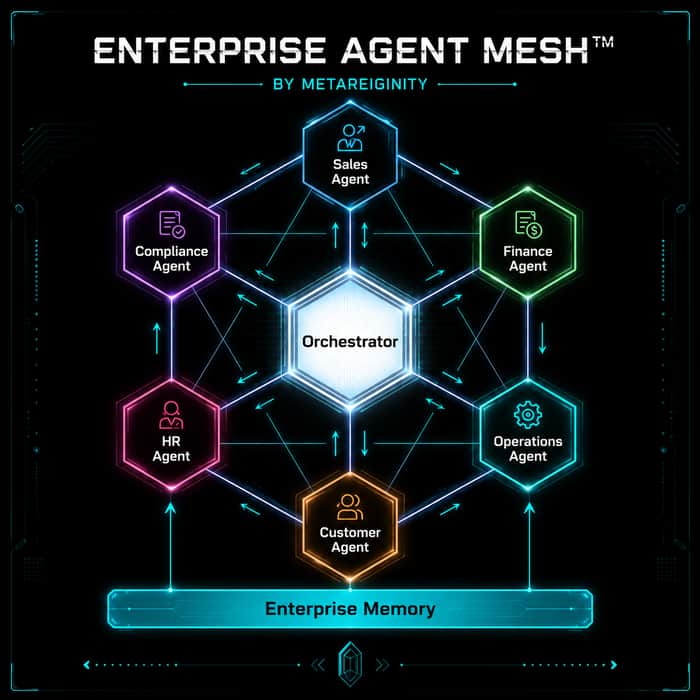
Enterprise Agent Mesh
Each agent has a defined responsibility.
The orchestration layer coordinates their interactions.
An Example of Multi-Agent Coordination
Imagine a customer completes a purchase.
The process could look like:
Customer purchase
↓
Sales Agent
↓
Deal confirmed
↓
Finance Agent
↓
Invoice generated
↓
Operations Agent
↓
Inventory allocated
↓
Customer Agent
↓
Onboarding initiated
The important part is that the agents aren't operating independently.
They share context and coordinate actions.
A human doesn't need to manually connect every operational step.
This is the idea behind the Enterprise Agent Mesh™ — an interconnected network of specialized AI agents operating as a unified digital workforce.
Agentic AI vs Workflow Automation
Agentic AI and traditional automation aren't necessarily competitors.
They solve different types of problems.
Rule-Based Automation
Works from predefined conditions.
IF X happens
THEN do Y
It's excellent for predictable processes.
Its limitation is that it can break when circumstances fall outside the predefined rules.
RPA
Robotic Process Automation generally mimics human interactions with software.
For example:
Open application
→ Click button
→ Copy information
→ Paste information
→ Submit form
RPA can be useful for repetitive processes, but it generally doesn't provide the contextual reasoning of an agentic system.
AI Assistants and Copilots
Assistants help humans work faster.
A human provides direction.
The AI provides assistance.
Human
↓
AI Assistant
↓
Recommendation / Output
↓
Human executes
Workflow Automation
Workflow automation connects systems through predefined sequences.
For example:
New lead
→ CRM
→ Email
→ Notification
→ Task creation
It's effective when the process is predictable.
Agentic AI
Agentic AI is designed around objectives rather than only predefined sequences.
Objective
↓
Understand context
↓
Determine approach
↓
Plan
↓
Execute
↓
Evaluate
The agent can potentially adapt its approach when circumstances change.
When Should You Use an Agent?
A useful way to think about the distinction is:
Predictable process → Automation
Repetitive software interaction → RPA
Human assistance → Copilot
Context-dependent decision → AI Agent
Cross-domain coordination → Multi-Agent System
A production enterprise architecture may combine all of these.
There is no requirement for an organization to replace every workflow with agents.
In many cases, the strongest architecture combines deterministic automation with agentic decision-making.
Where Multi-Agent Systems Become Interesting
The real complexity appears when agents need to work together.
Imagine an enterprise with:
Sales Agent
Monitors pipeline activity, prioritizes leads, and manages follow-ups.
Finance Agent
Tracks invoices, reconciles payments, and identifies financial anomalies.
Operations Agent
Manages inventory, suppliers, procurement, and logistics.
Compliance Agent
Monitors regulatory requirements and policy adherence.
Customer Agent
Handles support activity and identifies potential churn.
HR Agent
Manages onboarding and employee workflows.
Each agent can specialize in its domain.
The orchestration layer becomes responsible for coordinating them.
What Does the Orchestration Layer Do?
As the number of agents increases, coordination becomes increasingly important.
An orchestration layer may manage:
Task delegation
Agent communication
Priorities
Workflow sequencing
Resource allocation
Conflicts
Failures
Escalations
Permissions
This creates a system where individual agents don't have to understand the entire enterprise.
Instead, each agent understands its domain while the orchestration layer manages the relationships between them.
That is one of the foundations of a multi-agent enterprise architecture.
Designing Agentic Systems for Production
A production agentic system requires much more than a good prompt.
Engineers need to consider several infrastructure concerns.
Identity
Which agent is acting?
Permissions
What systems and information can it access?
Memory
What information should it retain?
Observability
Why did it make a particular decision?
Auditability
What happened, when did it happen, and which agent performed the action?
Recovery
What happens if an agent fails?
Escalation
When should a human take control?
Governance
Which actions are prohibited or require approval?
These concerns become increasingly important as agents receive more operational authority.
The Emerging Enterprise Architecture
The progression can be viewed as:
Traditional Software
↓
Workflow Automation
↓
AI Assistants
↓
AI Agents
↓
Multi-Agent Systems
↓
Autonomous Enterprise
Each stage introduces a greater degree of intelligence and operational independence.
But greater autonomy also creates greater architectural requirements.
The more authority an AI system receives, the more important memory, governance, orchestration, observability, and security become.
The Enterprise Agent Mesh™
At Metareignity, we use the term Enterprise Agent Mesh™ to describe an interconnected network of specialized AI agents operating across an organization.
Instead of thinking about AI as a single assistant, the organization becomes a network of specialized digital workers.
The agents specialize.
The orchestrator coordinates.
Enterprise memory provides persistent organizational context.
Governance establishes operational boundaries.
Together, these components form a foundation for autonomous enterprise systems.
The Engineering Question Is Changing
The interesting question isn't simply:
"How do we build an AI agent?"
The more important question is:
"How do we build a reliable system in which many agents can safely operate together?"
That is where agent orchestration, memory, governance, permissions, observability, and enterprise architecture become critical.
Agentic AI isn't simply about creating smarter chatbots.
It's about creating systems capable of participating in the execution of work.
Conclusion
The progression from traditional software to autonomous enterprise systems is not a single technological jump.
It's an architectural evolution:
Automation → Assistants → Agents → Multi-Agent Systems → Autonomous Enterprises
AI agents provide the ability to reason and act.
Tools provide the ability to execute.
Memory provides continuity.
Orchestration provides coordination.
Governance provides boundaries.
Together, these components create the infrastructure required for increasingly autonomous organizations.
Metareignity is exploring this architecture through the Enterprise Agent Mesh™ and its broader autonomous enterprise model.
The larger question is no longer simply what AI can generate.
It's:
What does a company look like when intelligent agents become part of its operating architecture?

Good framing. I think the “agent is the system around the model” point is the one people skip too fast.
The model is only one part. The hard parts are state, permissions, memory, failure handling, and what happens when multiple agents influence each other.
I think that’s where agentic AI gets much more interesting. The model is almost the interchangeable component; the real “agent” emerges from everything wrapped around it: what state it can access, what it remembers, what it’s allowed to do, how it handles failure, and how its actions affect other agents.
And once multiple agents start influencing each other, you’re no longer just designing prompts , you’re designing a system with its own dynamics, feedback loops, and failure modes.
That’s actually the problem space I’m exploring with what I’m building at Metareignity. The goal is to move beyond isolated AI assistants toward more structured, autonomous systems.
Still early, but if that direction interests you, you might find the project worth following: https://metareignity.com
this is something I have been really interested by recently and how people seem to solely be using ai to replace repetitive steps or something else instead of combining its knowledge with ours. i recently tried using an agent for outreach and just found the results shocking. although i used it for another companies outreach and it worked perfectly.
That's exactly the shift I think we're heading toward: AI shouldn't just replace repetitive steps, it should combine its capabilities with an organization's knowledge, context, and judgment. The fact that the same outreach agent can perform brilliantly for one company and poorly for another shows how important that context layer is.
That's a big part of what we're exploring with Metareignity: autonomous enterprise systems that learn how an organization operates rather than simply automating isolated tasks.
I'm curious, what was different about the company where the agent worked perfectly? That kind of real-world insight is exactly what we're looking for as we shape the platform.
If you're interested in exploring the idea with us, we're also opening the Metareignity waitlist: https://metareignity.com
The governance point feels like the part that gets underestimated. Once agents can actually take actions across systems, the hard problem stops being whether they can reason and becomes deciding what they’re allowed to do without escalation. Autonomy seems to create a governance problem almost as fast as it creates an engineering one.
Exactly. Once an agent can act across systems, autonomy without governance becomes a liability.
I think the next evolution is moving from “AI that can execute” to enterprises that can define, enforce, and continuously adapt the boundaries of that execution.
That’s a core part of what we’re exploring with Metareignity. I’d be curious to hear your take:
what should trigger human escalation in an autonomous enterprise?
If this direction interests you, we’re building the vision with early users and would love your perspective: https://metareignity.com
That’s a good question. I actually sent you an email about this earlier — happy to continue the conversation there. Would be good to hear your thoughts when you get a chance.