How AI Agent Orchestration Works
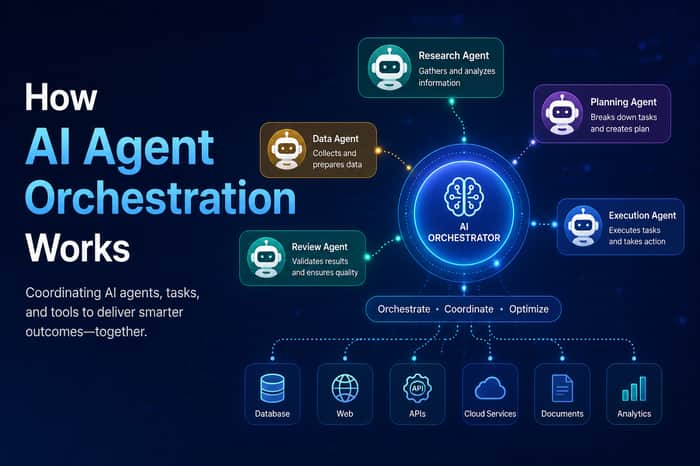
You build one agent. It reads your email, drafts replies, books meetings, and updates the CRM. For about a week it feels like magic. Then it books a call into a calendar you deleted, quotes a refund policy you never wrote, and burns forty thousand tokens deciding what to do about a newsletter. The model is fine. The problem is that you handed one agent a job that needs five different kinds of thinking, and asked it to hold all of them in its head at the same time.
That gap is what orchestration fills. It is the layer that decides which agent (or which step) runs next, what information moves between them, what happens when one fails, and where a human gets to step in. Most agent systems that break in production break here, not in the model.
Here is how the actual machinery works, minus the hype.
Start With One Agent's Loop
Before you can coordinate agents, it helps to see what a single one does. An agent is a model running in a loop. It gets a goal, looks at the tools it has, picks one, calls it, reads the result, and decides whether it is done or needs another turn. The loop keeps going until the task is finished or a limit is hit.
The tools are the important part. A tool is just a function the model is allowed to call: search a database, send a Slack message, run a SQL query, hit your Stripe API. These days most teams expose tools through MCP (the Model Context Protocol), which standardizes how a model discovers and calls external functions, so you are not writing a custom glue layer for every integration.
One agent in a loop handles a lot. The trouble starts when the job has parts that fight each other. A research step wants to be slow and thorough. A reply step wants to be fast and on-brand. A compliance check wants to be paranoid. Cram those into one prompt and the agent does all three badly.
Orchestration Is the Control Layer Above the Loops
So you split the work. Now you have a researcher, a writer, and a checker, each with a tight job and its own tools. Orchestration is whatever decides who runs, in what order, with what context, and what to do when one of them returns garbage.
That sounds simple. It is not, and the reason is state. When the researcher finishes, the writer needs the findings but not the researcher's twelve dead-end searches. When the checker rejects a draft, something has to route it back with the reason attached, not just start the whole chain over. Passing the right slice of memory between agents, and only the right slice, is most of the real work. Frameworks give you the loops. State propagation, retries, and visibility you mostly build yourself.
The Patterns That Actually Get Used
You do not invent a topology from scratch. A handful of patterns cover almost everything, and in 2026 the supervisor pattern has become the default starting point.
Supervisor and workers. One orchestrator agent owns the goal and delegates pieces to specialist agents, reads their results, and decides the next move. It is the easiest to reason about and the easiest to debug, because there is one brain making routing calls and a clear log of who got asked to do what. If you are building your first multi-agent feature, start here.
Pipeline. Agents run in a fixed sequence, each handing output to the next. Extract, then validate, then format. Predictable and cheap, but rigid. If step two needs something step one did not produce, the chain stalls.
Fan-out (parallel). The orchestrator dispatches several agents at once and merges their answers. Good when you are comparing three vendor APIs or summarizing ten documents that do not depend on each other. It cuts wall-clock time and raises your token bill at the same time.
Debate. Two or more agents argue toward a better answer, critiquing each other before settling. It improves quality on fuzzy reasoning tasks. It also costs roughly two to three times a single model call, so you save it for the decisions that are worth the spend.
Real systems mix these. A billing tool might use a supervisor at the top to decide which invoices need review, a pipeline inside each invoice to extract and match line items, and a fan-out when checking against several payment providers. The pattern is a tool, not a religion. Pick the simplest one that solves the task, and resist the urge to jump a tier up.
The Frameworks, Briefly
You have options, and they cluster into camps. LangGraph models everything as a graph of nodes and edges, which gives you fine control and good checkpointing when workflows get cyclical. CrewAI organizes agents into role-based crews and is the fastest path from idea to a working prototype, at the cost of weaker observability when things misbehave. The OpenAI Agents SDK and the Claude Agent SDK keep you close to one provider with handoffs and tool use baked in. AutoGen, which popularized agents chatting in a shared room, has folded into Microsoft's new Agent Framework, so if you are starting today, build on the current line rather than the legacy one.
For agents that need to talk across systems you do not own, the A2A (agent-to-agent) protocol is the emerging standard, the way MCP became the standard for tools.
Do not over-shop. The framework choice matters less than whether you instrument what you ship.
The Part Nobody Warns You About
The agent loops are the fun bit. The grind is everything around them: deciding what memory each agent sees, what a retry actually means when a step is half-finished, and how you watch a five-agent system without printing the entire trace to your terminal. Observability is not optional here. It is the same discipline IT teams lean on for unified observability across their systems: when something breaks, you need to see which component caused it, or you are debugging blind.
Governance is the other quiet killer. Gartner has predicted that around 40 percent of agentic AI projects will be scrapped before the end of 2027, and the usual cause is not bad models. It is cost that nobody tracked, failures nobody could trace, and no clear human override when the system went sideways. None of that is new, by the way. IT operations teams have fought the same battles for years, which is how AIOps grew into its own field.
Where to Actually Start
Build the smallest thing that works. One agent in a loop, with two or three real tools, beats a six-agent swarm you cannot debug. Add a supervisor only when one agent is clearly doing two jobs poorly. Add parallelism only when latency hurts. Log every tool call and every handoff from day one, because the day you need that log is the day you do not have time to add it.
Orchestration will not make a weak idea work, and a clean topology will not save a system you cannot see into. But get the control layer right and you can take an agent from a demo that impresses your friends to something that survives real users, real edge cases, and a real bill at the end of the month. That last part is the whole game.
