How I made $50k in 3 months with AI consulting

3 months ago I gave all my equity to my cofounder and left my AI education company. We bootstrapped a company together to ~$300k revenue in a year which I wrote about before here
Some of the reasons are public (which I covered in the first post on my blog -- The Lumberjack -- you can read it here) and some I’d like to keep to myself.
Lots of my followers and readers are trying to make money with AI. This is not surprising, hype or not, there are loads of opportunities in AI. A big chunk of them come from consulting. I shared the original version of this post on my blog but I think having this blueprint is useful so I decided to post it here too.
AI is the new SEO
Around last spring I had the intuition that AI is basically the new SEO.
It is unlikely to spread to organizations like wildfire. The technology challenges the unit economics of human labor too much for its utility to be trivial.
This is proven by the fact that individuals are seeing great success with AI but when you zoom out to organizations, the picture gets bleaker. Ethan Mollick writes about how everyone is now in R&D.
He says that successful AI implementation will depend on unlocking and scaling the expertise of people.
“In fact, for large companies, the source of any real advantage in AI will come from the expertise of their employees, which is needed to unlock the expertise latent in AI.”
Unlocking the benefits of AI promises many treasures for any company. But doing so is not trivial. AI literacy is a vast topic including Machine Learning (like Random Forests and Dijkstra’s Algorithm), engineering principles (like Black Box Programming and First Principles Thinking) and whatever tech stack you’re building with (I’ll share my own next time).
It is reasonable to expect that organizations would seek to hire specialists to do this non-trivial task of figuring out how to squeeze dollars out of machine learning.
In other words: finding value in AI is hard as shit. In order to succeed you need to be a machine learning engineer AND a financially literate entrepreneur. It’s easier for companies to hire people like this than to train them.
This reminds me of SEO. Technical SEO is not particularly hard but it is complex. Lots of moving parts, some technical knowledge, it’s a profession on its own. When search became a thing, companies needed to change how they did business to unlock value from SEO.
This is done by hiring SEO people who sit at the intersection of content and web development. SEO experts are change agents.
I hire someone who comes in, does a VERY thorough SEO audit, gives me a huge list of things I need to change, crafts an entire strategy and then gives me a quote for doing it themselves if I don’t fancy learning my ass off.
But once they’re done, in about 6-9 months, it just works.
So SEO spread once more people learned the ins and outs of it and started changing companies — one by one.
I think I’ve found a way to make this work. A business model that puts food on the table. It took me a long time to find it, and as one of my clients, Amanda Dahler, COO of No BS Agency told me,
true value unlocks when you embrace being a category of one.
How NOT to make money with AI
Before I tell you what works, here are a few things I tried and didn’t work:
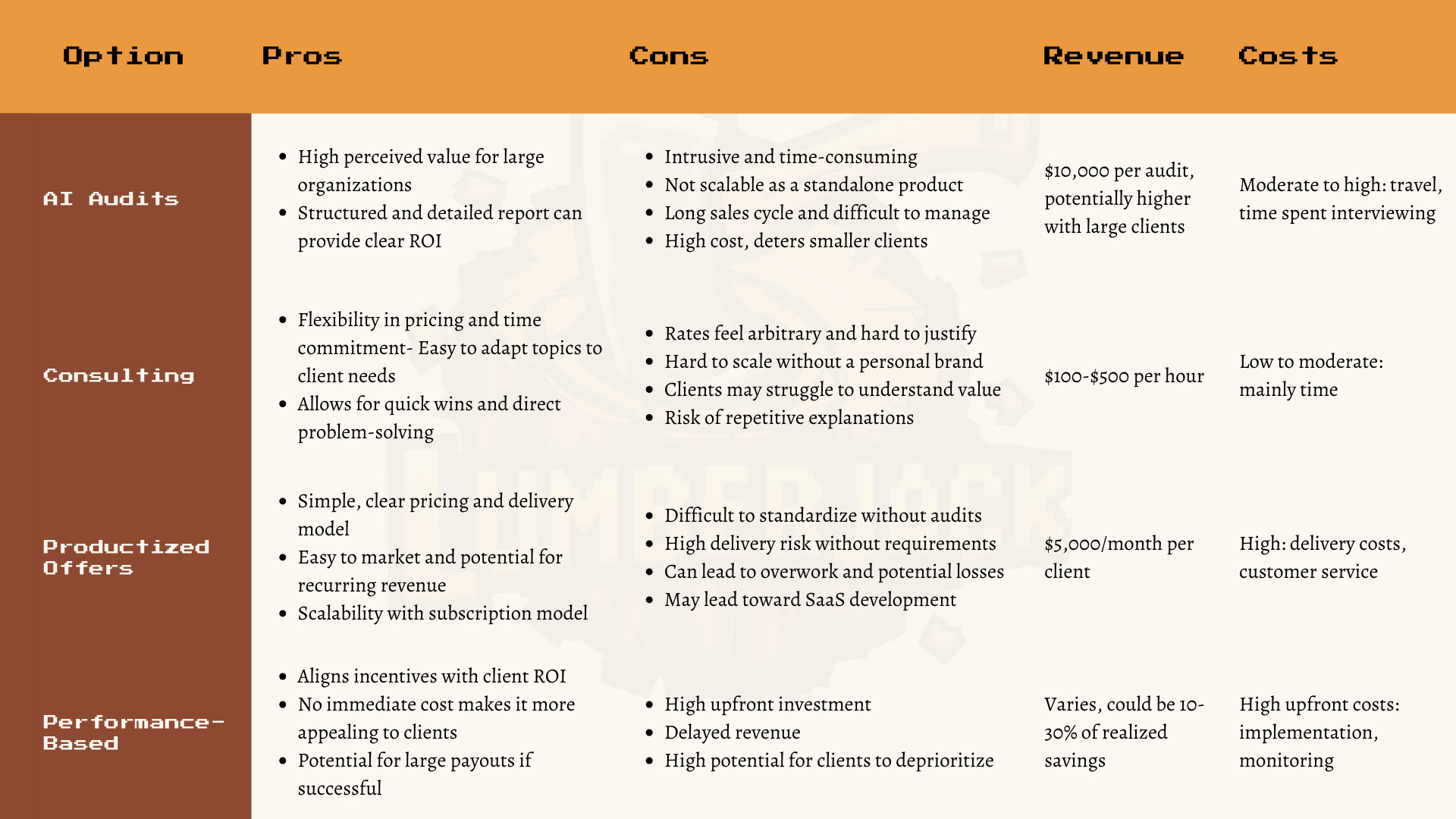
- AI Audits
- Hourly consulting
- Productized offers
- Performance based offers
AI Audits
This was my first thought. My friends at Neuron Solutions (a wickedly smart bunch with higher PhD per square meter metric than most companies) have been doing rudimentary tech audits for large organizations for years.
I figured that just like an SEO expert would do an SEO audit, this could be a great offer for any company.
I created an AI audit template and build a procedure inspired by McKinsey and started offering it for $10k.
The value proposition: I’ll screen your entire organization and find you WHERE and HOW to implement AI and what will ROI look like.
It was a bigger flop than the new Joker movie (which I personally liked but I’m weird).
The process was incredibly intrusive. I’d need to go in talk to a bunch of people over weeks and months and prepare a fancy report at the end. This would be a great product for larger companies as part of a bigger deal (just like what the Neuron guys are doing) but as a standalone product and a high ticket consulting service, it was untenable.
Hourly consulting
I spent hundreds of hours consulting people on AI and LLM use in the last two years at varying hourly rates from $100 to $500 per hour. I never felt this to be a great fit, because of two reasons:
-
Arbitrary rates. I even remember an argument from someone saying I should “charge $500 per hour, because if you are fully booked at 160 consulting hours per month, that makes you $960k per year which means you’re a Million Dollar Consultant.“ No thanks.
-
Unclear value. Most people cannot utilize expert knowledge well because they don’t know what they don’t know. Most of the time I would explain simple basic concepts over and over again. I don’t want to charge a few hundred bucks just to regurgitate what you can watch in a Youtube video.
Of course there is a justification to saying in an hour I can shortcut someone to solving a specific problem or make them unstuck that would otherwise cost them $X, but it’s a gamble.
Also in order for this to work you need to build an extensive personal brand to create a cultlike following and a relationship that’s anything but a peer to peer one.
Productized offers
Brett Williams runs Designjoy which is a subscription-based design agency service. You pay Brett $5k per month and you can make one request at a time with an average (but not guaranteed 48 hour delivery) and a bunch of extra goodies.
When I saw this I was over the moon. “This is it” — I thought.
I would build unlimited AI bots (one request at a time) using my no-code stack. No guarantee but I’d aim for 2 week delivery.
Here’s the problem. While AI audits tried to sell the idea of “I’ll denoise AI for you so you know what you want” this tried to sell the idea of “I’ll build what you need”.
It’s easy to sell this but very hard to deliver.
It works for design because it’s a commodity:
“Hey give me a logo — sure here’s your logo.”
But without denoising AI for the client this would make it very hard to deliver. You’d end up working your ass off at a loss, writing it off as a loss or renegotiating the deal.
It might be possible to create productized offers with AI but it would require such specialization that you’d quickly find yourself in SaaS land.
Performance-based offers
Another idea was that I’d do not just the audit but also the implementation for free. I’d agree with the clients on success metrics and attach monetary value to it.
It would go something like this:
“If my AI agent delivers, you save 160 hours per month which is a full time employee. Average salary of an employee doing this work is $50k per year, so that’s what I’m saving for you. I’ll charge you 20% of that savings.”
No client would ever say no to this, but it has a VERY long payback time.
You need to put in lots of upfront work, then keep monitoring everything. Essentially you work for 6 months for free and then you start getting a paycheck.
If you retain control of the agent you build, the incentives are aligned, but not many people can afford working for free for months only to see SOME payment.
Not to mention the uncertainty of clients disappearing, not keeping it as priority, not following through with implementation, etc.
Summary
I’m not saying these are not good business models, but they didn’t work for me. There are pros and cons of each. I created a summary, you might need to open the image in a new window to see it in proper size.
My business model → Power Day
As always it’s a work in progress. But it did allow me to rebuild my life immediately after I left my previous company and I feel comfortable with this. I can control how many clients I work with and if I wanted I could potentially scale this to become an agency (not sure if I want to).
I’ll show you a rudimentary “customer journey” although I must say it’s all very organic.
There are a few key learnings from trying out all those models above:
Each time I either tried to cover the discovery or the delivery part of the equation.
About Discovery:
- Skipping discovery will always fail.
- Discovery must go narrow and deep to unlock value.
- Discovery must deliver rapid results.
About Delivery:
- What I didn’t get from the client during discovery, I won’t get during delivery.
- Leaving critical elements to delivery creates a high likelihood of the project stalling (I don’t know how the task is currently done so I can’t build an agent, but nobody is available to tell me.)
- Failure of delivery will always be my fault.
Based on these I’m doing two things:
- Paid discovery called a Power Day (It’s a shit name but I can’t be bothered to find a better one)
- Delivery projects that have clear success criteria.
Value Equation
I love Alex Hormozi’s “Value Equation”. It’s succinct and does the job. It essentially says that the value you can deliver as a person to another person is a function of four things:
- The client’s dream outcome
- The perceived likelihood of achievement
- Time delay (how long I’ll need to wait to get it)
- Effort and sacrifice (what I need to do to get it)
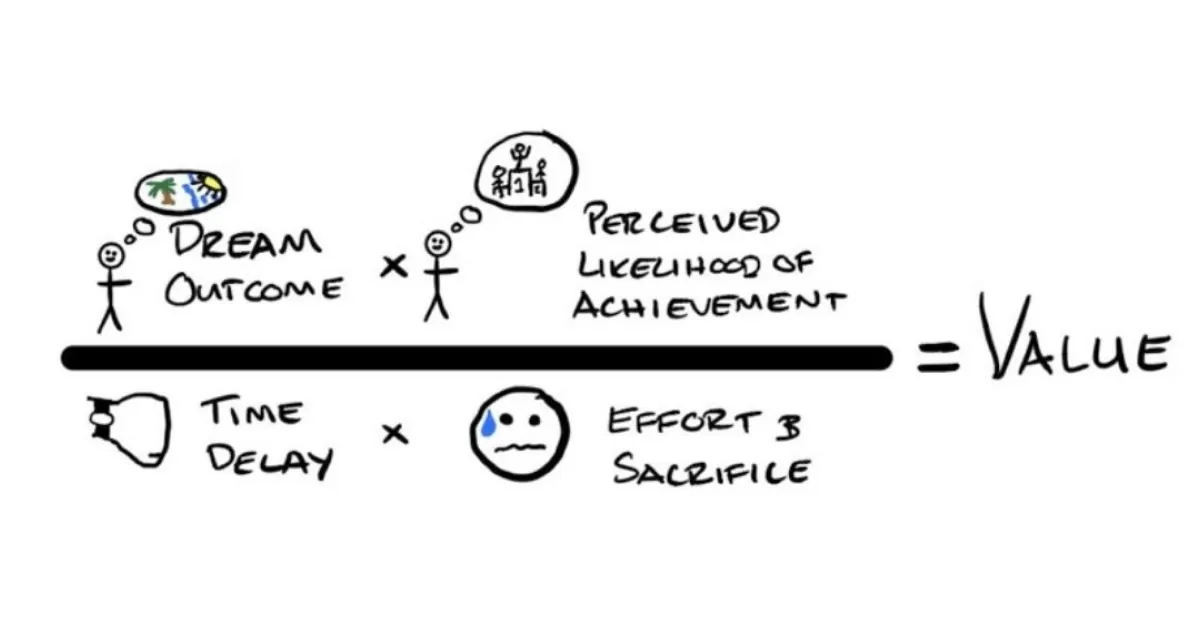
A business owner’s dream outcome is simple: make more by spending less. Some are time-poor, some are cash-poor, but most conversations I have about AI ends up being a conversation about growth and efficiency.
So I designed the business model to optimize for value.
Power Day
This is a paid discovery service. I dedicate a full day’s work for the client. I charge $3000 for this.
The value proposition is this:
“Unconfusing AI: Within one day you’ll know exactly how you can best benefit from AI, how much it will cost you and what the solution looks like.”
The delivery method of the Power Day is the following:
- We get all the stakeholders involved in our little “Company loves AI” project in the same room.
- We spend up to four hours workshopping the most pressing problems and finding potential solutions.
- After that I spend ~4 hours designing and planning a project that would deliver the desired solution.
This is VERY similar to the AI Audit offer, but it’s tailored to the Value Equation: both the time delay and the effort have been MASSIVELY reduced (from lots of meetings and back and forth for unknown periods of time to one workshop on one day).
The 4 hour workshop is pretty simple. I ask five questions:
- What’s your most painful problem right now?
- How are you solving it right now?
- Why is it not working? (If it was, it wouldn’t be a problem)
- How much does it cost you to do it this way?
- What would happen to your business if this was 10x less painful or 10x cheaper, faster, better.
I want to connect to the most painful problems the business currently has. Move the focus away from AI and towards the business.
Once the client opens up, I can ask about their existing workflows. That’s what we’ll need to automate with our AI agent. Then in Question 3 I’m exploring some rabbit holes and dependencies that will impact the project.
Question 4 and 5 are about value and pricing for delivery. It helps me understand the dream outcome better.
I go away and design a full project report. This is the final handover document of the Power Day. I like to give a bit of a legroom with a one week deadline for delivery.
This is not just the handover but also the brief for building the solution and an offer that comes with it.
Building
My default is that I’ll build stuff in no-code. Sometimes it makes more sense to build custom stuff. In my Alfred project I built a health data extractor that pulls all my Apple Health Data and pushes it to Airtable. (I shared the GitHub repo on our Discord). Make handled it perfectly but it was using way too many operations. I opened Cursor, pasted the Make scenario and built a Node.js app in less than 30 minutes, hosted it on Vercel and does the job for free, 5-7 times a day ever since.
So here’s the deliverable and also a good overview of how I’ll build stuff. These are screenshots from the full project report of an actual project.
I’ll start with a VERY specific description of the problem.
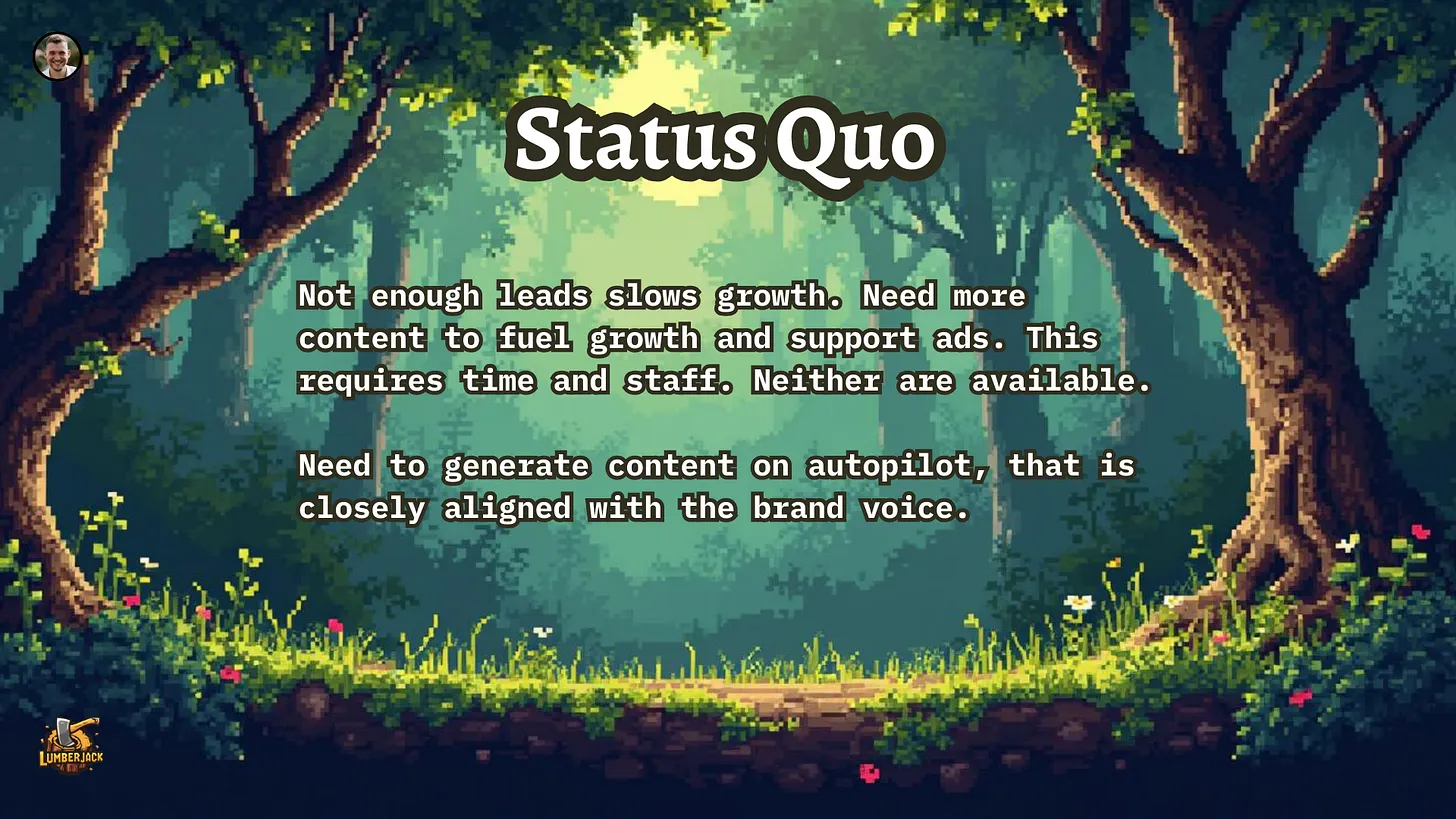
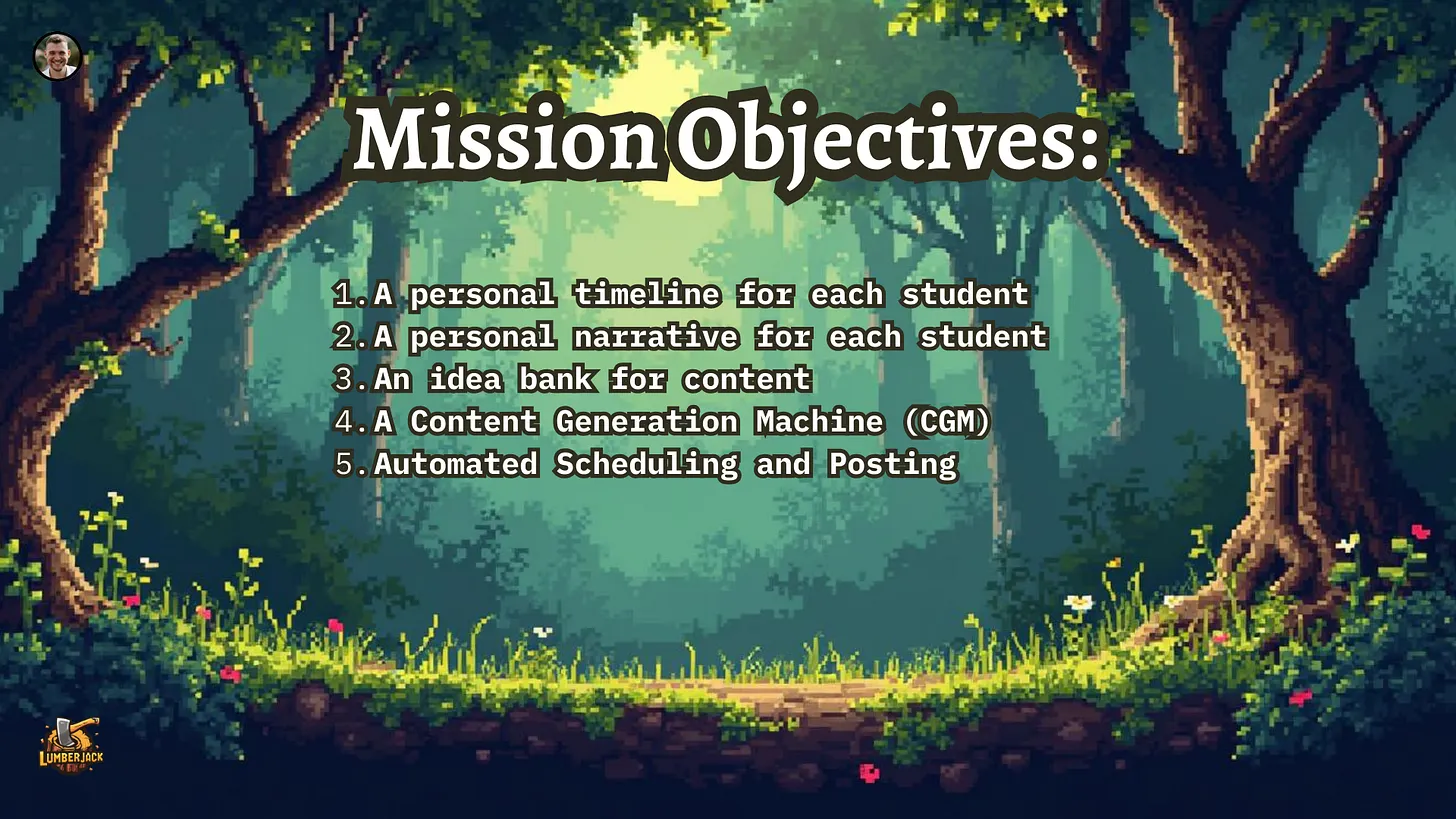
Then I follow up with the agreed upon objectives. This is basically an “in principle” description of the solution. If the client is not happy with this, chances are I misunderstood something and need to go back. If they’re happy, I know we’re on good track.
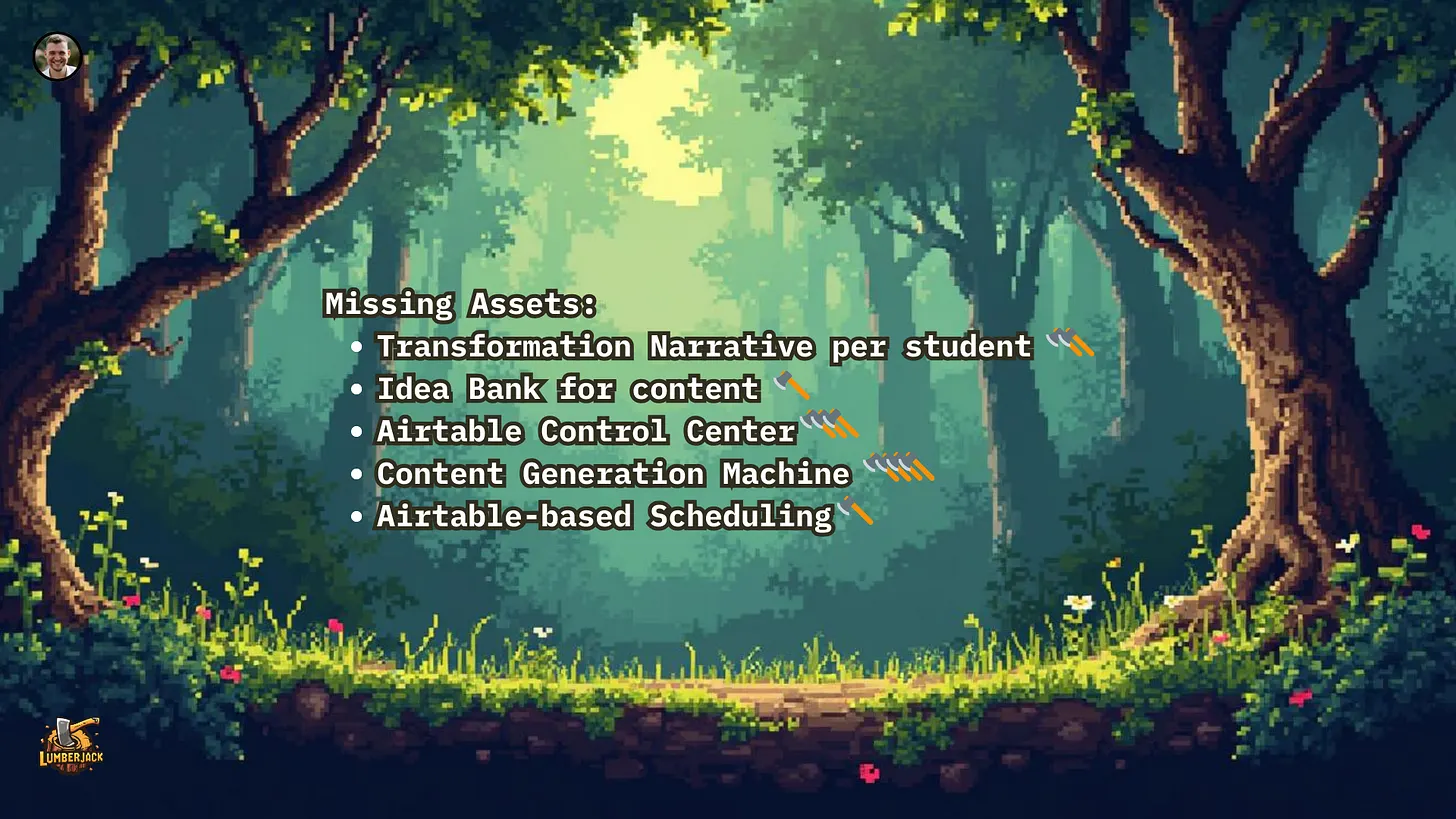
Then I list the assets that are available from the client and most importantly the assets that are missing and also mark how complicated I think they will be to develop.
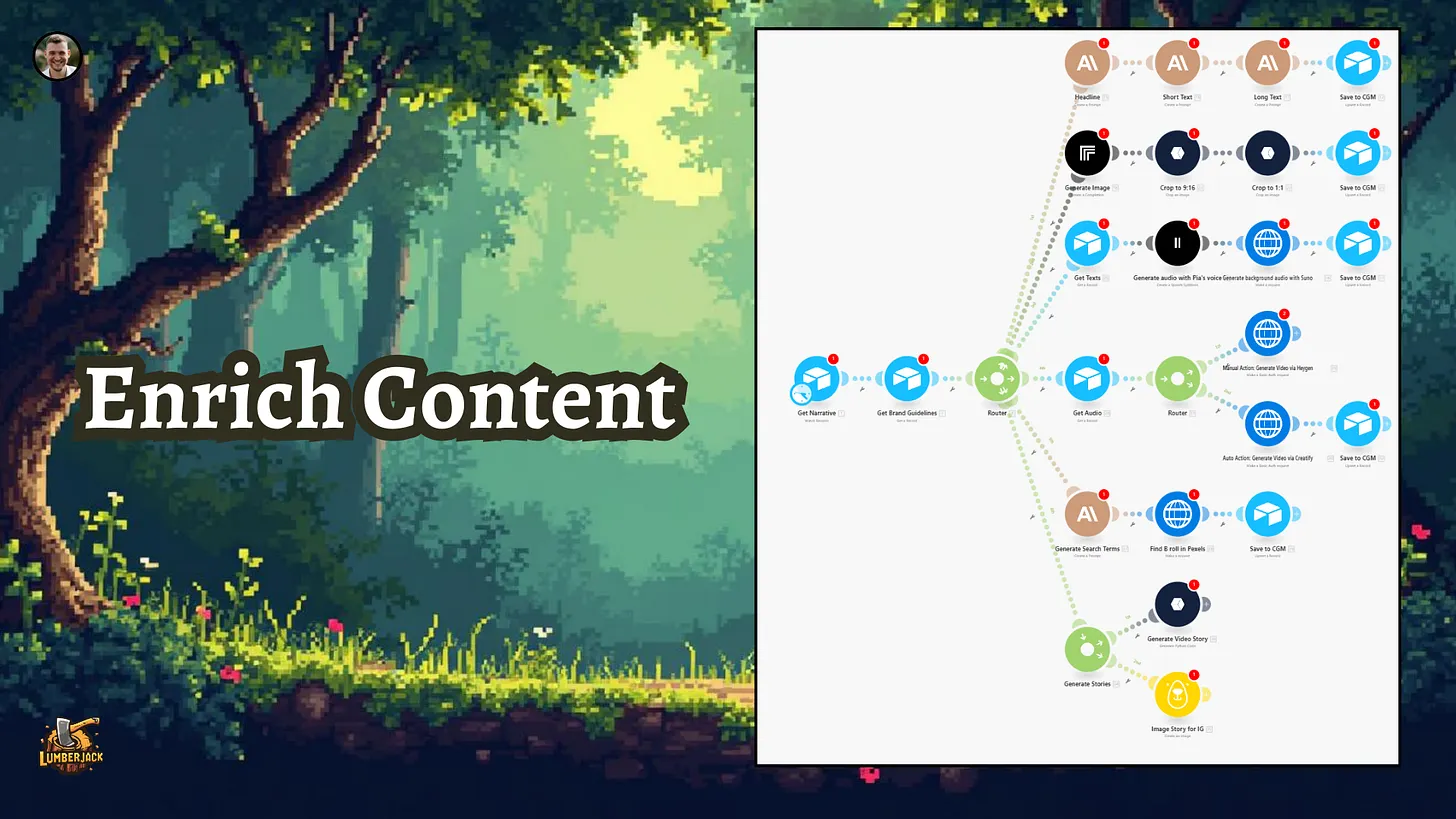
Then I like to use Make’s UI to build schematics for how the solution will look. You can see from the red dots that these are not actually configured, but give a clear understanding of how the solution will work as a whole. There are several pages like this (in this project we had 4.)
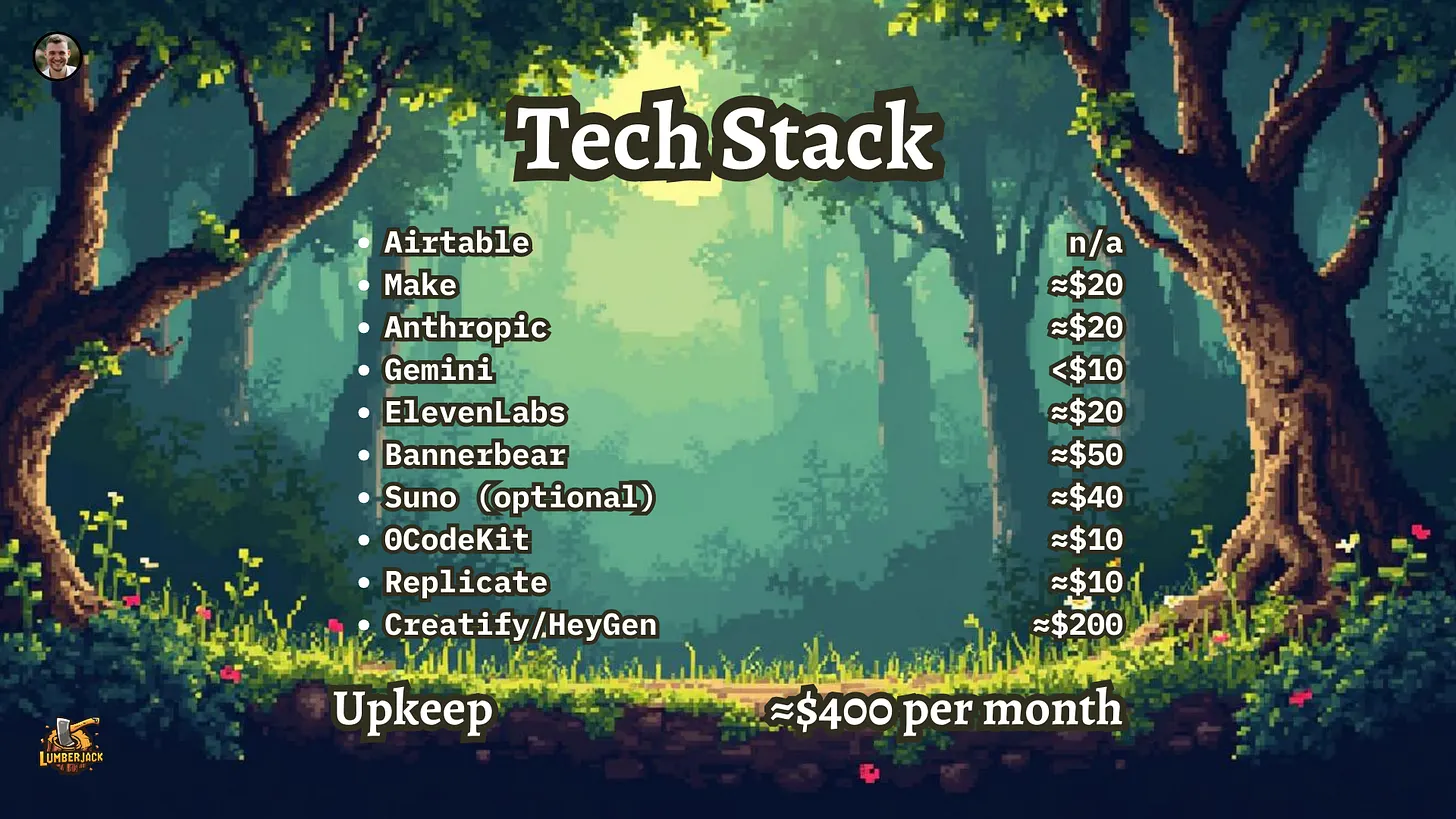
This is followed by a brief overview of the tech stack once the solution is live. This gives the customer a good idea on the costs and allows them to make on the spot decisions.
In this case, we ditched video and Suno, changed Bannerbear to Canva (which they already used) and got rid of 0CodeKit (doesn’t make sense to use it since Cursor AI can build full Node.js apps and custom APIs in a matter of minutes). I won’t go into great detail here, because I’ll write up a separate post about my full tech stack.
This meant that we ended up reducing the upkeep AND the scope drastically before we even started working together.
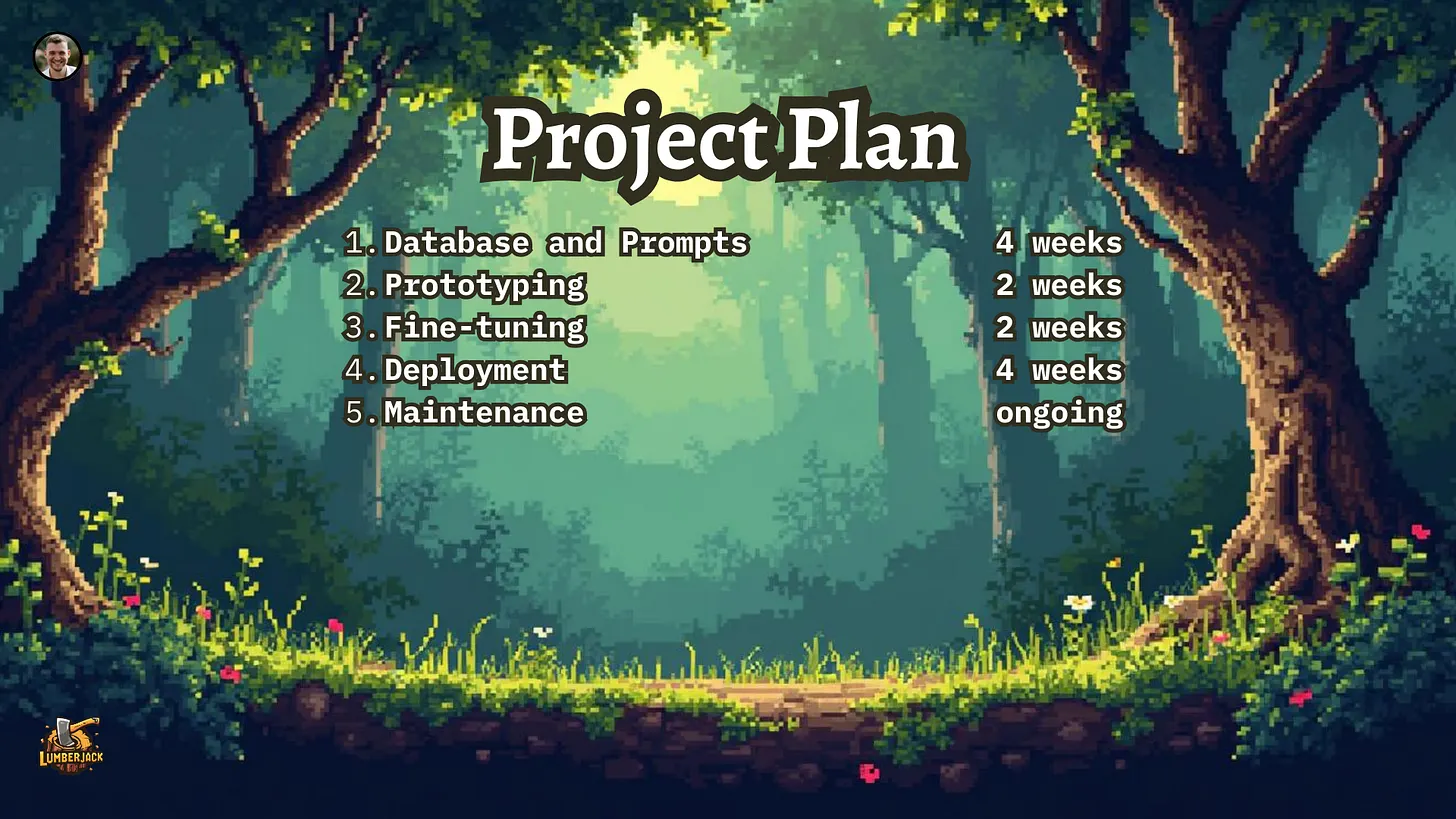
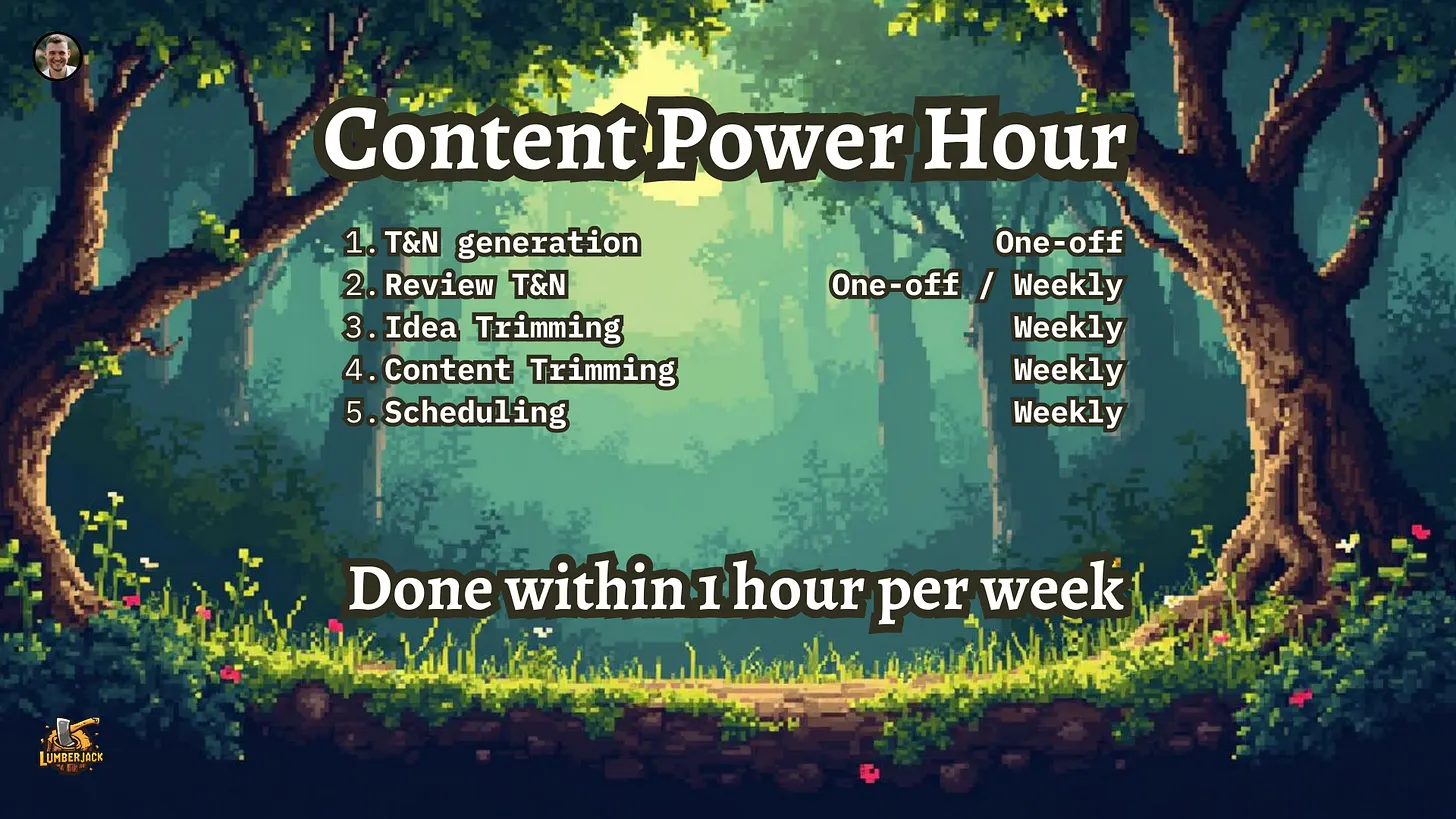
I aim to do projects in 3 month batches so the following is pretty straightforward and standard:
If the new AI agent requires human supervision (it should) I need to design the SOP for the team to use it and provide training. This might change by the time we finish the project, but this also reduces uncertainty for the client.
Pricing
By this point the client should have everything to make a decision, so next stage is pricing.
During Power Day I got the answers to Question 4 and 5. This gives me a range. At worst I’ll be saving all the time and I could in theory take all those savings and they’re still breaking even from year 2 (minus upkeep). But unlocking more time almost always results in more growth.
So while saving one full time employee’s time with an AI agent is worth $50k, it might unlock $500k in annual revenue increase.
Of course, the more we go into “potential territory” the more slim the likelihood of success becomes. I don’t want to take responsibility for the client’s growth opportunities, because I’m not a growth agency.
But I can take responsibility for the results my agent delivers.
Here are a few rules of thumb:
- I like to aim for $10k per month of work. It’s a good ballpark for my efforts and how I value myself. If this is a relatively simple project, I’ll aim for $10k. If it’s a more complicated project, I’ll ask for more, $30k for 3 months, $50k for 5 months, etc.
- I usually ask for 3 month delivery even if it’s shorter than 3 months. I’ll need to get access to all the services, stuff might happen. Easy to miss deadlines even if it’s not my fault if the project is too short.
- I probably wouldn’t take on a 3+ month project as a first project for a new client. There are a lot of moving parts when things might go wrong. The example slides are from the CGM project I’m doing for No BS Agencies. We’re now talking about doing some cool stuff with their curriculum which might be a 6-9 month project of even longer. There are opportunities once I’m settled and we know each other. But as a first project, I aim for <=3 months.
- As a rule of thumb I like to see if the estimated annual savings are higher than what I would ask for. If they’re lower, this is not a good fit. Since I have this data from the Power Day, I control what goes into the presentation and I can make sure that I design a solution that makes sense to both parties.
- The cost of the Power Day is deducted from the final price. So if the project is $10k, the client only pays $7k because they already paid $3k.
- I’ll take 50% upfront and the rest (minus the $3k) in monthly instalments over 12 months during the maintenance period, a.k.a No Headache Guarantee.
- This means that a client that buys a $30k package will pay $3k for the Power Day, then once they accept my terms pay $15k, then once I deliver the project and we move over to maintenance period, they pay me $1k per month for a year.
You can click here to get the contract template I’m using.
No Headache Guarantee
This is the part when I want to overdeliver. The client pays a premium for going from anxious about AI to confident. Their confidence is in me and my work, not themselves. Once I deliver them the solution, I offer them to have a 12 month maintenance period, where I maintain the stuff for them.
GPT-5 comes out? Sure I’ll upgrade your agent. If the cognitive architecture needs changing I’ll do that too.
Basically I guarantee that the agent will do what it needs to do, no matter what happens.
I like this because it also ensures an ongoing relationship with the client which means I can upsell more projects to them and once the one year expires, we can make a decision to renew the maintenance contract or not.
As you can see, all these decisions are managing different parts of the Value Equation.
This model works for me because I have control over my time, I get to decide how many clients I want to take on and how busy I get. I like to be very hands on with my clients so I don’t take too many projects on at once.
This also means I can overcommunicate. I often send multiple update messages (at least every 2-3 days) even if there’s no progress. The clients often don’t even react if they’re busy but they know I’m working. This is the human, relational aspect of this business that I find very important. It’s also what most service providers miss, so competing on this is easy.
Final Thoughts
I’m hoping you can get some value out of this post and inspire you to structure your business offering. If you need more help, you can always join my free Discord], we have more than 100 people now. There I’m taking requests to build AI bots for others for free, I’m sharing deep insights and progress into the AI agents I build for myself and for my clients and we have really cool conversations.

Big consulting months still hit Sept 15 estimated. Sept 15 Estimated-Tax Worksheet for 1099s, $19. https://atlashelpscompany.gumroad.com/l/zfdxar Not tax advice.