How to approach product challenges?
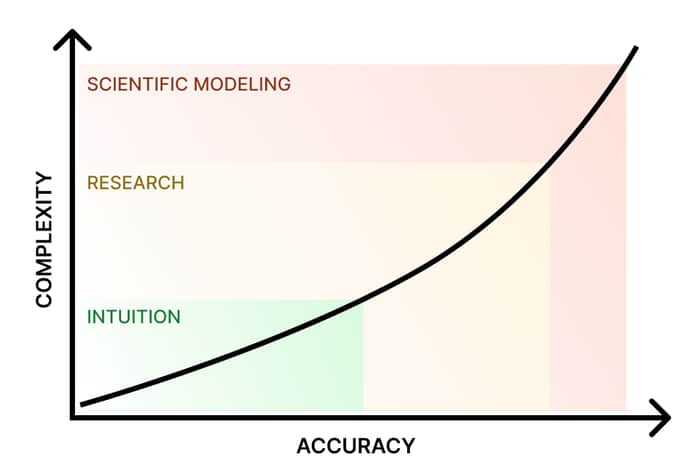
Here’s my take on this.
👉🏻 When dealing with a challenge that has low complexity and doesn’t require high accuracy then we can use intuition to quickly come up with a solution based on our experience and gut feeling. Though, in this case, the cost of a mistake should be very low.
👉🏻 When the complexity increases and a solution has to have higher accuracy then it’s important to allocate resources for qualitative and/or quantitative research:
📝 Qualitative methods like surveys, interviews, and user testing sessions help us better understand people's perception of the problem, the root cause of it, and how they feel about our potential solution.
📈 Quantitative methods using data analysis help us collect and get meaning of data on the problem we’re solving, formulate hypotheses and run experiments to find a solution.
👉🏻 When high accuracy is important for people or it has the defining factor for business then it’s vital to consider building a scientific model, e.g. using Machine Learning, based on all data insights that we can collect. A data model can be trained, tested, and improved in a safe simulated environment until we achieve the desired level of accuracy.
–––
What's your perspective on this?
