How to Validate Your Idea Without Wasting Months (And Avoid the Startup Death Spiral)
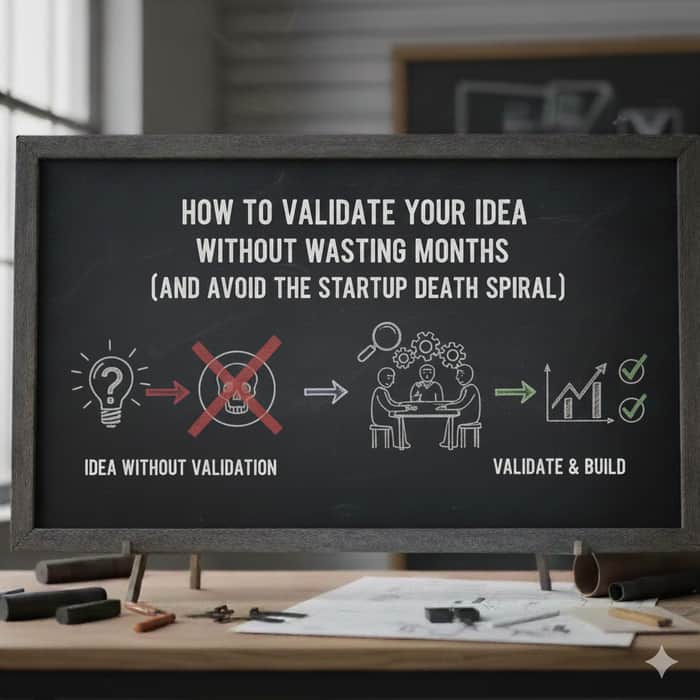
How to Validate Your Idea Without Wasting Months (And Avoid the Startup Death Spiral)
Every founder has been here:
You have an idea. It seems promising. You read all the advice, plan for months, maybe even sketch a roadmap. But months go by, and the product is still nonexistent.
The harsh truth: most startup ideas die not because they’re bad, but because founders validate wrong — or not at all.
This article gives you the step-by-step framework to validate your idea in weeks, not months, while avoiding the emotional and financial traps that kill momentum.
Why Most Idea Validation Fails
Most founders validate their ideas incorrectly. Here’s how:
-
Talking to the wrong people
You ask friends or colleagues who aren’t your target users. They nod politely. You assume the idea works. Reality? They don’t represent the paying audience. -
Over-researching before testing
You read articles, watch videos, and map competitors endlessly — but still haven’t seen real user behavior. The result: analysis paralysis. -
Building too early
Some founders jump into full development before validating. Months of work later, users don’t care — and pivoting is expensive and demoralizing. -
Relying on surveys and assumptions
Survey responses often tell you what people think they want, not what they will pay or use.
The Framework That Actually Works
Validating an idea is simple — but it’s not easy. It’s about discipline and speed. Here’s a framework I’ve used with multiple founders to validate without burning months:
Step 1: Identify the Core Problem
Ask yourself:
“What is the ONE problem I am solving that users feel strongly enough to act on?”
Cut everything else. The sharper the problem, the faster validation works.
Example: ❌ Problem: “I want to build a project management app.”
✅ Problem: “Small teams are losing deadlines because Slack notifications get buried.”
Step 2: Map the Minimum Testable Solution
You don’t need a product yet. Define the smallest thing that can prove users care:
A clickable prototype
A landing page
A simple tool in Notion or Google Sheets
The goal: measure actual interest without building a full product.
Step 3: Measure Real Engagement
The key metrics matter:
Click-through rate on your landing page
Email signups from cold traffic
Early beta testers actually using the prototype
Ignore opinions. Focus on behavior. Behavior is the only signal that proves demand.
Step 4: Iterate Rapidly
Validation is not a one-off. Once you gather data:
-
Cut features users ignore
-
Highlight features they love
-
Adjust messaging until engagement increases
This iterative loop is the fastest way to learn what works — without wasting months coding and debating features.
Step 5: Know When to Kill or Pivot
A lot of founders hang on to ideas that fail validation. Here’s the mental shortcut:
If less than 20% of your target audience engages or expresses intent, the idea needs a pivot or death.
Don’t force it. Accept the feedback. Moving quickly is far more valuable than stubbornly holding on.
Why This Framework Works Better Than “Build First”
Most founders wait for “perfect confidence.” That leads to:
Delays
Overbuilding
Burnout
By validating first, you:
Reduce emotional attachment to non-performing ideas
Save time and money
Accelerate real learning
The Hard Truth About Execution
Even with the best validation, execution is the bottleneck. Founders stall because they:
Try to do everything themselves
Get lost in feature creep
Don’t know what to build next
Validation is the map, execution is the journey. Without both, ideas die — even validated ones.
If You’re Stuck Between Idea and Execution
Here’s what I see over and over: founders know what to do in theory, but can’t move fast enough. That’s where guidance matters.
📩 Email me at quratulaincreatives@gmail.com
Tell me:
Your idea
Where you’re stuck
I’ll give you a step-by-step path to validate, build, and launch quickly, so you don’t waste another month guessing.
No fluff. No guessing. Just clarity, speed, and results.

The "behavior over opinions" point is critical and often missed. I've seen founders get excited about survey responses where 80% say "I'd definitely use this!" - then launch to crickets because there's a massive gap between hypothetical intent and actual behavior.
The 20% engagement threshold is a useful heuristic. One nuance I'd add: the quality of that 20% matters as much as the number. If your engaged users are exactly your ICP and have the problem acutely, that's a stronger signal than 30% engagement from a mixed audience.
A few additions from what I've seen work:
The "would you pay for this right now?" test - Skip the landing page and go straight to asking for money (even if it's just a pre-order or deposit). It's uncomfortable, but nothing validates demand faster than someone handing over a credit card.
Validate the channel, not just the idea - Even a perfect product dies if you can't reach customers. While validating the idea, also test: can I actually get in front of these people? Reddit, cold email, communities - wherever your ICP hangs out.
Time-to-value as a validation metric - Track how long it takes new users to get their first "win" with your prototype. If it's more than a few minutes, that's often a UX problem masquerading as a product-market fit problem.
The "kill or pivot" step is where most founders struggle emotionally. Having pre-committed criteria (like the 20% rule) before you start helps remove ego from the decision.
What's the shortest validation cycle you've seen work? I'm curious if there's a floor below which you're not getting real signal.
This framework really nails the essentials — fast feedback beats long planning cycles every time. The hardest part isn’t the idea, it’s getting real user behavior signals before you build.
A few tactical ways I’ve seen work extremely well:
Start with a paid micro‑offer: even a $1 pre‑order on a simple landing page tells you far more than a “join the waitlist.” If people hand over money, even tiny, that’s demand.
Talk to real target users first: not friends or generic forums — communities where your exact ICP lives (Reddit threads, niche Discords, LinkedIn groups). Then refine your test based on the language they actually use.
Measure behavior, not opinions: clicks, signups, replies, pre-orders — these are far stronger signals than “I’d use it.”
The biggest trap is starting with features instead of outcomes. If what you’re testing doesn’t help someone complete a specific job in a measurable way, it becomes noise. Execution after validation becomes far more focused when you’ve already seen real traction signals.
I help founders with partnership at Cognimuse turn early ideas into structured validation tests and MVP plans, so the first launch isn’t just shipped — it actually moves the needle. If you want a quick framework for a testable MVP, feel free to DM me or email me at quratulaincreatives@gmail.com.
This comment was deleted 8 months ago
This comment was deleted 8 months ago
The framework sounds solid, but here's what I'd add from experience: the real trap isn't just speed, it's validating against a sample that's too narrow. I've seen founders do 10-15 customer interviews and feel confident, but then miss massive problems that thousands of public complaints would have surfaced immediately. The best validations I've done combined both — quick conversations to understand the human side, then mining what people are already saying publicly to see if the pain is real at scale.
What type of ideas are you personally trying to validate with this approach?
This is a solid breakdown, especially the emphasis on behavior over opinions. One nuance I’d add from experience is that a lot of founders still get stuck even when they follow steps like this, because the signals collapse into a single question: “Is this idea good or bad?”
What helped me was reframing validation as assumption testing instead of idea testing. Low engagement doesn’t always mean “kill the idea.” It often means a specific assumption failed, like urgency, audience, or willingness to pay. Those failures point to very different next moves, but they can look identical if you only track surface metrics.
I also like your point about speed, but I’ve seen founders move fast in the wrong direction by iterating features instead of pressure-testing the riskiest assumption first. Cutting the feedback loop is powerful only if you’re clear on what decision the signal is supposed to inform.
Curious how you help founders distinguish between “this idea is wrong” and “this framing or assumption is wrong” when the early data is mixed. That decision seems to be where most people either compound learning or spiral.
Strong point about behavior > opinions.
One thing that changed validation for me was treating time as the real cost, not money.
If users won’t give you time (reply, try, follow up), they won’t give you money later.
Validation isn’t about proving you’re right — it’s about killing weak ideas fast enough to protect the strong ones.
Absolutely — treating time as the real currency is a game-changer. User attention is the strongest early signal; if they won’t spend time engaging, paying usually never follows. Validation isn’t about proving ideas; it’s about learning fast, killing what doesn’t work, and doubling down on what does.
we help founders turn these early behavioral signals into clear, revenue-ready decisions — so you know which ideas are worth building before wasting months.
That’s a great way to frame it — time exposes truth much faster than money.
One thing I’ve noticed is that time has layers:
• passive time (reading, lurking)
• active time (replying, testing)
• committed time (following up unprompted)
The jump between those layers seems to be where most ideas either die quietly or suddenly accelerate.
Curious — what was the first signal that made you personally stop debating and actually commit?
Love that breakdown — the distinction between passive, active, and committed time is super practical. You’re right that the leap from lurking to actual follow-through is where everything either flops or takes off.
For me, the first real signal that pulled me out of debating and into committing wasn’t a metric — it was consistent action from real humans: someone not just clicking a link, but actually replying with a problem they couldn’t easily solve themselves. That first message that went beyond “cool idea” to “I need this” changed everything. It told me there was enough pain on the other side to justify effort.
After that, the next litmus was repeat behavior — not just one person, but two or three different people saying the same exact thing without me prompting for feedback. That’s when I stopped theorizing and started building.
Curious — in your observations, do you treat repeat unprompted engagement as a stronger signal than long usage time when deciding to commit?