How vital are your Core Web Vitals?
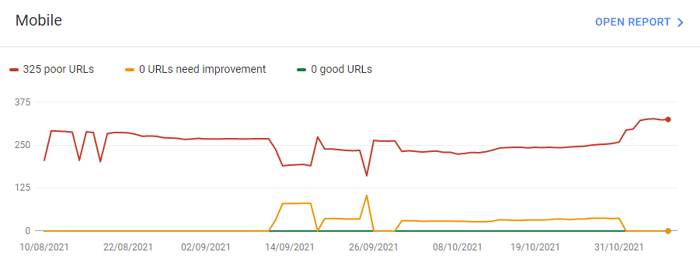
Just wondering how serious IH's are taking their Google Core Web Vitals metrics?
We now have 325 poor mobile URLs which Google is warning us about. Our desktop stats are not great either with 285 needing improvement.
Just wondering how important these figures really are but if Google is warning us about them then we should probably be doing something about them right?
Not surprisingly Google is our main source of organic traffic. I suspect most people are in the same boat and any shift in those figures for most people who rely on these can make or break you.
LCP - Largest Contentful Paint, FID - First Input Delay, CLS - Cumulative Layout Shift are all playing a part in where everyone ranks but how much? Should we care?
What do you think...
- Just don't care?
- Worried about them?
- Sorted them out and noticed rankings and/or impressions rising?
Even if you don't care what Google thinks of your site and its performance you must be worried about your visitors experience right?

I think that is the right way to think about it, and fixing these issues will also help with your ranking (although nobody really knows how much of an impact it has).
I always look at the results as things I could improve on for my application/website. If Google tells me to improve something, I'll l add it to my to-do list to see if I can resolve the issue or improve it (in the case of LCP, FID, and CLS)
Yes, our thoughts also.
Have you sorted any of the suggestions Google has given you? And if you have did you see any improvements?
It's on our to-do list but it has been for some time and wondering about how much time and effort we put into it.
I divide it into priorities. If it's an error (red), I'll try to get to it in a timely manner. Warnings are mostly part of my backlog or something I put on the roadmap.
LCP, FID, and CLS are, however, good things to improve if they are horrible. These are three metrics that are tight to the UX of your site, so I always try to keep them out of the red and into the green zone (I use lighthouse).
LOL. Everything is RED :) Better get on with it.
Thanks for the advice.
Hey @Checkify!
With Web Vitals Google's objective is to simplify the #webperf metrics "Jargon" so that everyone is measuring and talking about the same thing.
I personally believe that improving web performance must be for users (and business of course) first. SEO arguments are fine too but shouldn't totally correlate both.
To answer your question regarding IndieHackers web perf, I'm building a web performance tool, and it allows to measure, monitor, and compare web vitals between multiple websites. If you are interested I could show you a demo.
Aymen,