I built a location-aware social platform as a solo founder - now I need real feedback
Hey Indie Hackers,
I’m Fotios, a solo founder and Creative Technologist from Greece.
Over the past months I’ve been building Wedbeas, a location-aware social discovery platform designed around one idea: helping people connect not only with people nearby, but also with places they’re visiting or considering moving to.
I wanted something that sits somewhere between social discovery, local communities and relocation tools — without simply becoming another generic social network.
So far I’ve built and shipped features including:
Local and Traveller modes
Location-based discovery and radius search
Profiles, likes and matches
Real-time chat
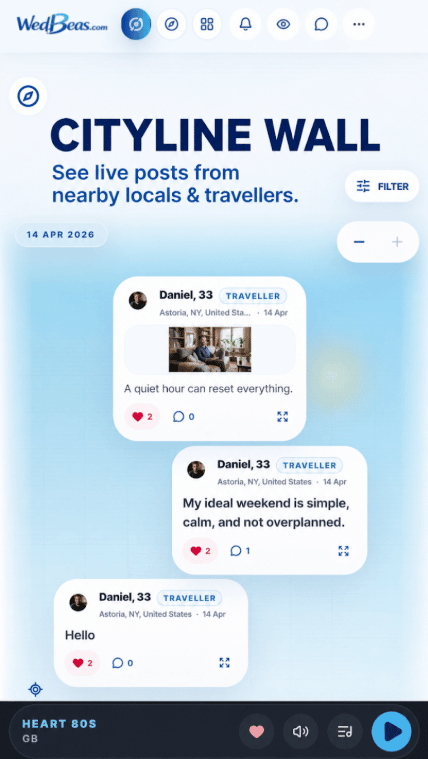
Social posts, comments and reactions
City-based feeds
Maps and location-aware features
Relocation-oriented tools
Shared music listening inside chat
Web + Android versions
I’ve been building it mostly solo using an AI-assisted development workflow, with React, TypeScript, Supabase and a lot of rapid prototyping, testing and iteration.
The technical side is not the biggest question for me anymore.
The big question is: would people actually want this?
I’m now at the stage where I need people outside my own circle to use it and tell me what feels useful, confusing, unnecessary or missing.
I’m especially interested in feedback on:
Is the core idea immediately understandable?
What feature would make you come back regularly?
Would you use something like this before travelling or relocating to another city?
What would stop you from signing up?
I’m not looking for polite feedback — I’d rather hear what doesn’t work.
Wedbeas: https://wedbeas.com
If anyone here is also building a social/community product, I’d love to compare notes on getting the first real active users without spending heavily on ads.
Thanks!

Building solo with an AI-assisted workflow on React/TS/Supabase is a good stack for speed; the part that usually bites later is location data privacy and battery drain from constant geolocation polling, worth testing on a few real devices before you scale up. What's your current strategy for getting a first real cohort in one city rather than spreading thin everywhere?
Good point on both privacy and battery usage. Wedbeas doesn't need precise location to be constantly exposed to other users, and I'm looking at making that distinction much clearer in the product.
For the first real cohort, I'm increasingly leaning toward exactly what you mentioned: concentrating acquisition in one city instead of trying to create density everywhere at once. The feedback here has reinforced that quite a bit.
That feature list is huge for one person - chat, maps, matches, shared music listening. Honestly I'd cut to just the relocation angle first, that's the one where I'd actually go looking for a tool. Which city has the most real users on it right now?
That's useful feedback. The relocation side is also the part that seems to be standing out most consistently in this thread.
I don't necessarily want to remove the broader social layer, because the idea is that relocation can be the reason someone joins and the local community becomes the reason they stay. But I agree that the first use case needs to be much sharper.
I'm still too early to claim that one city has enough real usage to be the clear winner, which is exactly the problem I'm trying to solve now.
The location layer would be my main trust hurdle. Before signing up, I’d want a clear explanation of what other users can see: my exact position, neighborhood, radius, or just city—and when location stops updating. I’d make precision user-controlled and default to the least precise setting. For this kind of product, privacy isn’t just a settings detail; it’s part of the value proposition.
I completely agree with this.
There's an important difference between using location to make the product useful and making users feel like they're broadcasting where they are. Wedbeas shouldn't require the latter.
I'm going to make the location/privacy explanation much more explicit what is visible, at what level of precision, and what users can control.
The honest question isn't "would people use this" — it's which moment makes them open it. Relocation is high-intent but short-lived; local discovery is permanent but low-urgency. I'd optimize for the move-to-a-new-city moment, make that one experience excellent, and let habit grow from there. What brings a user back after week one?
I think you've described the product tension really well.
Relocation has a strong trigger: "I'm moving somewhere and need people/information now." Local discovery has less urgency, but potentially much longer lifetime.
The model I'm increasingly interested in is using the move/new-city moment as the acquisition trigger, then letting the local social/community layer become the ongoing reason to stay.
The week-one return question is exactly what I need to measure next.
Adding one I don't think has come up: the login wall doesn't just stop people evaluating you, it stops you being findable at all. A city-based product has the best organic shape there is, because city plus intent is genuinely how people search. "expats in Berlin", "meet people in Lisbon", "moving to Amsterdam alone". That's real volume with real intent, and it's the exact thing someone types the week they relocate, which is the week you want them.
Right now none of that can reach you, because every city feed sits behind log in and there's essentially nothing on the domain for a search engine or an assistant to read. InterNations and Meetup win a lot of those queries by having a public page per city, not by being better products.
The cheap version isn't opening the app up. It's one public, read-only page per city: a preview of the feed, member count, a few upcoming things, sign up as the CTA. Keep the wall for participation, drop it for discovery. I'd do that before more features, because it compounds quietly while you build and a feature list doesn't.
This is excellent feedback and something I hadn't framed this way before.
A public read-only city layer makes a lot of sense because it lets people discover Wedbeas around the exact intent the product is built for without exposing private participation.
Something like city pages with a limited preview, useful city context and a clear signup CTA could also solve the "I need to register before I can understand the product" problem.
Definitely adding this to the list.
Interesting journey. I’m currently building a new social network in France focused on real-world positive actions, so I’m facing similar questions around early adoption. What was the most effective way for you to get your first active users?
I'm actually still working through that question myself.
So far I'm at the point where the product is built enough that broad "does this sound interesting?" feedback isn't very useful anymore. I'm now trying to get much more targeted about reaching people who already have the problem travellers, relocators and people new to a city.
Happy to compare notes as we both test this. Social products have a very different cold-start problem from most SaaS products.
The relocation angle is what stands out to me over the dating/social framing - "city feeds for people starting a new chapter" is a much less crowded lane than general social discovery. If I'd just moved somewhere new, the feature I'd actually open daily in the first couple weeks isn't a feed to browse, it's something closer to "who's near me right now that's also new here" - a live, low-stakes signal rather than a profile to scroll through.
Have you noticed newly-relocated users engaging differently than the travellers/locals segments, or is usage pretty uniform across the three right now?
That's a really interesting distinction.
"Who else is new here?" may actually be a stronger social signal than simply "who is nearby?" because both people already share context and intent.
I can see something like a "new in this city" layer fitting naturally into the existing Local/Traveller model without turning the experience into endless profile browsing.
I'm still early enough that I don't have reliable segment-level usage data yet, but this is exactly the kind of behavior I want to start measuring.
This caught my attention because I’m also working on a location-based social product.
I’d be really interested to hear what has been harder so far: getting the location/discovery experience right, or getting users to actually take the step from browsing to meeting in real life?
That conversion from “this looks interesting” to “I’m actually going” feels like one of the biggest challenges in this space.
I think the second problem is probably the harder one long-term.
Building location discovery is technically solvable. Creating enough trust and intent that someone goes from seeing another person to starting a real conversation and eventually doing something in the real world is much more behavioral.
That's one of the reasons I'm interested in designing Wedbeas around context rather than random proximity: same city, same stage, travelling there, moving there, new there, etc.
I like the traveller vs local angle because it gives the product a clearer use case than just “another social app.” For me, the biggest question would be what makes someone open it repeatedly after the first few days. Maybe city-specific events, useful local recommendations, or relocation questions could help create that habit. Also curious which feature has actually gotten the strongest response from early users so far?
That's exactly the retention question I'm thinking about now.
Local vs Traveller gives people a reason to enter the product, but the city itself probably needs to become useful enough to revisit.
Events, useful local information, questions from people moving there and activity from people who are actually in that city could all make the city feed more than a generic social feed.
I don't have enough real usage yet to call one feature the winner, so that's one of the things I need to instrument properly next.
The concept is good...To answer you questions directly...
The concept of the app is actually easy to understand.
I actually love the location based discovery and radius search feature
I would be more inclined to use before travelling but the relocation feature would also be super useful.
But then specialization is key here...You seem to have a lot of features and if you spread yourself too thin trying to be the best on all of them, you might end up having mediocre results on the things that actually matter.
But overall I love the concept.
The feature list is the tell: local/traveller modes, matching, real-time chat, city feeds, relocation tools, shared music, that's five different products bundled into one app before any single one is proven. I'd cut it down to the sharpest audience, people relocating to a new city in the next 90 days, kill everything except chat plus a way to find three real locals, and let the rest of the roadmap get earned from what that group actually asks for.
I think the strongest use case might be the moment before someone moves somewhere new. “I’m moving to Athens next month and know nobody” feels like much stronger intent than just “show me people nearby.”
Have you tested onboarding around destination + moving/travel date instead of location alone? Curious whether people engage more before they arrive or once they’re already there.
The honest problem with location-based social isn't the product, it's density: in a city with 8 signed-up users the experience is empty, and empty kills retention before any feature can help. If I were you I'd stop asking "would people want this" globally and pick one city plus one narrow persona — say newly relocated expats in Athens — then hand-recruit 50 of them from existing Facebook/Reddit relocation groups and refuse to open other cities until that one feels alive. Seed it manually too: run a weekly real-world meetup or a "who's new here this week" thread yourself for the first two months, because early social apps are operated, not launched. On the feedback questions, the one that actually predicts survival is not "is the idea understandable" but "did a user come back on day 7 without a notification" — instrument that and you'll learn more than a hundred survey answers. I'd also cut shared music listening for now; it's charming but it's a retention feature for an app that doesn't yet have anyone to listen with. One last thing: ask your first 20 users what they were doing instead of your app, and you'll find the actual competitor is usually a WhatsApp group.
I am Chinese, but I can't find my city in your website, so I can't go on next
I'd disable half the extra features for now and focus 100% of your onboarding on the "Local vs Traveler" connection to see if people actually start conversations.
Your first question is testable, so I tested it: I opened wedbeas.com cold and wrote down what the page told me, before re-reading your post.
What the home page says: a skyline of world landmarks, the words LOGIN, MATCH, CHAT, TRAVEL, SETTLE arcing across it, the headline "CONNECT ACROSS CITIES. MEET WITH INTENTION.", one button (LOG IN / SIGN UP), then a section titled "SERIOUS CONNECTIONS ONLY" about a "more serious, respectful, and meaningful way to connect online." Under a brand that starts with "Wed", match + meet-with-intention + settle reads as an intentional-dating app.
What your post here says: locals and travellers, city feeds, local communities, relocation tools. Almost none of that vocabulary is on the home page - the only "community" is the Community Guidelines link in the footer. The whole page is about 550 characters of text: hero, the serious-connections paragraph, footer. So on your first question: the page isn't just unclear, it's clearly communicating a different idea than the one you described in this post.
The odd part is your About page already has the fix. "a city-based social connection app for locals, travellers, and people starting a new chapter in a new city" is the actual idea in one sentence, and "Moving across the world should not mean moving alone" is a stronger headline than the one currently on the hero. That copy is sitting one click away from where every stranger lands.
What would stop me from signing up (your fourth question): the only door on the page is log in / sign up, and nothing of the product is visible before it - no screenshot, no example city feed, no map. I'd be committing before seeing anything. And if I'd come for the relocation side, "SERIOUS CONNECTIONS ONLY" reads like a sign that this place is for a different visitor.
One data point for the three-products observation above: right now the browser tab says "City-Based Social Connections", the home page says intentional dating, and this post says discovery plus relocation. Three surfaces, three pitches. Whichever product you pick, the home page is where the pick has to show up first.
The feature list here is honestly the concern, not the tech - you've shipped chat, feeds, maps, relocation tools, shared music, matches, web and Android, all before finding out if the core loop works. That's a lot of surface area to maintain feedback on at once. If I were narrowing it down I'd temporarily kill everything except one mode (my guess is local, for the reason the other commenter gave: travel has a built-in expiration date that ends the habit) and ship that alone to 20 real people in one city. Right now feedback on "the whole platform" is going to be diffuse and hard to act on - feedback on one sharp feature is something you can actually decide to keep or cut. What's the single feature people have organically used the most without you prompting them to?
Solo builder here too, also past the "does the tech work" stage and squarely in the "will anyone actually want this" stage — so this resonates a lot.
On your question about first real users without ad spend: I'm currently testing direct outreach to a narrow, specific audience (people who already show clear intent for the exact problem I'm solving) rather than broad posting, and it's slower but the signal feels more honest — fewer polite "cool idea!" reactions, more actual silence or actual follow-up questions, which is the contrast I actually want to see.
Question back on Wedbeas: of "local mode" vs "traveller mode," which one are you finding pulls people back more? My guess would be traveller mode has a natural expiration (the trip ends) while local mode needs an ongoing reason to open the app — curious if that's matched your early usage or if it's the opposite.
Happy to compare notes on the outreach side if useful — direct message works for me.
You’ve built a lot around the location layer, so I’d be less interested in whether each feature is useful individually and more in whether people immediately understand the one reason to use Wedbeas.
That distinction could affect both sign-up and repeat usage.
The fact that you've shipped this much as a solo builder is impressive. But "would people want this" is actually the measurement question most builders skip - they measure features shipped and months of work. You measured the output correctly (lots of features) but the hard part is measuring the boundary: what specific outcome does each person join for, and are they coming back for that. When you measure what people are actually trying to solve (moving to a new city? making local friends? finding places?), you find three different products inside one app. Most location platforms die here - they try to be everything. The ones that work pick one measurement: "did they find what they came for?" and strip away everything else.