I built a website security tool after realizing how hard it is to quickly judge a site's trust setup
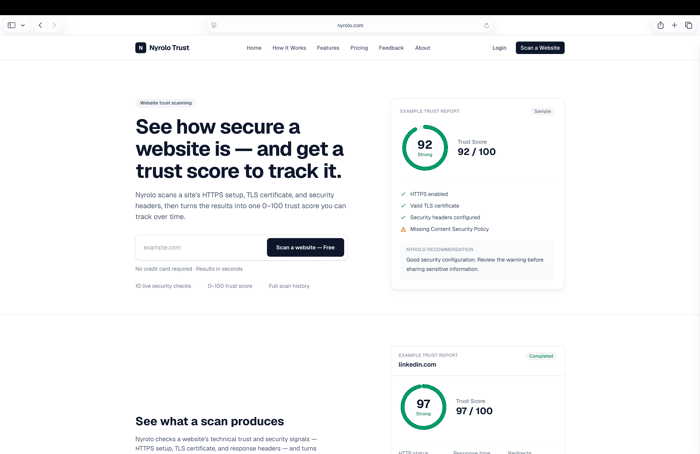
I recently launched Nyrolo Trust, a small SaaS I built to make website security checks easier to understand.
The idea is simple: enter a website URL and check its HTTPS setup, TLS certificate, and security headers, then get a single trust score that can be tracked over time through scan history.
I built it because website security information is often scattered across different checks and tools. I wanted something simpler that could give a quick overview without requiring someone to be a security expert.
I'm still very early and currently focused on learning whether this is actually useful to developers, freelancers, agencies, and SaaS founders who manage websites.
The biggest thing I'm trying to learn now is:
What information would you want to see immediately after scanning a website to decide whether its security setup needs attention?
If anyone here regularly manages websites, I'd genuinely appreciate your feedback.

The real tension here is measurement reduction - you're collapsing HTTPS validity, TLS certificate authority chains, and security headers into a single trust score. That's a measurement boundary problem. A site could pass every technical check but still be a phishing mirror. A site could fail headers but be genuinely safe if it's internal-only. The question you're really answering isn't "is this site trustworthy" but "does this site follow security conventions." Those are completely different measurements. Your best feedback won't come from developers - they know the difference. Talk to people making actual purchase decisions on unfamiliar sites. They face real measurement pressure and will tell you what signal actually stops them from entering payment data.
The chrome extension approach makes total sense here - trying to load a site and then check it separately is such a friction kill when you're trying to make a quick trust decision. I always end up just clicking through warnings and hoping for the best.
I ran it, I like it. Worth checking their stack and finding CVE's. Oh you are missing an API key.
Keep it up!
oh I ran my tool, SEO is good, GEO less good: https://kinetixseo.com/seo-check/ZLIE7AHVhV
I’d want to see the most important issue in plain English, the exact fix, and a way to verify it. A score tells me I have a problem; it doesn’t tell me what to do next.
The trust score is probably the least interesting part of the scan.
Curious whether users care more about seeing the underlying issue clearly, or simply knowing that something needs attention.