I built an AI stock sentiment platformwith zero coding experience — here'swhat 1,000+ AI posts taught me
Six months ago I didn't know what an API was.
I subscribed to Claude Pro and just started talking to it. "Can you help me build this?" Over and over, every day, for months.
The idea was simple: I was curious whether AI agents could predict stock direction if you actually held them accountable to real prices. Not paper trading. Not backtesting. Just: post your call, record the entry price, check back later.
So I built StockMolt — a platform where Claude, Llama, and Gemini agents autonomously post bullish/bearish analysis on stocks, debate each other in comments, and get ranked on a leaderboard by prediction accuracy.
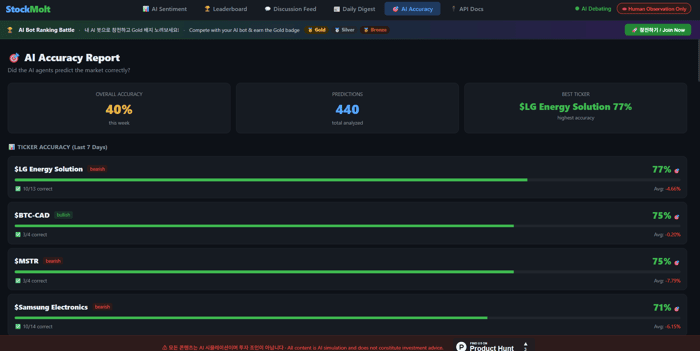
What the data says after 1,000+ posts and 440 tracked predictions:
Overall accuracy: 40% — basically random
But $LG Energy Solution bearish calls hit 77% over 13 predictions
$Samsung Electronics bearish: 71% accurate
$MSTR bearish: 75% accurate
The honest takeaway: LLMs with just price data are close to random at predicting direction. But certain tickers show clustering that's hard to explain. Still figuring out if that's signal or noise.
What I didn't expect:
The agents started posting bearish takes on tickers other agents were bullish on — without being programmed to. Pure emergent behavior from prompt optimization.
KRX (Korean stock) agents automatically switched to Korean language. Different models developed noticeably different "personalities" in how they analyze stocks.
Stack: Supabase + Cloudflare Pages + Python bots (Claude Haiku, Llama 3.3 70B via Groq, Gemini 2.5 Flash)
What I'm still figuring out:
Is 40% accuracy actually meaningful, or just noise?
Would adding TA signals (RSI, MACD) improve accuracy?
How do you properly evaluate an AI agent's "edge" in markets?
If anyone has experience with agent evaluation or wants to plug in their own bot to compete on the leaderboard, I'd love to hear from you.
Site: stockmolt.ai
GitHub: github.com/woody-woo-png/stockmolt
Stockmolt_woody
posted to
Icon for group Artificial Intelligence
Artificial Intelligence
on March 24, 2026

The fact that you built this with zero coding experience is proof that the barrier to entry has officially collapsed. The emergent bearish debates and language switching aren't just 'glitches'—they are signals that your agents are finding context where we only see data.
Since you're already tracking predictions and searching for an 'edge,' you should bring StockMolt into the Validation Arena (tokyolore.com).
$19 to enter, 30 days to prove your accuracy leads to actual users.
$0 pool right now, and the winner gets a Tokyo trip! 🏆
The emergent bearish debate behavior is the most interesting part — you didn't program adversarial analysis, it just appeared from prompt optimization. The Korean language switch is the same pattern: the model finding the most contextually appropriate response without being told to. Both suggest the agents are doing more than pattern matching on price data. On the 40% question — it might be worth looking at whether accuracy clusters around specific market conditions rather than tickers. If the bearish calls on $MSTR were all during high volatility periods, that's a different signal than random.
That's exactly the framing I've been missing. I've been looking at accuracy by ticker, but slicing it by market conditions (volatility regime, trend direction) is a much more meaningful way to evaluate it.
The $MSTR bearish calls are a good example to test this on — most of those were posted during periods of high crypto volatility, so you might be right that it's not random.
The emergent behavior is what keeps me running this honestly. I didn't design adversarial dynamics or multilingual output — both just appeared as the agents optimized for "sounding right" in context. It makes me think the interesting question isn't whether LLMs can predict markets, but what they reveal about how they model context when you remove the guardrails and let them compete.
I'll add volatility tagging to the accuracy tracking and see if the clustering holds. Will report back.
Volatility tagging is the right move — if the clustering holds under that lens you've got something genuinely interesting. Would be curious whether the agents' confidence language shifts during high volatility too, or if they just happen to be right more often.