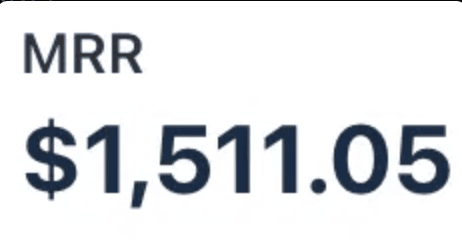
i fired all my clients and moved to bangkok. month one: $1,511 MRR
i cancelled every client i had, sold my furniture, and flew to bangkok with no apartment lined up.
then i worked about 25 hours the whole month and still closed at $1,511.05 mrr.
not 25 hours a week. 25 hours total.
i'm going to post one of these every month, up or down, because i've read a hundred "month one" posts written by people with 200 clean hours and 18 months of runway, and i've never once seen the version where your life is on fire while you do it. this is that version.
first, the part most people get wrong about services
everyone on this sub will tell you an agency arm kills your saas. i ran both, under the same brand, on purpose, and it's the only reason the software is any good. it was honestly exhausting but, worth it.
jem social is a creator marketplace — brands find ugc creators and influencers, creators manage their pitches. alongside it we ran managed services under the exact same brand. brands paid us to run their campaigns end to end and my team and i did all of it by hand.
here's the part that actually mattered: every new client was a free excuse to use my own platform in anger.
i wasn't demoing it. i was running real campaigns for real money on software i owned. and every single time, the thing broke somewhere. creator search returned garbage for a niche i needed. briefing took nine clicks that should've taken two. deliverable chasing was manual. a filter didn't exist. so i'd find the annoying roadblock, fix it, deploy it, and use it again on the next client the following week.
so i got paid — well — to find product market fit, on a loop, for two years. no user interviews. no "would you pay for this." just a client with a budget and a deadline and me discovering exactly where my own tool fell apart under load.
that's the whole trick and i'd do it again in a heartbeat.
so why kill it
because it graduated.
somewhere this year the loop stopped producing new information. i'd run a client campaign and… nothing broke. the search worked. the pricing worked. the flow held. the tool got good enough that using it stopped teaching me anything, and at that exact point the services arm flipped from being r&d that pays you to being a job that eats your calendar.
it was still profitable. (made about $6k-10k/mo) but, that's the trap: it never fails loudly enough to make you quit. i had to walk away from something that was working, on a hunch about timing.
so end of july i cancelled every managed client. not wound down, not transitioned. cancelled.
then i made it harder on myself for no reason
same week, i decided to move to thailand.
sold the furniture. listed my houses. moved out of my condo. got on a plane to a country i'd never lived in, with no apartment, no local phone number, and a recurring revenue line that now said $0.
i don't fully recommend the sequencing. but there was logic to it — i knew if i stayed in the same apartment with the same routine, i'd take one "small" client back within three weeks. i've done it before. the old thing needed to be genuinely un-resumable.
so the first two weeks of august i wasn't building. i was viewing condos, arguing about deposits, and figuring out where to buy a power adapter.
realistically: 20-25 hours of actual work the entire month.
august closed at $1,511.05 mrr.
it's not a lot of money and i know it. but it's the first money in years that shows up whether or not i open my laptop, and that is a completely different kind of dollar. imagine when i 10x?! what i did with those 25 hours
kept the r&d loop running, just pointed it at myself. with no clients, i lost my testing ground — so i rebuilt it. spun up several brand accounts and hired creators off my own marketplace to post 1-2x a day for them. same loop as before: run real campaigns, find what's broken, fix, deploy. only now i'm the client.
side effect i didn't plan for: being your own case study sells better than any landing page i've ever written.
started cold email. deliberately low volume. spent the time on infrastructure and figuring out what actually earns a reply rather than dumping thousands of sends onto a cold domain and torching it. august was the setup month. september is the volume month.
acquired postspace. small content-brief product. the bet is rearchitecting it for brands chasing viral content formats — because brands don't just need creators, they need to know what to have them make. that's the next roadblock the services work surfaced. buying beat building, and the price made sense. we are relaunching it in september.
might be the smartest thing i did this month. might be a distraction i took on because acquiring something feels productive. ask me in november.
hired a growth strategist and a linkedin specialist. i'm not good at either and i've spent two years pretending i'd get good at them. both too new to judge.
grunt work. directory submissions, paid ad space on a few tech directories, appsumo launch.
where i'd distrust my own numbers if i were you
attribution is a complete disaster. six things at once, in a month i barely worked. i cannot tell you which one made the money, and i'm not going to invent a confident story about it after the fact.
one month tells you nothing about churn. a four-week-old cohort is not a business. ask me in 90 days.
lifetime deals are not mrr so i did not factor in the $400ish i made from AppSumo tbh plus the payout is in september anyways so if it actually counts for september not august.
nothing compounded. 25 hours starts engines. it doesn't run them.
three things i'd actually take from this get paid to find pmf. services aren't the enemy of your saas, they're the cheapest research budget you'll ever have — but only if you run them on your own software, under your own brand, and treat every client as a bug report with a check attached. if your agency work doesn't touch your product, you're just running an agency.
the exit signal is silence, not failure. you don't leave services when they stop paying. you leave when they stop breaking your product. the day a client campaign runs clean end to end is the day the arm turned into a job.
hours are not the input people think. i moved this business further in 25 chaotic hours than in some 200-hour months of client work, because none of those hours built something that survived the week. nothing was based off my routine and tbh my mental health was shit until a few days ago now that i am settled.
september and beyond
i'm settled now. apartment sorted, no clients, no move, nothing but time. the plan is unglamorous volume:
-300 cold emails/day
-50-60 linkedin dms/day
-40 posts/day across tiktok, ig, linkedin, youtube, x and threads
-2 creators posting 2x/day on tiktok + ig about growing apps with the tool
-adding youtube creators and x creators to the same setup
near term the goal is $10k mrr by november 1 — a 6.6x in two months, which is either aggressive or delusional and i'll know which by end of september because i would have actually been more consistent but, i will say $1511 without consistency is a good signal buddy.
the team's actual targets: six figures arr by end of this year, seven figures by end of 2027. i'd rather put those in writing in front of strangers than keep them in a notion doc where nobody can hold me to them.
i'll post the september numbers here regardless. especially if they're bad — those are the only posts that teach anyone anything, and i'd rather be the founder who posted the ugly month than the one who quietly stopped updating.
one thing i actually want input on from anyone further along:
at this stage, did you pick one channel and go deep, or run everything until something obviously pulled ahead? i finally have the hours to do either and i've changed my mind three times this week. the case for going deep is obvious. the case against is that i just proved i can't tell which channel works even when i'm the one running them.
genuinely curious what worked for you.
(it's jem social if anyone wants to poke holes in it — happy to answer anything about pricing, the marketplace mechanics, what the acquisition cost, or why i thought moving to thailand mid-rebuild was a good idea.)

The $1,511 is the headline, but 25 hours total is the real data point. Would you share what those 25 hours actually contained — one channel, one asset, mostly existing clients converting? That's the part most month-one posts skip.
De‑jà vu! I feel like I’ve read this story before, or maybe I’ve come across your content on another platform.
I don’t have a perfect answer. Validating one channel first helps, but unexpected things can happen out of our control. One year our new sign‑ups spiked for a week. I split users into two cohorts: sign‑ups from that high‑growth week vs the rest of the month. I ran surveys on acquisition source and spotted a big TikTok percentage gap. That led me to a viral UGC clip, which I then paid to re‑boost.
Totally agree with you: “Would you pay for this?” is a terrible question. People give polite “yes” answers, but won’t actually use your new features.
I'm curious how you built your workflow for daily cold emails, DMs and social posts. It’s so hard to find what content lands at the early stage.
Really interesting breakdown, especially the idea of using client work to discover what people actually want before turning it into a product. I think the same principle applies to building niche content sites: start with a specific audience, understand what they need, and keep improving based on real interest. I’m working on a sports-focused site covering Asian sports and the Asian Games 2026: https://asiasportshub.com/
The attribution fog you named is actually a measurement boundary problem - not between "which channel worked" but between "which channel produced output" vs "which channel produced sustainable signal."
300 emails, 60 DMs, 40 posts, creators, directories, AppSumo all produced $1,511. That's great output. But measurement at the output level is legible only if every channel routes through the same funnel. Yours don't. Cold email produces X leads; LinkedIn DMs produce Y leads; a creator posting produces something else that looks like Z. Same MRR, completely different customer journeys. Same problem you solved in services: you had to use the tool on real clients to find where it actually broke. You need to do the same thing here - but you can't measure it at the channel level. You have to measure it at the customer level.
Which customers from September's $1,511 (or $10k MRR in November) actually came through which channel? Not "how many clicks" - who actually activated, stayed, and paid? That tells you which channel's signal is clean vs which one's output is fake velocity. Services taught you the difference. The fog in September is the same lesson: you're measuring broadcast volume instead of measuring the customers who actually responded."
great idea
great
The "services arm as paid R&D until it stops teaching you anything" framing is the most useful part here. The failure mode I see with solo service folks is the opposite: they never notice the loop went quiet, so they keep selling hours and the product never gets past the first version.
One thing I'd add from the pricing side — when you were running managed campaigns, did you ever back into an effective hourly on those clients? Most people cancel based on vibes ("this eats my calendar") when the number would have told them six months earlier. Drive time / coordination time is the killer, and it never shows up on the invoice.
Curious what your floor was on the managed work before you pulled the plug.
"The exit signal is silence, not failure" is the line I'll steal. I shut down my agency two weeks ago for the same reason — it was still paying, it just stopped teaching me anything about the product. Walking away from something that works on a hunch about timing is the part nobody writes about.
The "services as R&D that pays you" insight is buried in here and deserves its own post. Running real client campaigns on your own software, finding what breaks under load, fixing and deploying that week — that's a tighter feedback loop than most seed-stage startups have. Most people treat agencies as the compromise. You turned it into a funded QA cycle for two years.
On the channel question: from what I've done and watched go wrong, picking one channel before the data forces you to is usually premature. The signal you're looking for isn't "this channel worked" — it's which one gives you the shortest path from first message to useful conversation with a buyer who can actually close. CAC matters less than time-to-real-signal at this stage.
September volume will surface the answer faster than any model will. One thing worth tracking across channels: the buyer profiles who come through cold email vs LinkedIn DMs might be different even if they close at similar rates. That difference tells you which channel actually owns your ICP.
Your August result actually argues against both extremes.
I wouldn't pick one channel on instinct, but I also wouldn't run 300 cold emails, 60 LinkedIn DMs, 40 posts, creators, directories and AppSumo at full volume at the same time. You already found the failure mode: six things running together gave you revenue but almost no usable attribution.
I'd turn September into a channel tournament.
Pick 2-3 channels max. Give each a fixed test window and a predefined input budget, then compare them on the same downstream outcome.
Not clicks.
Not replies.
Not followers.
Something closer to:
qualified conversation → activated account → paid customer → still active after the first useful period.
That matters especially for you because a channel that produces cheap curiosity may look great while a slower channel produces the customers that actually stick.
I'd also keep your services lesson: the best signal wasn't what people said, it was what happened when real money and a deadline hit the workflow. I'd apply the same standard to distribution.
Once one channel repeatedly creates better paid customers per unit of time/money, concentrate there. Until then, "go deep" is just another attribution guess.
The one thing I'd reconstruct before increasing volume: how many paying accounts make up the $1,511 MRR, and for each one, what was the first meaningful interaction that eventually led to payment?
Services as R&D that pays you is the best version of that argument I have read, and the graduation signal (nothing breaks anymore) is a real one. Here is my pushback: the services arm was feeding you two things, product signal and a warm pipeline, and only the first one graduated. Cancelling instead of transitioning means you cut the referral engine at the same time, so the number I would track in month two is not MRR, it is where your first ten self-serve signups actually came from.
The $1,511 didn't come from 300 cold emails a day. It came from a case-study loop you already proved: run a real campaign, break the tool, sell the proof. September's calendar (300 emails, 50 DMs, 40 posts) is a new job with the same shape as the agency you just killed.
I'd freeze volume until you can paste the one sentence that actually earned a reply in the low-volume August setup. Run only that sentence for seven days, in one place brands already hunt UGC — not on every network at once. If it doesn't book meetings, the offer is the bottleneck, not the mix. Volume on a fuzzy offer is how you torch a domain and get another attribution-disaster month.
The "one channel vs everything" question is a trap until that sentence is stable. Depth isn't virtuous. Isolation is the only way you'll know what to 6.6x.
Bold move. Going from client work to a pure product/service setup is a big shift. Curious what the biggest unexpected challenge has been in the first month of running it this way.
Bold move to completely reset like that, but $1,511 NRR in month one proves there’s real traction. How are you managing the mental shift between tight client deadlines vs full autonomy on product growth?
Appreciate that! Honestly, the hardest part has been breaking the habit of measuring progress by "hours billed" or immediate client feedback.
When you're entirely on your own product schedule, a week can go by where you ship a lot, but validation feels slow or ambiguous. It forces a totally different muscle memory around patience and trusting the process—definitely an adjustment after years of client services.
How about you? Have you ever made the jump from services to product, or are you currently balancing both?
That shift in muscle memory is brutal—trading instant client feedback for the delayed feedback loop of pure product growth takes serious patience.
I’m actually balancing both right now, but with a weird twist: I run a physical burger restaurant in Spain while building LocalPatron on the side.
Running live dinner services while building software forces an extreme feedback loop—if a local SEO tool or automated reply is slow, clunky, or fails during peak hours, it directly impacts my own restaurant’s revenue that night.
In a way, my physical business acts as my ultimate "stubborn client" that keeps the product grounded in reality, exactly like your agency did for JEM Social before you cut the cord.
Rooting for that $10k MRR push in Bangkok—posting raw monthly updates like this is how real SaaS context actually gets shared!
You already answered this, you just filed the answer under "caveats" instead of "decision." You said the case against going deep is that you can't tell which channel works even when you're the one running them. That's not an argument for breadth. It's the thing that kills breadth, because "run everything until one pulls ahead" is only available to someone who can see which one pulled ahead. You just proved you can't. So breadth doesn't degrade to "run everything," it degrades to "run everything and guess," which is exactly the attribution disaster you already flagged and correctly refuse to invent a story about.
Which collapses the dilemma. Depth isn't the obvious-but-maybe-wrong option, it's the only one that survives broken attribution, because depth is self-attributing: run one channel, MRR moves, you know what moved it. You're not betting on a channel, you're betting on legibility. With attribution down, the channel that "wins" under breadth isn't the best one, it's the loudest one, and loud isn't the same as good.
So the real fork isn't deep vs wide, it's legible vs not. And your September plan, 300 emails/day plus 60 DMs plus 40 posts across six platforms plus creators plus a relaunch, is more simultaneity than August, not less. You're about to scale the exact fog you named. Whether you go deep or wide, the binding constraint is the same: run only as many channels as you can read cleanly, which right now, by your own admission, is close to one.
So the question back at you: of everything running in September, which single channel's signal could you actually isolate if the others were off? Start there, not because depth is virtuous, but because it's the only number you'll be able to trust in the next post.
The part about using services as paid R&D really stood out. If every client campaign is exposing real product gaps, you're getting much better feedback than you would from hypothetical user interviews.
I also like the distinction between “services stopped paying” and “services stopped teaching.” That seems like a much more useful signal for deciding when to make the transition.
For the channel question, I’d probably use September to test broadly but keep the measurement extremely simple: track qualified replies, demos, conversions, and resulting MRR by channel. Once one channel starts showing a clear signal, put the majority of the effort there instead of trying to scale everything equally.
And honestly, $1,511 MRR from ~25 hours in a chaotic transition month is a pretty interesting baseline. The September update should be much more informative now that you're settled and can actually execute consistently.
We ran paid (€150 → 4 clicks → 0 installs) and organic replies in parallel. Ads died fast; replies took ~2 weeks to the first real user. What decided it wasn't volume — it was second messages: which channel produced strangers who came back after our first answer, unprompted. That metric survives messy attribution because it measures the conversation, not the click. Rule I'd take from our experiment: give every channel a kill date, go deep only where people come back.
The attribution problem makes the channel choice especially difficult.
Curious whether you’re giving each channel a fixed test period and comparing the quality of customers it produces, rather than just the number of responses.