I Kept Seeing the Same Problem Everywhere. So I Started Building a Solution for It.
I Kept Seeing the Same Problem Everywhere. So I Started Building a Solution for It.
-A housekeeper lifting heavy mattresses, shift after shift.
-A developer dealing with carpal tunnel after 12 hours of typing.
-A lawyer with chronic neck pain from years at a desk.
Different professions. Same underlying pattern: physical and mental strain that builds up quietly, until it doesn't.
I spent most of my career inside hotel operations, managing teams on the ground, living the daily pressure of demanding shifts. That's the world I know best, and it's where I kept asking myself one question:
👉Why do we wait for the problem to become serious before we act?
That question is why I started building Esencia S.S.
It is still evolving. It is not a finished company. It is not a polished success story. It's an attempt to build something around a problem I've seen up close and now I'm looking for people who want to help me challenge it, improve it, and possibly take it somewhere much bigger.
👉The real cost of acting too late
Absenteeism isn't just a company problem. It affects people, teams, operations, healthcare systems and families.
When someone is already injured or burned out, the corporate machinery rushes to react: last-minute absences drive up overtime and emergency replacement costs, turnover increases because people simply can't sustain the pace, sick leave and insurance premiums climb year after year.
We log the incident, calculate the financial impact, and move on. Prevention can't keep being an annual compliance PDF or a 20 minute mandatory video nobody pays attention to. It needs to be part of the daily workflow not replacing doctors or occupational health professionals, but a simple layer that helps people notice their physical and mental load during the working day. A small intervention, at the right moment, before a small problem becomes a bigger one.
👉What I'm building
Esencia S.S. is a Progressive Web App designed to bring ergonomics, micro-recovery and daily wellbeing directly into the workflow, without friction.
Working prototype: https://well-rested-pro.lovable.app
Demo video: https://youtu.be/krhcgtYawsM
. Ultra-fast daily check-ins under 30 seconds, at the start, middle or end of a shift.
. Role-specific AI micro-interventions the system suggests posture adjustments, micro-stretches and recovery guidance based on reported fatigue.
. Privacy by design , health and pain data stay confidential to each individual. A coworker never sees another coworker's data, and management never accesses individual-level metrics , only aggregated trends.
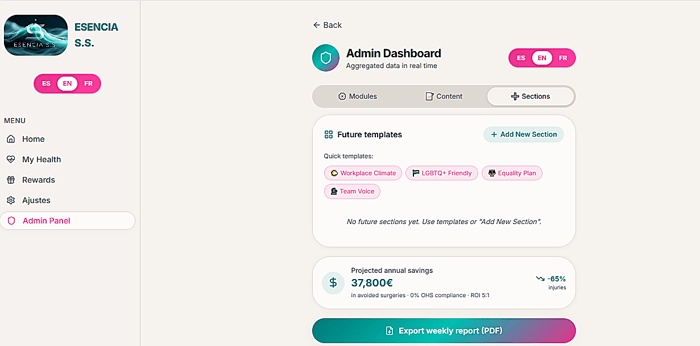
. Aggregated risk dashboards for the business , anonymized heat maps that help detect operational overload before it turns into costly medical leave.
Why this matters to the business, not just the person.
-Insurance premiums: Lower incident rates directly reduce corporate risk and policy costs.
-Replacement costs: Fewer unplanned absences reduce reliance on temp staff and emergency overtime.
-Talent retention: Teams with less physical strain show lower turnover and better morale.
Projections based on sector-wide models for a mid-size operation estimate up to a 40% reduction in ergonomic-injury sick leave. I want to be precise about that: these are informed projections, not a measured multi-site outcome yet , I'd rather say that plainly than oversell it.
I am not a traditional developer
I spent most of my professional life in hospitality, not software ,25 years in hotel operations, most recently managing housekeeping teams in a five-star hotel. I studied computing years ago, but my career took a different path.
Then AI changed something for me. I realized that, for the first time, people with deep domain knowledge could participate directly in building digital products. So I started learning AI, product development, Lovable, Supabase, automation, UX, prompting, architecture, and a lot of things I still don't fully understand.
I'm rebuilding my professional path while building this product. Sometimes that's exciting, sometimes frustrating. But I believe domain expertise combined with new technology creates something interesting because knowing how to code is valuable, but knowing which problem is worth solving is valuable too.
But this is where I want to be completely honest: I don't believe the current version is necessarily the final answer. Maybe some sections need to change. Maybe the engagement model is wrong. Maybe people won't use it exactly the way I imagine.
What happens if people don't engage?
You can build the most beautiful app in the world AI, dashboards, gamification, great UX. But if the people who need it don't use it, none of that matters.
How do you create a prevention tool that someone actually wants to use during a demanding shift not because management forces them, not because it's another corporate program, but because it genuinely helps? Maybe the answer is micro-interactions. Maybe rewards. Maybe better timing. Maybe a completely different interface. Maybe the answer isn't an app alone.
I honestly don't know yet. This is exactly where collaboration becomes valuable.
Who I'm looking for
I'm not looking for people to tell me the project looks good -I already know there are things that need improvement. I'd value people who tell me:
"This part doesn't make sense." "Your users probably won't use this." "You're solving the wrong problem." "Here's how I'd redesign the business model."
I'd love to connect with:
📌Technical co-founders / full-stack developers to strengthen architecture, scalability, offline support and data flows.
📌B2B SaaS sales & growth specialists with experience selling risk-reduction or wellbeing solutions to mid-size and large companies.
📌Product / UX-UI designers focused on habit design, micro-interactions and frictionless flows.
📌Occupational health / ergonomics / physiotherapy experts to validate and enrich the AI recovery engine.
I don't know yet what shape a collaboration would take, and I'd rather leave that conversation open than force it into a box too soon.
THE BIGGER PICTURE.
Esencia S.S. started in hotels because that's the world I know. But the underlying problem isn't limited to hospitality physical load, repetitive strain, stress, late intervention exist across many industries. Hospitality may simply be where I can test the idea first.
Before thinking too far ahead, I want to get the fundamentals right: does it solve a real problem? Will people actually use it? Does it create measurable value? Who pays for it? How should it be commercialized?
Three questions for this community.
1-Adoption & habit , how would you structure the first-use flow so a 30-second daily check-in doesn't feel like corporate surveillance?
2-Positioning ,would you sell this primarily as a risk-mitigation / insurance-savings SaaS (to Finance/Ops), or as a wellbeing & retention platform (to HR)?
3-Product looking at the current prototype, what's the biggest operational or UX bottleneck you'd flag?
I'm genuinely open to collaboration, feedback and hard questions. If this resonates, leave a comment or send me a message.
Esencia S.S. is here: https://well-rested-pro.lovable.app

The depth of firsthand experience behind this is unusual. You’ve clearly spent a lot of time thinking through the problem from multiple sides. Curious what feedback has surprised you most so far.