I’m building a Product Hunt alternative for indie makers — what would make you actually use it?
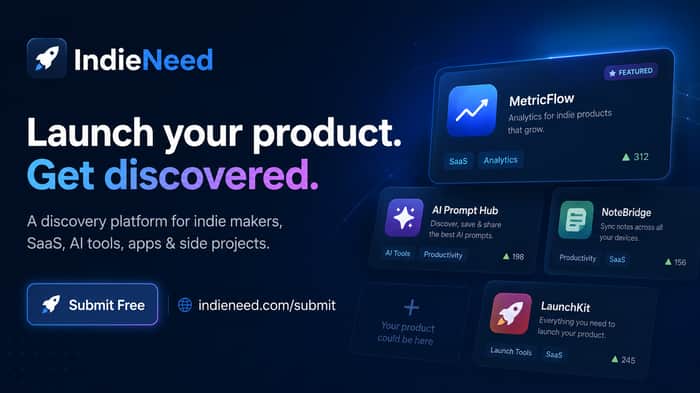
I’ve been building IndieNeed because I kept noticing the same problem:
You spend weeks or months building a product.
You finally launch it.
And then… almost nobody sees it.
Big launch platforms are extremely competitive, social media reach is unpredictable, and many startup directories feel like places where you submit a link and never get anything back.
So I started building IndieNeed — a product discovery and launch platform focused on indie makers, SaaS founders, AI tools, apps, and side projects.
The goal is simple:
• Make it easy for small products to get discovered
• Give founders a permanent product page + backlink
• Let the community upvote and discover new launches
• Give makers another source of early users and traffic
• Eventually provide useful launch analytics instead of just vanity numbers
I’m still improving the platform, and I’d rather build what founders actually want than guess.
So I have 2 questions for Indie Hackers:
- What would make you submit your product to a new launch platform?
Traffic? Backlinks? Feedback? Rankings? Newsletter exposure? Analytics? Something else?
- What do you hate about existing product launch platforms?
I’d love brutally useful feedback.
And if you have something you’re currently building, feel free to submit it — I’d love to personally check out the first Indie Hackers launches:
👉 https://indieneed.com/submit
Happy to answer any questions about what I’m building too.

Discovery that actually works. Product Hunt's front page feels like a lottery now. Helping the right people find relevant products without voting games seems like an actual gap.
One thing I've noticed with small businesses is that the CRM itself often isn't the biggest problem — it's having a simple process for tracking customer information, conversations, follow-ups, ticket status, priority, and escalations.
I've been working on a simple Helpdesk CRM workflow around these areas, and I'm finding that keeping the process lightweight is much more useful than adding lots of features.
Curious to hear how others here currently manage customer support and follow-ups — CRM, spreadsheets, helpdesk software, or a combination?
For me, the biggest reason to submit to a new launch platform would be qualified traffic, not just another badge or upvote count.
If I’m submitting a product, I’d want to know that the people discovering it are actually founders/builders who might use it — and ideally see where that traffic came from.
The biggest thing I dislike about existing launch platforms is that a lot of the launch feels like a one-day spike. You get votes, comments, maybe some traffic, and then the product disappears.
A platform that gives products long-term discoverability + useful analytics + recurring exposure would be much more interesting to me.
One thing I’d definitely prioritize: make it extremely easy to discover products by problem/use case, not just category. That could become a real differentiator.
Completely agree on problem/use-case discovery.
I’m planning to make that part of IndieNeed rather than relying only on broad categories.
So instead of just browsing “AI” or “Marketing,” people could discover products around problems like “build a waitlist,” “improve SEO,” or “collect customer feedback.”
That should also help IndieNeed send founders more relevant traffic instead of random clicks.
The part about discovering products by problem and use case is an excellent idea that's lacking from most product launch platforms
Agreed. This is moving high on the IndieNeed roadmap.
Categories are useful, but the actual question users have is usually “what can help me solve this problem?”
I want IndieNeed discovery to reflect that.
To answer your 2 questions directly:
If this platform focuses on permanent organic indexability plus lifecycle feature updates, it will immediately differentiate itself from traditional one-and-done upvote sites.
To answer your 2 questions directly:
What makers HATE about existing launch platforms:
• Upvote Cartels & Pay-to-Win Dynamics: Traditional launch platforms have become gaming-heavy, where launch agency packages and private upvote groups dictate the leaderboard rather than organic product merit.
• The 24-Hour Vanity Cliff: You get a single 24-hour spike of low-intent "congrats!" comments, followed by absolute zero traffic on Day 2. Most directories feel like link graveyards after launch day.
• Low-Intent / Spammy Traffic: Half the comments are agency bots trying to sell dev services or SEO packages, rather than actual users giving real feedback.
What would make makers ACTUALLY submit and stay engaged:
• Dofollow SEO Backlinks & Structured Indexing: Giving bootstrapped products a permanent, indexable page with clean SoftwareApplication microdata that actually helps domain authority over time.
• Targeted Niche Category Matching: Matching launches with category-specific subscribers (e.g. Developer Tools vs Marketing AI) so founders reach actual potential buyers, not just other makers.
• Feature Milestone Bumps: Allowing founders to submit "Version 2.0" or "Major Feature Release" updates every 60-90 days so a product page remains living and discovers new visitors over time.
• Guaranteed Newsletter Syndication: Curating weekly highlights based on feedback quality rather than raw vote manipulation.
If IndieNeed focuses on permanent organic indexability plus lifecycle feature updates, it will immediately differentiate itself from traditional one-and-done upvote sites.
One thing I would want before traffic is proof that the listing stays useful after submission.
Permanent product pages are a good idea, but they can quietly become stale: old screenshots, dead links, outdated pricing, broad claims that no longer match the product. A small “last verified” or “last updated by founder” signal would make me trust a launch directory more than another ranked feed.
For founders, that also creates a reason to come back after launch day. Not just “submit once and disappear,” but “keep the product record current and get another chance at discovery.”
Would you optimize IndieNeed more around launch-day ranking, or around maintained product records over time?
If you are building something valuable, you will sell them at high prices. And you must need to spend money on promotion or marketing because you’re object has value and it deserves that marketing, it deserves to spend money on it, because it will be giving you money multiplied many times.
I believe the most challenging aspect of launch platforms occurs after the launch day.
Attracting people’s attention is one thing, but getting their interest is a much more useful observation. With only a couple of clicks, some accurate feedback or even just knowing where people come from can tell you much more than an upvote count.
I’ve learned that valuable launch feedback often comes from the small signals left by people rather than the big numbers.
It makes a lot of sense to me to give founders something interesting to look at after the first launch.
The traffic problem isn't discovery, it's that directories give founders nothing to do after listing day. Pair the free listing with a small tool that stays useful after launch, like a simple visitor or backlink tracker tied to the product page, and people come back to check it instead of forgetting it exists. That's the same lesson we built SocialPost around: give people a reason to open the product daily, not just once.
The painful part of launching isn't the launch. It's that every destination wants the same product described in a different shape: a 25-word blurb here, 100 words there, a 60-character tagline, a 220-character "why does this exist" box, five screenshots at a specific aspect ratio, and a category taxonomy that never matches the last site's. I keep one master description document and hand-cut it into each submission, and it's still hours per destination.
If your platform let me store one structured product record (positioning, boilerplates at three lengths, assets, an honest feature list) and then emitted the right shape for each destination, I'd use it for that alone, before any audience showed up. Distribution is the promise every launch platform makes and mostly can't keep. The formatting tax is real, universal, and nobody has solved it.
Second thing: a launch is a day, a product is a year. Something that let me post a meaningful update three months later, to the same people who saw the launch, would matter more to me than the spike ever did.
This solves such a massive pain point. Launches feel like throwing a party where nobody got the invite, and directories usually just feel like shout-into-the-void backlink graveyards.
Love the focus on actual useful analytics over just vanity upvotes! What's the main way you're planning to keep the community active so products actually get ongoing eyes on them after launch day?
The backlink + permanent page angle is smart — that's a real reason to submit even if traffic is low initially.
Honest answer to your question: what would make me actually use it is knowing my listing gets verified — that it went live, that the link works, that it wasn't silently rejected. Most platforms feel like a black hole after you submit.
What does the submission review process look like on your end right now?
Feedback, not traffic. Getting a spike of visitors who bounce in ten seconds does nothing for a solo founder, but a handful of people who actually use the product and tell you what's broken? That's gold.
The permanent product page idea is what caught my eye — most platforms give you a 24-hour window and then you're buried. If IndieNeed can make a listing a lasting asset, that's a real reason to submit.
What would you do to encourage real conversations between makers and early users rather than just upvotes?
For me, feedback and relevant traffic would matter much more than the ranking itself.
One thing I've learned from launching on a few different platforms is that getting views isn't necessarily that useful if you don't learn anything from them. A smaller number of people who actually try the product, leave feedback, or start a conversation can be much more valuable.
I also like the idea of a permanent product page. If it keeps being discoverable after launch day rather than disappearing once the ranking is over, that would give me a reason to submit.
Feedback, not traffic. Platforms that just collect a link and return a view count die because the maker gets nothing back. What would keep me on IndieNeed: a launch page that shows who actually looked and what they did — "3 visited, 1 asked a question" beats 500 anonymous views. Discovery brings strangers; the reply is what makes them stay.
the audience-mismatch point from gbresciano is the one I'd push on further, it's not just "product builders aren't my customer," it's that a directory of any kind, however well-built, is inherently an audience of people looking for tools, not an audience of people with the actual problem your product solves. that's fine for dev tools and SaaS-for-founders, but for a consumer app the qualified traffic you actually want may not be reachable through any launch directory at all, however permanent or well-attributed
not a criticism of what you're building, more a genuine question: is IndieNeed positioning itself for founder-facing products specifically, or trying to also work for consumer-facing ones? because the "who is this for" tagging idea you mentioned only solves the mismatch if the underlying visitor pool actually contains those people, not just other builders wearing a different tag
Thoughtful ask — from our side building devtools: the biggest unlock isn't another 24h spike, it's durable discovery. Three things would make us submit to a new platform: 1) problem/use-case search vs generic tags, 2) shelf life beyond launch day ("recently updated" or "hidden gems" style feeds where small products get second exposure), 3) structured lightweight feedback after trial (what blocked you / what was unclear) instead of just upvotes. What kills motivation on existing platforms is ranking that rewards network size over engagement and pages that die after day one. If you nail fair discovery + feedback loop + showing view → click → trial funnel (even anonymized), that's genuinely useful for iteration — not just vanity. Starting wedge as indie SaaS / bootstrapped makes sense, you'd get higher signal density vs broad consumer. Curious how you're thinking about weighting comment quality / return visits vs pure vote count.
Honestly, I'm super new to the distribution side of things, so I'm happy to try anything. Ironically, one of the things that makes me optimistic about my own project is that it does distribution in a new way, which is supposedly in great demand. But that doesn't help me get those first users! So take what I'm saying with a grain of salt.
One thing will probably come up though - I think you've thought about this but here's how I'd put it - is that most of the internet is dominated by the matthew principle: more popular submissions get to the front of the line, becoming more popular, etc. If you can break the competition up - sorting for best quirky fit in this user's case rather than most generally interesting - that would do a lot for the 80% of projects that are still only getting 20% of the eyeballs.
I'm actually in the exact position you're describing right now — I just launched an AI learning app and I'm looking for ways to get those first users without relying entirely on an existing audience.
For me, the biggest differentiator wouldn't just be another product directory or backlink. I'd want the platform to actually help me get qualified users who might genuinely use the product.
The features that would make me submit:
One thing I'd be careful about is becoming another directory where founders submit their product once and then never have a reason to return.
If IndieNeed can make the post-launch period valuable too, that's where I think it could actually differentiate itself from Product Hunt.
For me, the real key would be some kind of feature that relaunches registered apps every so often. I’ve seen a lot of sites, and very, very few have this feature it would be great.
In addition to adding backlinks for it to work, it absolutely must have backlinks since every competing website offers this service, which is one of the best ways to attract visitors.
That’s all. I hope these ideas are helpful to you 🤙
Honest answers, and I've done the grind. I submitted two of my own sites to 36 free directories last month. Zero referral visits between them. So the bar for "another directory" is genuinely low, which is good news for you.
What would make me submit: get IndieNeed's product pages cited by AI engines, then say that on your landing page. That's the only offer I'd act on.
I run a site tracking AI search citations, so I test this on my own content constantly. Two things I found the hard way. First, ranking doesn't get you cited. I have posts sitting at #1 organic on Google for their exact question and ChatGPT still answers from OpenAI's help docs instead. Went 0 for 6 across six topics, then reran the whole thing in casual real-person phrasing in case my prompts were too SEO-shaped, and it changed nothing.
Second, the one piece of mine that did get cited by ChatGPT was the one with a specific number in it, a stat from a study on how often ChatGPT triggers a live search. It got pulled alongside Semrush. My well-written explainers with no hard number in them got nothing.
That's the design brief for your product pages. One concrete, quotable, specific line per product, not "powerful platform for modern teams". The engines lift a sentence, they don't summarize a vibe. If IndieNeed pages become the thing that gets pulled when someone asks ChatGPT for a tool in a category, that's a real product and nobody else is selling it.
What I hate about existing ones: the page is dead the day after launch. Permanent matters, you're right, but permanent is worthless if nothing ever crawls it again. The upvote mechanic mostly measures Twitter follower count, so the ranking tells me nothing. And analytics showing views without the query or referrer is vanity numbers with extra steps.
One feature I'd actually watch: tell me when an AI crawler hit my product page and which one. It's in your server logs already and nobody surfaces it.
This is extremely useful. I agree that another indexed directory page alone isn’t enough.
For IndieNeed, I’m now thinking much more about making product pages specific and useful: what the product does, who it’s for, the exact problem it solves, use cases, pricing and concrete founder-provided facts instead of generic marketing copy.
AI crawler activity is also an interesting idea. I wouldn’t want to claim that a crawler visit means an AI engine recommended the product, but showing verified crawler activity inside IndieNeed analytics could be genuinely useful.
The goal is definitely long-term discoverability, not another launch-day page that gets forgotten.
Love this direction ,. a lot of indie makers want discovery without the “launch-day theater.”
If I’m honest, I’d switch only if 3 things are clearly better than PH:
A few ideass that could make this stand out:
Biggest risk: becoming another list of links. Biggest opportunity: become the best place to get actionable feedback + long-tail discovery.
Curious - what’s your first wedge? (e.g. indie iOS tools, bootstrapped SaaS, AI utilities)
This is very close to the direction IndieNeed is moving toward.
The three things I’m prioritizing are long-term discovery, fairer visibility for smaller founders, and useful signals beyond raw upvotes.
I’m also planning feeds like Hidden Gems, Feedback Wanted and Recently Updated so products can get another chance after launch day.
The first wedge is indie SaaS, AI tools and bootstrapped products, since that’s where most of the early IndieNeed community is coming from.
Your third condition is the hard one, and I don't think it's a feature you can build. Shelf life and fair ranking are mechanics. Buyer intent isn't. Almost everyone browsing a launch directory is another founder, and founders are there to be seen, not to buy. That's the actual reason intent feels thin on PH, and no ranking change fixes it. The only visitors carrying real intent arrive from outside, off a search or an AI answer, with a problem already in mind. So intent is downstream of whether the pages get found at all, which is why I keep dragging this thread back to citation rather than feed design.
Category leaderboards I'd back hard, but for a different reason than fairness to small products. Narrow categories are exactly where AI engines have no confident default answer. Ask for the best AI writing tool and you get the same five names off a G2 roundup every time. Go three levels narrower and the models visibly flail. A leaderboard page for a narrow category can realistically become the page that gets pulled. A broad one never will.
The post-upvote feedback prompt is a good feature with the wrong justification. Feedback from someone who spent 8 seconds on the page won't be actionable. What it does produce is visitor-written text sitting on the product page, in the words real people use, changing over time. That's crawl freshness plus query-language matching, and both are worth more than the feedback itself.
On your "another list of links" risk, the test I'd use: is this page the best page about this product anywhere other than the product's own site? If it just restates the tagline, no feed structure saves it.
I launched KinetixSEO.com on indieneed. Easy to do and the site is not cluttered. Not sure what the amount of visitor are. I havent seen any traffic from indieneed so far. Time will tell, starting is not easy! Good luck Rahul.
Thanks for launching KinetixSEO on IndieNeed — and this is exactly the kind of feedback I need.
If IndieNeed sends no meaningful traffic, then a clean listing alone isn’t enough.
I’m working toward showing founders actual views, outbound clicks and traffic sources, while also improving how products keep getting discovered after launch day.
Still early, but qualified traffic and long-term discovery are becoming the main priorities.
Interesting perspective on product. The point about product is particularly valuable. How long did it take to see results?
IndieNeed is still early, so I don’t want to pretend there are huge results yet.
Right now I’m using founder feedback like this to improve the core loop: better discovery, useful analytics, feedback and longer product visibility.
The goal is to make the value measurable rather than just saying a product was “featured.”
A permanent page and a durable backlink are necessary, but they are not why I would switch. What I actually need from a discovery platform is signal after the spike: who came back, which problem page converted, and whether the traffic matched the buyer I am trying to reach. Launch day upvotes are easy to game and hard to learn from. If IndieNeed can show me that a visitor returned a week later or bounced for a specific reason, that is more useful than another badge on my landing page.
Exactly. A raw view count isn’t enough.
For IndieNeed I want the useful funnel to be closer to:
discovery → product view → website click → feedback → return visit
Traffic source and internal discovery source are also important so founders can understand what actually brought interested visitors.
The longer-term goal is to help founders learn from discovery, not just count it.
Huge congrats on building this! I'm curious about your process: when it comes to your content strategy, did you lean more into long-form SEO to drive traffic, or was it mostly community-driven engagement that helped you convert those early users? Also, did any specific AI-powered tools help you scale your workflow as things started picking up speed? Keep building!
IndieNeed is still early, and most of the useful traction so far has come from talking directly with founders and participating in communities rather than pretending we’ve already solved SEO or distribution.
That’s actually why I’m collecting feedback here before building too much.
The focus now is making IndieNeed useful enough that founders have a reason to return after submitting, then building distribution around that.
This is an important point.
IndieNeed shouldn’t send a founder 100 random builders if the actual customer is a recruiter, marketer, designer or ecommerce owner.
That’s why I’m planning to add “who is this for?” and “what problem does it solve?” to products and use those signals for discovery.
The goal is qualified discovery, not just more traffic.
Honest answer from someone whose acquisition is 100% organic search and has never done a launch: a one-day vote spike is worth almost nothing to me. My users arrive one at a time through search, over months.
What would actually make me submit is a permanent, indexable product page, a durable (ideally followed) backlink, and honest categorization so I can show up for the problem I actually solve rather than compete in a launch-day popularity contest.
PH’s value is the spike. The durable-page part is the gap you could actually own.
This is exactly one of the gaps I want IndieNeed to focus on.
Permanent, indexable product pages and durable backlinks already make more sense to me than designing everything around one launch-day spike.
I’m also working toward better problem/use-case categorization and recurring discovery so those pages continue having a reason to be crawled and visited after launch.
The main thing that would make me use something like this is if it felt less about launch-day spikes and more about sustained discovery for smaller products. Curious how you’re thinking about that part.
That’s becoming one of the core ideas behind IndieNeed.
I don’t want a product to disappear after 24 hours.
I’m planning continuous discovery through things like Recently Updated, Hidden Gems and longer-term discovery feeds, so useful products can resurface based on real activity and meaningful updates rather than only launch-day votes.
The goal is for an IndieNeed launch to have a shelf life measured in months, not hours.
That direction makes a lot of sense.
Most launch platforms peak in the first day and then the product basically disappears, even if it’s still being improved. Having ways for useful products to resurface based on real updates and activity feels like a much healthier model for indie makers.
Curious how you’re thinking about balancing “new” vs “still actively improving” in those longer-term feeds.
For me, the biggest reason to use a new launch platform wouldn't be another product page or backlink — it would be the feedback loop after submitting.
A lot of launch platforms are great at creating a spike of visibility, but once the launch is over, there's not much reason to come back.
I'd be more interested in something that helps answer: who actually discovered my product, what caught their attention, what they didn't understand, and what changed after the launch?
Even lightweight structured feedback around those questions would be more valuable to me than another upvote count.
The interesting challenge might be making the platform useful between launches, not just on launch day.
This is probably the strongest point I've heard so far. The “what happens after the launch?” problem keeps coming up.
I'm thinking about giving founders a dashboard showing discovery → website clicks → feedback, and adding structured questions like “what caught your attention?” and “what was unclear?”
I also really like the idea that IndieNeed should remain useful between launches. Would recurring product updates + resurfacing be enough to make you come back, or would you want something more?
I think recurring updates + resurfacing is a good start, but I'd be careful not to make it another feed founders feel obligated to maintain.
I'd personally come back if the platform showed me something actionable each time — new feedback, meaningful discovery changes, or a reason someone engaged with my product.
Basically: less “post again”, more “here’s what changed since your last launch.”
Great idea. For me, the most valuable things in a launch platform would be real discovery, quality feedback, backlinks, and meaningful engagement rather than just an upvote count.
One thing I dislike about many launch platforms is that visibility can depend heavily on having an existing audience or paying for promotion. A fair system that gives smaller makers a genuine chance to be discovered would be much more useful.
I’d also value analytics showing where visitors come from and whether they actually engage with or try the product. That would make the platform much more useful beyond launch day.
Really useful feedback — especially the point about smaller makers competing with founders who already have an audience.
I'm considering making votes only one signal and having separate discovery sections like New, Trending, Hidden Gems and Recently Updated so every launch gets some exposure.
Analytics around views → clicks → actual engagement is also becoming one of the highest-priority features from the feedback here.
From the perspective of someone building a pre-launch and waitlist tool, what would make me submit is attribution and follow-through—not another launch-day spike. I’d want to know which visitors clicked through, where they came from, and what happened after the click.
My biggest frustration with existing platforms is that the launch effectively ends after 24 hours. A permanent page plus recurring resurfacing based on meaningful product updates would feel genuinely different. How are you thinking about preventing founders with larger existing audiences from dominating the rankings?
Exactly. Attribution + what happens after the click seems much more valuable than another vanity metric.
I'm thinking about tracking product views, outbound clicks, traffic sources and feedback, then allowing meaningful product updates to resurface a launch instead of everything ending after 24 hours.
For rankings, I don't want “founder with biggest X audience automatically wins.” I'm considering guaranteed discovery for new products + multiple feeds like Fresh / Trending / Hidden Gems rather than one winner-takes-all leaderboard.
Would that feel fairer to you?
Yes — guaranteed initial exposure plus multiple feeds feels much fairer than a winner-takes-all leaderboard.
I especially like the idea of Hidden Gems being based on performance relative to impressions, rather than simply low vote counts. That gives smaller products a genuine chance to surface without rewarding founders who already have a large audience.
Transparency matters too. Founders should have some idea why their product appears in a particular feed, instead of feeling like they’re dealing with another black box.
I’d be happy to test this flow with my app when submissions are ready.
The thing that would make me submit isn't traffic or backlinks — it's early, honest feedback from people who actually try the product. Launch platforms optimize for vanity numbers because those are easy to show. What makers actually need is the first few strangers who click through, use it, and tell you what's broken. If you can make that feedback loop visible and fast, that's a differentiator no directory has. The second thing I hate about existing platforms: they're a one-day event, not a conversation. Your permanent product page idea is the right instinct — build for the week after launch, not the launch day.
This is really helpful. “Build for the week after launch, not launch day” is probably going on my product roadmap 😄
I'm now thinking about adding a structured feedback flow where visitors can tell founders what they understood, what confused them and whether they'd actually try the product.
Then the permanent product page becomes more like an ongoing product journey rather than a static directory listing.
Hey, I like your idea.
But as a user, being very honest. I think your idea isn't the issue; it's your website design. Suppose you don't make your own website design. It becomes so hard to stand out.
If I put my hand on the logo, there is no way I can tell which website this is. Please put in some more effort and redesign your whole website to give it a unique look.
Fair criticism — and I appreciate you being direct about it.
I've been focusing heavily on functionality and discovery, but you're right that IndieNeed also needs a visual identity people can recognize immediately.
I'm planning to work on the design system, product cards and overall brand language rather than just making it look like another launch directory.
If there was one part you'd redesign first — homepage, product cards, navigation or product page — which would you choose?
To be honest, take your time and build all 4 pages at first, then update the full theme. Because changing just the homepage or product page doesn't stand out. And please try to avoid amke complete with AI, because it usually gives a generic design.
Design your structure your way.