Is culture killing community?
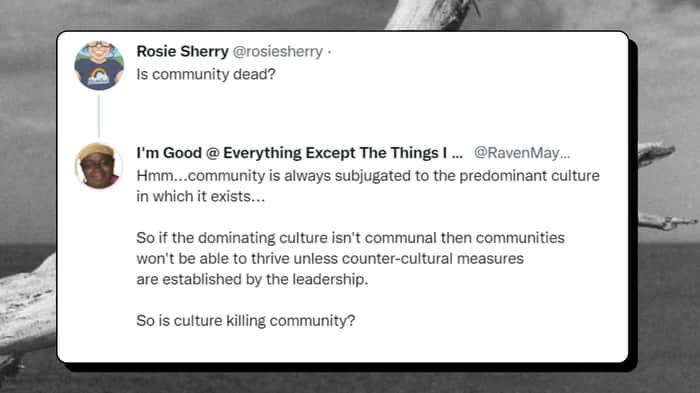
...So @rosiesherry tweeted "Is community dead?" and I responded with a more precise question "Is culture killing community?"
Now a short while ago Rosie posted on IH "Are forum platforms dead?" and so these 2 questions she asked are a subset of the larger question of "Is culture killing community?" which is yet to be addressed...hence this essay.
...So first let me answer the 2 supplementary questions
- Is community dead?...well it depends on how you define "community" and what you refer to by "dead"
So if "community" simply means a group of people with a common interest and/or goal and "dead" just refers to engagement in terms of posts, reactions & replies...
Then generally that version of community is alive in the tech/indie space.
- Are forum platforms dead?...again if you just mean "forum" as a viable platform medium and "dead" in terms of people asking questions & sharing information...
...then generally that version of forums is alive in the tech/indie space.
Now another big question is...why ask if forums & community is dead?
...Is this a "survey question" being asked to affirm or confirm public opinion to possibly gain consensus?
Is it a "debate question" being asked to refute or negate an opposing argument?
Or is it a "problem question" being asked to imply the existence of a much larger issue?
From my observation...
"Is community dead?" is a survey question
"Are forum platforms dead?" is a debate question
BUT the question I'm asking..."Is culture killing community?"
...is a problem question.
Why Indie Tech Culture is Problematic
So I wrote an IH essay "The Product Multiple: Why Indie Hackers don't Innovate Big" in response to an essay @channingallen wrote about innovation...and I ended with the conclusion that:
In the Indie Hacker culture not only are the micro innovations themselves problematic but also the processes, methods, tactics, techniques & strategies that are utilized to build, market & sell these innovations.
And why? Because of a cultural addictive-obsession to 3 major elements.
- Accelerated Performance
- Numerical Achievement
- Incremental Progression
...Plus macro innovations don't typically provide the kind of adrenaline rush & dopamine release that micro innovation does...hence...it's unattractiveness to most Indie Hackers.
So to answer my own initial questions:
- Is the Indie Hacker space is oversaturated with micro innovations?
Yes...it is!
- Should Indie Hackers pursue macro innovations?
Yes...they should!
But are Indie Hackers willing to give up the reward of immediate forms of gratification in pursuit of a much greater cause...despite little external incentivization?...No I believe this is a low probability...the cultural addictive-obsessions are too prevalent to suggest otherwise...
...so with all that being mentioned...is it any wonder why @MrJustinF said "A lot of posts on Indie Hackers are just guru sales pitches"
Once you have an addictively-obsessed culture you will always have bottom feeders trying to devour it.
So not only is the culture of micro innovation cannibalizing the entrepreneurial spirit [as mentioned in my previous essay]
But it also cultivates behaviors which are cannibalistic as well.
So the only way for the community to thrive is for the leadership to establish counter-cultural methods.
BUT this requires a macro innovative approach...and as I mentioned before there are little external incentives to do so.
Micro innovations that aim to tweak the platform won't work long term.
Bringing back previous features to get the feeling of the "old" IH are insufficient measures...because this problem has grown way beyond simple fixes.
This has become a foundational problem in 3 major aspects
- Economy
- Environment
- Ecosystem
The Indie Hacker Economy
The term "Indie Hackers" no longer simply identifies a sub-culture within the startup space but has also become a term that identifies a micro economy.
As defined by Investopedia
Microeconomics is the social science that studies the implications of incentives and decisions, specifically about how those affect the utilization and distribution of resources.
Microeconomics shows how and why different goods have different values, how individuals and businesses conduct and benefit from efficient production and exchange, and how individuals best coordinate and cooperate with one another.
KEY TAKEAWAYS
- Microeconomics studies the decisions of individuals and firms to allocate resources of production, exchange, and consumption.
- Microeconomics deals with prices and production in single markets and the interaction between different markets but leaves the study of economy-wide aggregates to macroeconomics.
- Microeconomists formulate various types of models based on logic and observed human behavior and test the models against real-world observations.
Simply put...the Indie Hacker culture needs to be studied from a microeconomic perspective.
The Indie Hacker Environment
Now once the economy is assessed we can then evaluate the environment that the economy has created.
The IH environment is dependent on the economy...so quite frankly...the IH community is somewhat a myth...
- "community" only exists as a social context in which the economy is able to persist.
In other words...Indie Hacker communities...to a great extent are simply disguised marketplaces.
So if the IH platform decided to adopt a marketplace model a majority of members would be overjoyed...because that's what IH is [to a large extent] in reality...
But what about those who actually desire community?
At this point the best option is to create small groups [50 members max] to form mini clusters like Not a Shovel Business
...because community at scale is simply unrealistic. BUT this only solves the aspect of size & space...the discussion aspect is still extremely problematic.
- The Not a Shovel Business group started in April 22 [as per date of the manifesto]... and there are 52 members but only 4 posts...2 in April & 2 in May...
So grouping people who want to opt-out of the marketplace culture doesn't create community.
But why?
Well...the thing is...there is nothing that is fueling behavior...remember that it's the economy that creates the environment...so if there is no economic incentive then there is no behavioral drive.
So...we're back at square one.
Truth is...community for Indie Hackers has to be systematically engineered...specified models have to be designed and developed for the platform.
The Indie Hacker Ecosystem
The ecosystem is the combination of the economy & environment and it functions like this:
The economy determines behavior
Behavior determines cognition
Cognition determines environmentThen the environment determines the economy
This is a continuous cycle...and when one element starts to spiral out of control...every aspect suffers the consequences.
The Responsibility of Leadership in Cultivating Community
Now I started this essay with my initial Tweet response
Community is always subjugated to the predominant culture in which it exists...
If the dominating culture isn't communal then communities
won't be able to thrive unless counter-cultural measures are established by the leadership...
Leaders are responsible for:
- Directing the economy
- Guiding the environment
- Instructing the ecosystem
So ultimately...unless @channingallen & @csallen put measures in place...nothing will change....culture will continue to kill community.
...but as I said before this requires a macro innovative approach...
But still...what I've discussed so far is the principle...as for the practice...I'm actually in a client partnership with Anthony Castrio to build the Indie Worldwide slack as a Community Architect...[but keep in mind this depends on the founder's leadership]
