Layers of mobile application architecture
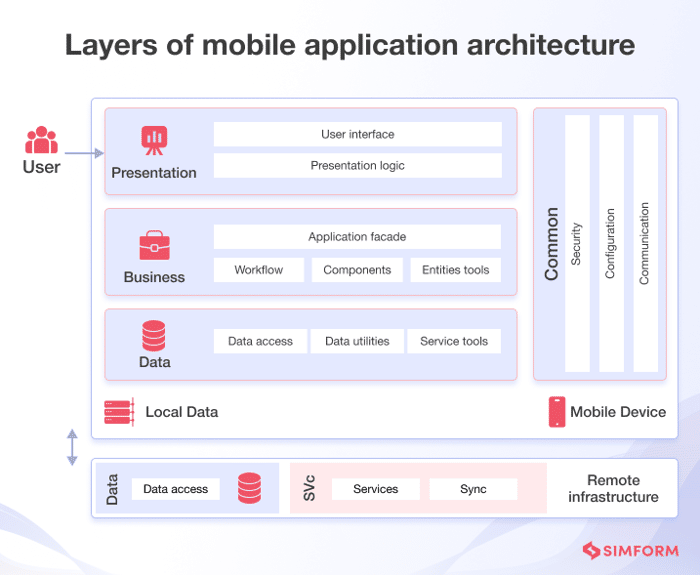
Mobile app architecture is the blueprint for building your app. The rules, processes, and structure determine how components like the front-end UI, backend database, APIs, etc, interact to process inputs and give outputs.
Layers of mobile application architecture:
-
Presentation layer
The presentation layer, or front end, is the user interface (UI) you see when opening an app. It includes the screens, navigation, controls, and visual elements. For example, in a messaging app like WhatsApp, the presentation layer comprises chat screens, contact lists, settings menus, etc. Its primary function is to enable user interactions by taking input from users and displaying output from the lower layers. -
Business layer
The business layer contains the core application logic that handles tasks like computations, validations, analytics, notifications, background jobs, etc.
In a messaging app, this layer handles functions like sending and receiving messages, encrypting data, detecting spam, managing notifications, etc. It takes input from the presentation and data layers, processes it, and prepares the responses displayed in the UI.
- Data layer
The data layer handles connections to databases and storage systems, allowing the app to save and retrieve data. For example, in WhatsApp, message data is stored in various databases.
The data layer abstracts the physical storage, so other layers don’t need to worry about the specifics of databases. It handles queries, connections, caching, concurrency, and other data access mechanics. The business layer interacts with the data layer by calling methods it exposes.
