Looking for founders killing Slack noise with closed decision rules.
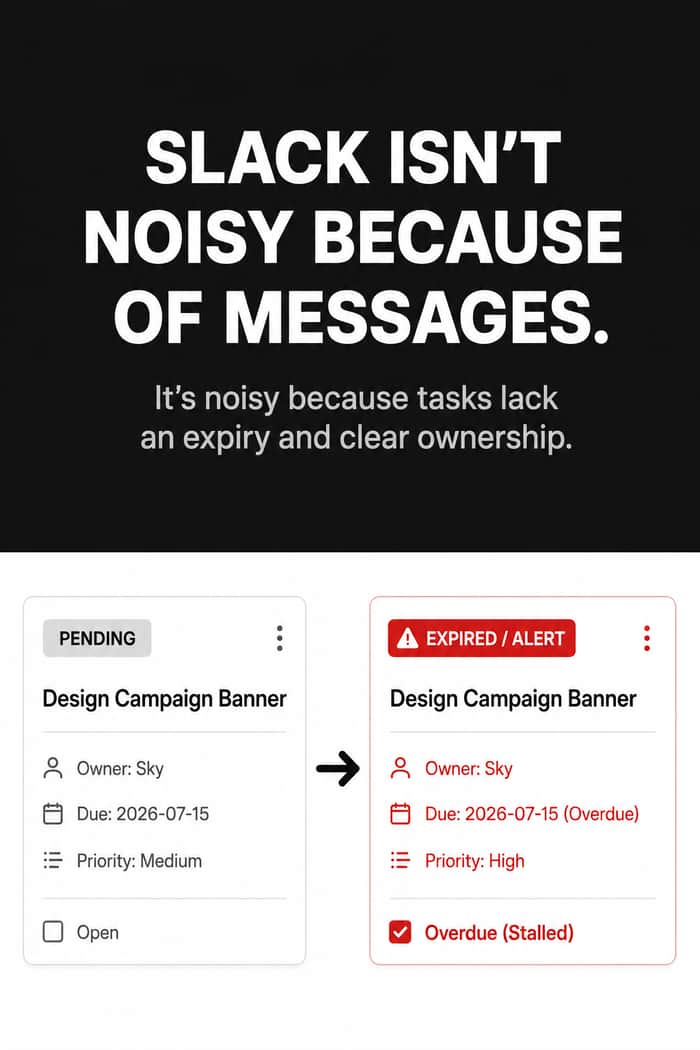
Stop fixing your async communication stack.
Your Slack channels aren't noisy because there are too many messages. They're noisy because tasks in them have no expiry and no clear ownership threshold — so every unresolved task generates repeated pings, repeated "just checking in," repeated re-asks. That's not a communication volume problem. That's execution drag.
A task with no expiry doesn't fail loudly. It just sits in "Pending" indefinitely, quietly accumulating check-ins, until someone finally notices it's been three weeks.
A task with an expiry condition does something different: it flips to "Expired / Alert" on its own, and forces a decision — reassign it, kill it, or close it. No more manual policing.
Don't add another tool to your stack. Add an expiry condition to your tasks.

This is a great distinction. Many “communication problems” are really ownership and follow-through problems hiding inside Slack. A clear owner, deadline, and automatic expiry would eliminate a surprising number of follow-up messages.
Couldn't have said it better. Automatic expiry rules do the heavy lifting so people stop pinging each other into oblivion. Drop me a note at koni910901@gmail.com if you ever want to compare architectural notes on this.
A task with no expiry does not fail loudly, it just sits there, that line applies to almost everything I have seen go wrong across the businesses I run. The expensive stuff is never the thing that screams, it is the thing that sits in Pending for three weeks because nobody owns forcing the decision. That gap between silent and expired is basically the whole product I am building.
Yeah, that's the exact mechanism. Silent isn't the same as stalled — a task sitting in Pending isn't failing, it's just invisible. No alert fires, no owner gets flagged, so it looks fine on every dashboard while it's actually bleeding time. The cost isn't the delay itself, it's that nobody ever gets forced to make the call.
That gap between silent and expired is where most execution systems break. Silent has no trigger. Expired has a trigger. Everything in everything in between is just vibes and hope someone notices. If your product enforces the expiry side — actually forces a decision point instead of just flagging age — that's the part most tools skip because it requires taking a stance on ownership, not just visibility.
I'm curious how you're handling the enforcement side specifically — hard expiry with auto-escalation, or something softer that still needs a human to pull the trigger? Worth comparing how our two approaches close that gap.
It leans softer on purpose. FounderFlow surfaces the expired item at the top of the daily view and forces a triage choice (handle it, push it, or kill it) rather than auto escalating to someone else. I tried the hard auto escalation route early on and it just created a new noisy channel, people got pinged for things they were not actually the right owner for, and trust in the alerts dropped fast. The version that stuck was making the expiry visible and undeniable but leaving the actual call to a person, since across my three businesses the right owner for a stalled task is not always obvious from the data alone. Curious if you found auto escalation worked better once you had more structured ownership data to route on.
Auto-escalation without clean ownership data is exactly that — alert spam with no trust behind it. Once people learn the pings are noise, they tune them out, and now your actual urgent cases get ignored too. Visual triage with a human decision point is the right call when ownership data is messy, because forcing a decision on bad routing just moves the friction, it doesn't remove it.
To your question directly: yes, hard auto-escalation only holds up once ownership is pre-mapped — a defined decision matrix where each task type has a known owner and a known fallback, not inferred from Slack activity or last-touched timestamps. Without that structure, escalation is just guesswork at scale. With it, escalation is enforcement.
Question back: is your ownership data coming from an org-chart-style mapping, or is it inferred based on task activity? That distinction changes whether structured auto-escalation is even reachable for your users without a manual setup step first.
It comes from an org-chart style mapping, not inference. Each recurring task type in FounderFlow gets tagged to a role rather than a person, software issues go to whoever owns product that week, care home staffing goes to the shift lead, and so on. That mapping is done once by hand and updated rarely, which is the manual setup step you are pointing at. Inferring ownership from activity or last-touched timestamps sounds appealing because it needs no setup, but in a business with three very different operations under one roof, the person who last touched something is often just whoever happened to be free, not the actual owner. Paying the setup cost once was worth it to avoid escalating to the wrong person forever.
That quote is the whole problem in one sentence. "Last touched it" is proximity data, not ownership data — it tells you who was around, not who's accountable. Activity-based routing looks automated but it's actually just randomness wearing a badge. Static role-mapping fixes that by decoupling ownership from whoever happened to be logged in.
And yeah, the manual setup cost isn't a tax, it's the actual product. You're paying once to buy certainty on every route after that instead of paying continuously in misrouted pings and re-triage. Most teams skip that upfront cost and then wonder why their automation feels untrustworthy.
Here's the next layer though: static role-mapping solves who owns it, but not what happens when the role itself stalls. If the shift lead is tagged as owner and the shift lead goes dark, the task is technically owned, but effectively unattended. Nobody reroutes it because on paper it's not unowned, it's just stalled. How are you handling that — does the role itself carry a secondary fallback, or does it simply fall back to the same manual escalation path as an unt校ged task?
Right now it falls back to the same manual escalation path, and I will be honest that it is the weakest part of the system. A stalled-but-owned task gets flagged as "no update in X time" and shown in the daily view same as anything else needing a decision, but it does not auto-reassign to a backup, mostly because defining a trustworthy secondary owner turned out to be harder than the primary mapping. Care home staffing has a natural backup (the next person on the shift schedule), but "whoever owns product this week" does not always have an obvious number two. My rough plan is to let each role optionally declare a fallback, and if none is set, silence just gets surfaced louder and faster rather than quietly waiting. You are clearly thinking about this at a level most people building internal tools do not get to, would be glad to keep going on this outside the comment thread if you want, happy to trade notes on X or over email.
Agreed on the number two problem. Defining a primary owner is a data lookup — defining a secondary is a judgment call, because you're pre-guessing who's competent and available for a failure state that hasn't happened yet. Most teams never actually assign it, they just assume someone will notice.
Surfacing silence louder and faster is the right mechanical direction. It doesn't solve the assignment problem, but it shrinks the blast radius while the assignment problem gets fixed properly, which is the correct order of operations.
Happy to continue over email. Drop me a line at koni910901@gmail.com and we can line up the specifics directly, faster than going back and forth here.
Appreciate the offer, thank you. Let me get back to you on email shortly, in the meantime the "assignment problem gets fixed properly" ordering you laid out is exactly the sequencing I ended up with too, secondary ownership is where most teams quietly give up.
Sounds good, I'll send you an email today so we can go deeper on this.
Hey FounderFlow,
Just circling back on this thread. You mentioned dropping a line at koni910901@gmail.com to check the Figma async blueprint and cold node mapping for handling handoff freezes.
Whenever you have a spare moment, drop a quick ping there and I'll send over the architectural specs. No rush, just keeping the sync alive.
Best,
Koni
Good to hear the sequencing landed the same way independently — that’s usually a sign it’s the actual bottleneck, not just a different way of describing it. Secondary ownership being where most teams quietly give up tracks with everything I've seen too.
Talk in email.
Koni, appreciate you circling back. Reply threads here only nest so deep, so posting this at the top level instead. Happy to continue over email, reach me at hello@founderflowhq.ai and I will follow up with the details on the Figma async blueprint and cold node mapping.
💬 Want a free TRS Friction Diagnosis? Drop your case below like this: