Marvelous Things: The Tesla Production Line
The modern production line has come a long way since Henry Ford’s revolutionary assembly line in 1913. Ford’s innovation reduced the time to build a car from over 12 hours to just 1.5 hours changing manufacturing forever. However, those early production lines heavily depended on human labor with minimal automation.
Take Toyota as a prime example of production evolution. In the 1970s, Toyota pioneered the “lean manufacturing” system that balanced human expertise with partial automation. Workers collaborated with machines rather than being replaced by them. This human/machine partnership was essential because humans could spot defects and make quality judgments that machines simply couldn’t match.
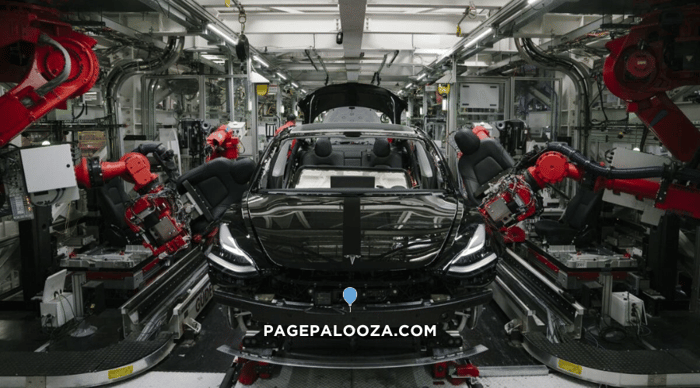
Teslas approach represents the next leap of evolution. While traditional automakers typically use around 130 robots in their factories, Teslas Fremont facility employs over 1,000 specialized robots with names borrowed from X-Men characters. These robots handle everything from welding and painting to installing seats and batteries, creating a line of mechanical arms that work with precision human hands could never achieve.
Building cards is really complex. A modern vehicle contains over 30,000 parts that must be perfectly assembled. Teslas highly/fully automated production line tackles this challenge with efficiency. The giga factories are designed to achieve unprecedented levels of assembly, with raw materials entering one end and completed vehicles exiting from the other.
The pace of Teslas automated production demands an equally sophisticated maintenance approach. While the robots work 24/7, specialized technicians monitor their performance through advanced diagnostic systems, ready to intervene whenever there is a malfunction. These maintenance teams don’t just repair failures, they document each incident, feeding this data into machine learning algorithms that could predict potential breakdowns before they occur. This predictive maintenance strategy has progressively reduced Tesla’s mean time to failure, with each generation of production line becoming more reliable than the last. The continuous feedback loop between human expertise and machine performance has made the production lines even more reliable. Robots build the cars, while humans build better robots.
This automation extends far beyond car manufacturing. The rules Tesla has refined could revolutionize production across many industries. For example, pharmaceutical manufacturing where robot precision could reduce contamination risks while increasing production speeds. Furniture assembly also where customized pieces could be created with minimal human intervention, as companies like IKEA are already beginning to explore.
For Tesla, this production approach isn’t just an innovation, it’s a survival strategy. Elon Musk has repeatedly emphasized that production efficiency is super important for the company. In 2018, during what he called “production hell” with the Model 3, Musk slept on the factory floor and warned the company was very close to bankruptcy. Teslas ability to overcome these challenges through production innovations saved the company.
In modern manufacturing, production and operations isn’t just a competitive advantage, it’s everything. What makes Tesla truly remarkable is that they didn’t simply manufacture a good car, they’ve transformed themselves into experts across multiple domains such as production lines, maintenance systems, robotics, artificial intelligence, and battery technology. This allowed Tesla to innovate at every level of the manufacturing process. As consumer demand for electric vehicles continues to surge, Tesla’s revolutionary production line may well be the company’s most marvelous creation of all.
If you are looking to build a custom web app or mobile app, checkout PagePalooza where you start with an informative website and collaborate with a Plaooza engineer to build core features for one-time fees, no customization limits and own all your code.
