Merchant of Record: Keeping Global Payments Safe
In 2022, data breaches have savagely inflicted a very painful average cost of $4.35 million on businesses. What's even more alarming is that the rate and cost of data breaches have surged by a staggering 1517% over the past two decades.
As cybercriminals evolve and perfect their tactics, SaaS businesses need to urgently safeguard their online payments. However, the current global landscape presents a myriad of challenges that can be daunting to tackle independently and certainly not easily done.
This is one reason why many companies are turning towards Merchant of Record services, finding that they can handle payment processing in a secure manner.
In this post, you will be diving into how MOR solutions tackle online fraud:
The 4 Security Measures MORs Should Have in Place
How To Achieve Safe Payment Processing Through an MOR
What is an MOR, and why is it important?
Before jumping down the secure payment processing hole, it’s important to quickly clarify what a Merchant of Record is and why this solution matters for Software and SaaS businesses of all sizes.
To put it simply, the Merchant of Record is the legal entity that takes on the responsibility of selling goods and services to the end customer.
This payment solution takes care of the entire payment process, offering a multitude of services like complete sales tax management, access to local payment methods and local business entities, compliance with local and international laws, dedicated support for resolving customer inquiries, fraud prevention, and chargeback management.
While businesses can act as their own Merchant of Record, considering the many services this payment solution brings forth, outsourcing all of these operations to a trustworthy entity would eliminate the pressure of selling globally while allowing them to focus on perfecting their products.
Read our complete Merchant of Record guide to find out more about what this powerful payment infrastructure can do for your business.
The 4 Security Measures MORs Should Have in Place
Due to the disturbing data we mentioned earlier, it’s critical that online businesses prioritize robust protection against fraudulent financial transactions if they want to survive.
When contemplating the Merchant of Record (MOR) business model, it's crucial to ensure that the payment infrastructure you're evaluating incorporates the following four essential security measures.
For an in-depth exploration of MOR compliance, check out our detailed guide, Merchant of Record: Navigating Compliance.
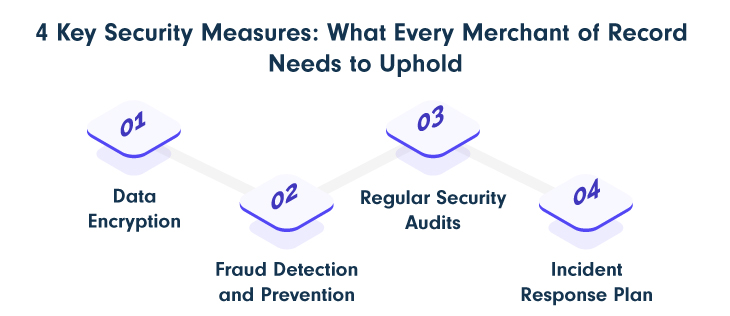
1. Data Encryption
When processing transactions and beyond, to adequately protect customer data from unauthorized access, Merchants of Record need to implement robust data encryption protocols.
TLS (Transport Layer Security) and SSL (Secure Sockets Layer) are necessary protocols employed for data encryption.
2. Fraud Detection and Prevention
Dedicated Merchants of Record will have advanced fraud detection and prevention mechanisms in place to quickly identify and block fraudulent transactions.
It’s also important that each strategy employed be customized, taking into consideration each business’s unique model.
3. Regular Security Audits
Your MOR payments infrastructure needs to conduct frequent security assessments to monitor and quickly solve system vulnerabilities.
Achieving PCI-DSS compliance is not only good for business, but it is also mandatory. In fact, to make sure that all security protocols are in place and executed, PCI-DSS attestation needs to be renewed every year.
Without ensuring that all security measures are effective, sensitive cardholder information is not fully protected from other threats, such as data loss, corruption, or tampering.
4. Incident Response Plan
Unfortunately, data breaches and cyberattacks take place.
Should this happen, you must be certain that your Merchant of Record partner is ready to respond swiftly and effectively to reduce potential damage and downtime as much as possible.
For this reason, having a robust incident response plan is required.
