My Google Maps scraper grew fastest when I stopped promoting it
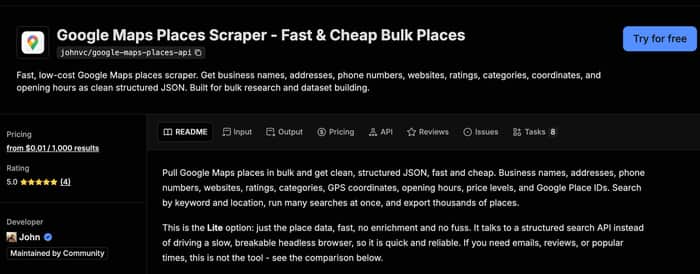
On July 28 I published the last of four launch articles for a Google Maps scraper I'd built, then moved on and forgot to followup, I wrote nothing else about it. On July 30 the store counter said 82 users. Today it says 316.
So the four weeks with no marketing behind them were the four best weeks that product has had.
Most of my working week goes into a content routine, and the thing that grew the most is the thing the routine ignored. That's either a lesson about content marketing or a lesson about my ability to measure it. Two weeks of digging and I still can't tell you which.
What the launch push looked like
The play I run on anything new is four articles across four channels inside ten days. This one got a Medium piece, a LinkedIn post and article, and a Peerlist project on July 21, then a longer technical write-up on Dev.to a week later. Call it the better part of a week of writing for one product.
Then I stopped, because twenty other things were waiting and as far as I was concerned the launch was done.
The month I published nothing about Google Maps scraping
Growth didn't flatten out after the articles. It got steeper. August sits at 73,265 places returned across 1,513 lifetime runs, which tells you the usage is bulk jobs rather than people poking at it once. Sixty of this month's users are paying. Nothing about the product changed in that window: no new features, no pricing change, not even a README edit.
If the July articles caused this, they caused it on a four week delay, which is a very convenient thing for me to believe and not something I can check.
Two products, same week, same four channels, opposite results
Here's the bit that stopped me writing confident retrospectives.
In one week I ran the identical four channel push on two other products. One moved zero users and four runs. The other went from 6 users to 15, and from 3 paying to 5.
The only real difference between them was what was already happening underneath. The one that moved had about 15,000 results of quiet existing usage. The one that didn't had about 400. So the push seems to amplify demand that's already there, and I have yet to see it manufacture any.
The number that flipped my own conclusion
Twice I wrote up a weekly review concluding that content wasn't the lever, using absolute user counts. Both times the untouched products added more users than the promoted ones, which looked decisive on the page.
Then I normalized by base size. Products with something published that week grew 15.2% on a median base of about 10 users. Untouched products grew 5.2% on a median base of about 51. Same rows, opposite reading, and the choice of denominator picked the answer for me. Neither version is causal evidence, but I'd happily written both up as though it were.
So I set up a holdout on my own marketing
Four products, matched on launch date, coverage and revenue tier, randomly split into two treated and two control. The treated pair got the full four channel push. The control pair gets nothing until the read date: no articles, no pricing change, no copy edits, no new example pages.
The read is Thursday. At the six day interim there was nothing worth reporting: free users up 2.5 on average in the treated arm against 2.0 in the control arm, paying users flat in both. The obvious weakness is that the bases are 10 to 20 users with two products per arm, so this can rule out a big effect and can't measure a small one. A weak test, but more than I had before, which was nothing.
What I'd tell another founder
A growth chart that reads two opposite ways depending on whether you normalize is not really telling you anything. Mine was mostly telling me what I already wanted to hear.
My first instinct was to build a better dashboard, and that was the wrong instinct. What actually helped was giving up one product as a control, which costs a week of not marketing something and buys the only version of the answer I can defend.
The uncomfortable part: I've been running this routine for months on numbers I had never once tested against a control.
The product, for anyone who wants it
The tool in question is a Google Maps places scraper that returns names, addresses, phone numbers, websites, ratings, categories, coordinates and hours as structured JSON. Standard results run two tenths of a cent per place, richer ones twice that. What people actually do with it is pull local business leads in bulk or call it from Claude as an MCP tool instead of clicking a UI. There's a longer technical walkthrough on Dev.to and a shorter build story on Peerlist.
The two questions I get every time it comes up: whether scraping Google Maps is legal, and whether the Google Maps API is free. On the first, public business listings are generally treated as public data, but that depends on your use and your jurisdiction, and I'm not a lawyer. On the second, Google's own Places API gives you monthly credit and then meters you, which gets expensive fast at bulk volume; that bill is usually why people come looking. And no, you don't need a Google Maps API key for mine, so if getting a key through Cloud Console is what's blocking you, that blocker is removable.
A real question for anyone here who publishes on a schedule: has anybody actually held one product back as a control? And if you haven't, what number would you need to see before you'd stop marketing something on purpose for a month?
