Native vs Cross-Platform: Which Should Your Startup Choose?
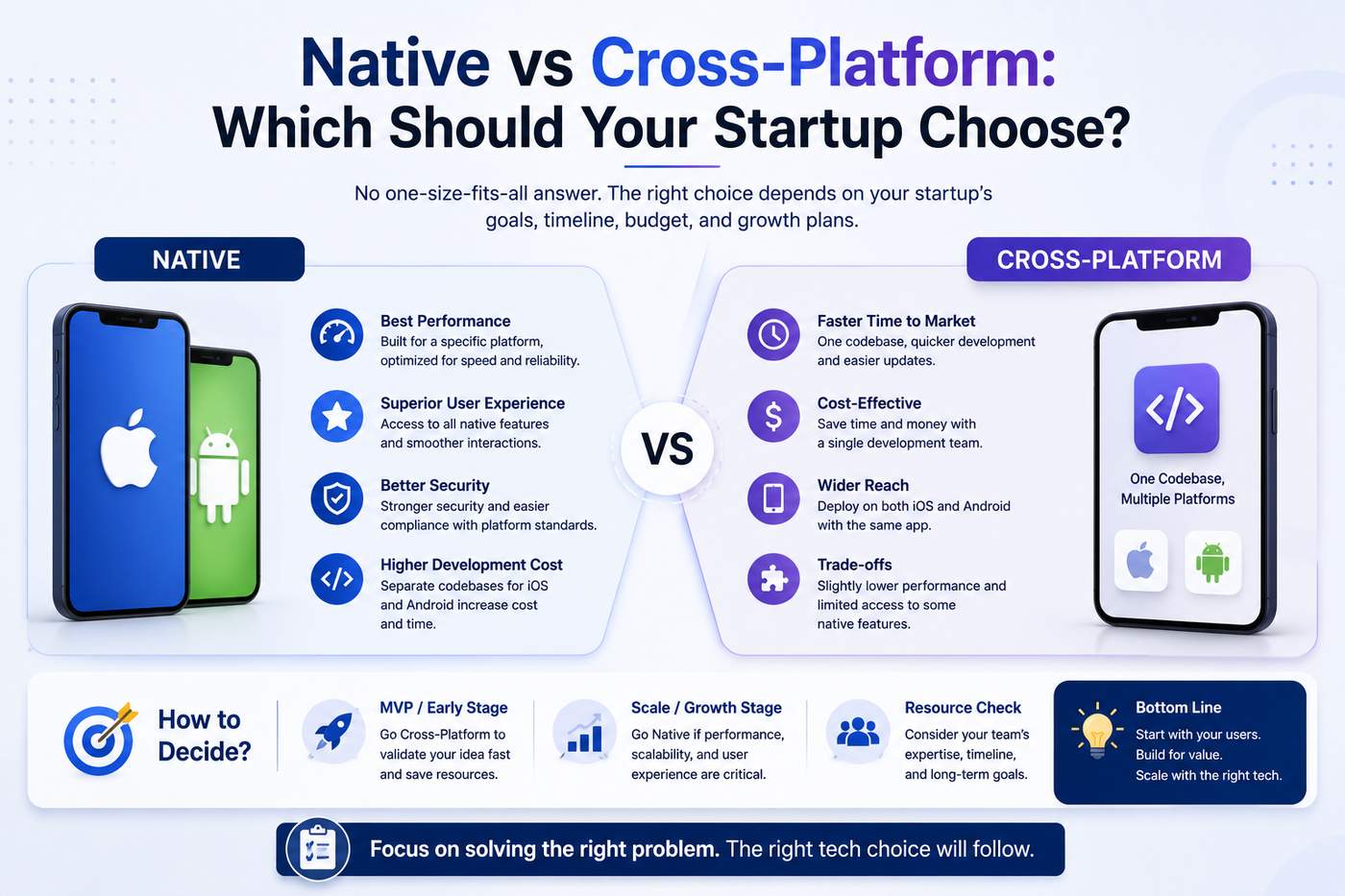
Building a mobile app is an exciting step for any startup, but one decision can quickly become confusing: Should you build a native app or use a cross-platform framework such as Flutter or React Native?
There isn't one answer that works for every startup.
Your budget, timeline, app complexity, target audience, performance requirements, and plans should all influence the decision.
For startups, the goal isn't to choose the most technically impressive option. It's to choose an approach that delivers a reliable product without wasting limited resources. Working with experienced mobile app development services can also help startups evaluate these trade-offs before development begins.
What Is Native App Development?
Native development means building an application specifically for one operating system.
For example:
Swift/SwiftUI for iOS
Kotlin for Android
Because the application is designed specifically for its platform, developers can work directly with platform-specific features and APIs.
Native development can be a strong choice when your application requires advanced performance, complex animations, extensive device capabilities, or highly platform-specific functionality.
The downside is that supporting both iOS and Android generally means maintaining separate codebases, which can increase development time and cost.
What Is Cross-Platform Development?
Cross-platform development allows developers to create applications for multiple platforms from a shared codebase.
Two popular options are:
Flutter
React Native
Instead of building two completely separate applications, much of the development work can be shared between iOS and Android.
For a startup working with a limited budget, this can be particularly attractive.
Why Startups Often Consider Cross-Platform
Imagine you have a startup budget of $50,000 for your first mobile product.
Building and maintaining two separate native applications could consume a significant portion of that budget.
A cross-platform approach may allow your team to share a substantial amount of development work between platforms.
That can potentially mean:
Faster initial development
Lower development overhead
Easier feature updates
Smaller development teams
Simpler maintenance
This doesn't mean cross-platform development is automatically cheaper in every project. The actual cost depends on the application's requirements and implementation.
But for many startups, reducing duplicated development work can be a major advantage.
Native vs Cross-Platform: The Key Differences
Development Cost
Native development can require separate iOS and Android development efforts.
Cross-platform development can reduce duplicated work by sharing code across platforms.
Startup advantage: Cross-platform
Performance
Native applications have direct access to platform-specific capabilities and can provide excellent performance.
Modern cross-platform frameworks can also deliver strong performance for many typical business and consumer applications.
Advantage: Depends on the app
Development Speed
Cross-platform development can allow teams to build features for multiple platforms from a shared codebase.
Native development may take longer when the same feature must be implemented independently for iOS and Android.
Startup advantage: Cross-platform
Platform-Specific Features
If your app depends heavily on specialized device capabilities or platform-specific behavior, native development may provide more flexibility.
Advantage: Native
Maintenance
With native development, changes may need to be implemented separately for each platform.
With cross-platform development, many changes can be made in shared code.
Potential advantage: Cross-platform
When Should a Startup Choose Native?
Native development may be worth the additional investment when your application depends heavily on:
Advanced graphics
High-performance processing
Complex animations
Bluetooth or specialized hardware
Platform-specific APIs
Advanced camera functionality
Intensive background processing
Highly customized platform experiences
For example, a sophisticated video-editing application may have very different requirements from a basic appointment-booking app.
The more your product depends on the unique capabilities of a particular platform, the stronger the case for native development becomes.
When Should a Startup Choose Cross-Platform?
Cross-platform development can be a good fit when you're building:
MVPs
Ecommerce apps
Booking platforms
Social applications
Business applications
Customer portals
Productivity tools
Content-based applications
If your startup needs to validate an idea quickly across both major mobile platforms, Flutter or React Native can be practical options.
This is particularly useful when the primary goal is learning from real users before making a larger technology investment.
Don't Choose Based Only on the Framework
A common mistake is asking:
“Is Flutter better than React Native?”
That's often the wrong question.
The better question is:
“Which technology fits our product, team, budget, and roadmap?”
A framework is only one part of the equation.
You also need to consider developer expertise, backend architecture, third-party integrations, testing, deployment, maintenance, and long-term product requirements.
This is where professional mobile app development services can be valuable. An experienced development partner can evaluate the complete product rather than recommending a framework simply because it is popular.
What About Your Startup Budget?
Budget should influence the decision, but it shouldn't be the only factor.
A cheaper initial build isn't necessarily cheaper over the lifetime of the product.
Consider:
Initial development + maintenance + infrastructure + testing + future features + developer availability
For example, saving money during development isn't helpful if your application later requires expensive platform-specific work that wasn't considered during the initial architecture.
The best approach is to evaluate the total cost of ownership, not just the first development quote.
A Simple Decision Framework
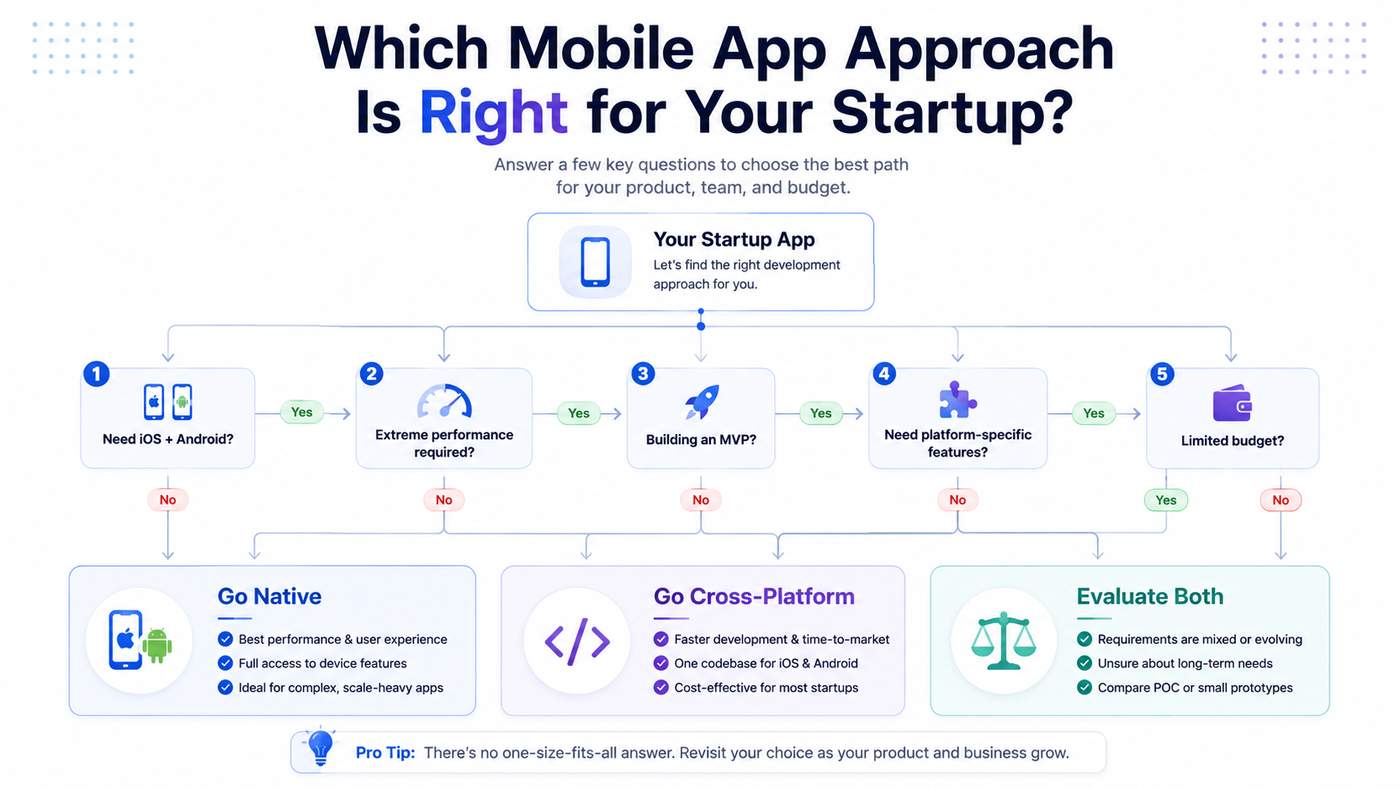
Ask these questions before choosing:
1. Do we need both iOS and Android?
If yes, cross-platform may reduce duplicated development effort.
2. Is extreme performance central to the product?
If yes, native deserves serious consideration.
3. Are we building an MVP?
If your priority is validating the idea quickly, cross-platform can be a practical choice.
4. Does the app depend on specialized device features?
If yes, native development may provide more flexibility.
5. What skills does our development team already have?
The technology your team understands well can sometimes be more valuable than choosing a framework based on popularity alone.
6. What will the application need two years from now?
Don't optimize only for launch day. Consider the roadmap.
Final Thought
For many startups, cross-platform development offers an attractive balance between cost, speed, and multi-platform reach.
Native development remains an excellent option when performance, platform-specific functionality, or highly customized experiences are central to the product.
There is no universally “best” technology.
The right choice depends on what you're building, how much you can invest, how quickly you need to launch, and what your product may become.
Build for the business—not for the buzz around a particular framework.
If you're deciding between native and cross-platform development for your startup, explore Acelan.ai's mobile app development services to choose an approach based on your product requirements, budget, and growth plans.

