No API for events!? (Day 71)
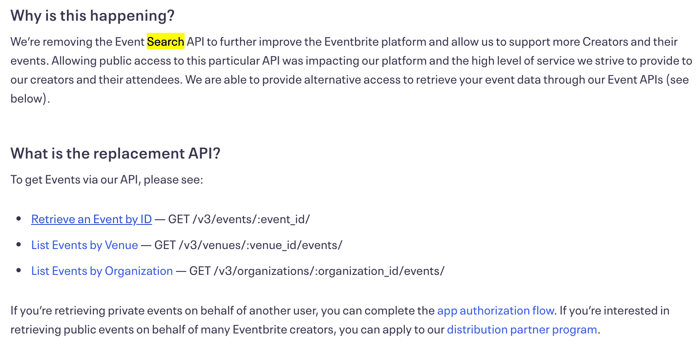
I am shocked to find out that the two well-known event sites have such poor support for API integration!
Eventbrite has its search events API deprecated! Why??? It's even worse for Meetup.com--it requires pay customers only, and need a real callback URL, how do we do development without any sandbox? And why force those who are promoting your events to be a paid customer? (Maybe I'm just too used to the open API ecosystems in the DeFi world.)
Do you know any other sites with tons of event info? I am trying to find events by non-profits or charitable events (e.g. fundraisers).

I don't have an answer, but I'm not surprised, they are long running websites that don't keep up with the times.
Meetup.com has now been sold twice, their UX hasn't changed much at all since it launched, or at least in the past 10 years.
Eventbrite is not far off. I remember the acquired lanyrd.com, it had such potential for events, but they just let it die a slow death.
It's mad that there still isn't a great events website/service
It is pretty maddening... But after trying to make one, I somewhat believe this is actually one of those impossible problems. I don't think anyone will ever "monopolize events" to the same extent Amazon dominates online shopping or Google dominates web search. I say this because it's a very tempting dream that I've seen many people fall for.
Back in 2018 (shortly after the Cambridge Analytica story broke), I started working on an "all-in-one events platform" (jokingly called Eventr) to compete with Facebook Events. We assumed people would be looking for alternatives to their Facebook services and we could be an outlet for that pressure.
We started with high hopes, but quickly realized what a rabbit hole we had fallen into.
One the first things we learned is that there is a huge variety of event types. For example there's casual P2P events like the classic "dinner with friends". Then there's professional P2P events like a "team meeting" or "weekly stand-up". Then there are also small B2C events like "booking a haircut" or "dinner reservations" (which notably could also be a "dinner with friends" event). Then there are the large ticket-based events like concerts, movies, sporting events, festivals, etc.
This huge variety of events creates a huge variety of logistical challenges. We quickly started falling into a "big MVP" problem. We would say things like:
Each new feature seemed like it would be the one to "fix the problem". People would show enthusiasm, but none of the features ever pulled in any users. Then things got more complicated as we started noticing digital events as a trend. Obviously our platform had to support digital as well (which have completely different logistical problems)!
We made a lot of mistakes. For example, we didn't follow "the mom test" and we didn't understand the "lean startup" model at the time. But the biggest mistake we made is that never identified a clear market need. We set out with a solution in mind "to build a better events platform", and that lead us to try being everything to everyone. The longer we worked at it, the more the dream began to feel a mirage. We always had a strong feeling there should obviously be a better events platform, but we could never figure out what the actual problem was nor who it was that had it.
I believe now most people have little frustrations when it comes to coordinating events, and it's possible to build niche services around those frustrations. But it's impossible to successfully build a service which solves the entire end-to-end coordination experience for all types of events. Great products have to make smart trade-offs and say "no" to lots things. Our mission eventually died when we realized no was actually looking for "a better events platform".
There are two apps I've seen that come closest to what we had originally imagined: IRL (https://irl.com) and Cue (https://cue.app). Imho, IRL is an okay product but not terribly great. I don't personally use it, because it doesn't solve a problem for me. They have a lot of the structural problems Eventr had in trying to be everything to everyone. I'm also not sure how IRL makes money and it concerns me to think about. Cue seems to have a lot of the same issues and I believe they might have actually shutdown (please don't quote me on that because I don't have direct knowledge, but I noticed their CEO's and company's Twitter accounts have recently disappeared).
As for Eventr, luckily we were able to salvage a bit our work and met a lot of great people on our journey. We eventually pivoted the product into a travel journaling app called SpaceTime which we're quite happy with: https://getspacetime.app
Interesting insight.
I remember Lanyrd working quite well, they initially focused in on the tech scene which probably helped.
I think there is probably room to create something for specific niches, the unbundling effect so to speak. Become a platform/website that lists all tech events, for example. That becomes valuable to people who host events and want to reach specific and new people.
Yes this exactly. There are tons of opportunities in the events space, but to capture them you have niche down on an actual audience with a real problem. We made the mistake of trying to build a platform for all events and all people that never ended up solving anything for anyone.
Thanks for sharing your experience.
Ticketmaster seems to have an API for this, but it looks like the events on there are geared toward professional/entertainment events.
Also, maybe another way you could approach this is by first finding some non-profit organisations on eventbrite, and then using the List Events by Organisation endpoint on each of those organisations https://www.eventbrite.com/platform/api#/reference/event/update/list-events-by-organization. That might be totally useless advice, but just throwing it out there in case it sparks any other ideas :)