Nobody Wants to Download Your Game Anymore
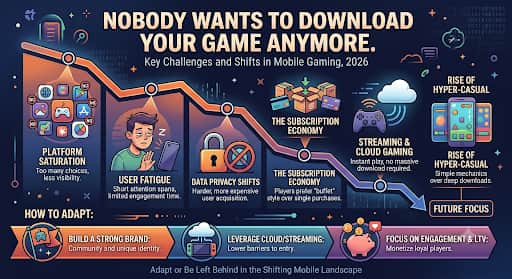
I covered a launch a few years back where the studio spent more money on the app store trailer than on half the game's animation budget. Made sense at the time. Getting someone to tap "install" was the whole battle, and if you won it, you had a player. These days I'm not sure that battle is worth fighting the same way.
Walk through what people actually play during a lunch break or a bus ride now, and a surprising amount of it never touches an app store. Browser tabs, mostly. Casino-style games, quick puzzle sessions, chaotic multiplayer arenas where you're dropped in with strangers thirty seconds after clicking a link. Nobody installed anything to get there.
It's easy to write this off as a minor trend in casual gaming. I don't think it is. It's closer to a quiet correction of an assumption the whole industry built itself around for the last fifteen years: that a real product needs a home screen icon.
Every Extra Tap Costs You a Player
Ask any mobile developer what kills their conversion numbers, and they'll usually mention the same thing before you finish the question: the install itself. A hundred people click an ad. Maybe twenty actually finish downloading. Of those twenty, a handful open the app more than once.
That drop-off isn't really about laziness. People discover games in the worst possible moments for patience, standing in line, half-watching a meeting, killing ninety seconds between tasks. In that window, a three-second load time wins almost every argument against a superior game buried behind a 500 megabyte download.
Browser games skip that argument entirely by removing the thing being argued about. You click, the page loads, you're in. There's no permission screen asking for your contacts, no storage warning, no "update available" notice showing up two minutes into your first session.
The App Store Isn't the Only Way to Reach People Anymore
For a long time, distribution meant getting past a gatekeeper. Submit the build, wait for review, hope the update doesn't get flagged for some policy nobody explained clearly. Even after approval, you're still fighting for placement in a store with a few million other listings.
A browser game doesn't ask permission from anybody. A developer ships a fix, and it's live the moment the server updates- no review queue, no waiting on Apple or Google to get around to it. That alone changes how fast a small studio can respond when something's broken or when a feature just isn't landing.
It also changes how a game actually spreads. A link dropped into a group chat is a different kind of invitation than "hey, go download this." One takes five seconds to act on. The other asks someone to make a decision about their phone's storage, which is exactly the kind of decision people put off indefinitely.
A few examples make the point better than theory does:
Slither.io and Agar.io built massive followings almost entirely through shared links and streamer clips, never requiring an install at any point.
Wordle was a daily habit for millions of people before The New York Times bought it, and it never had a native app during the stretch when it actually went viral.
Sites like Poki and CrazyGames now host thousands of instant-play titles, which tells you the audience for browser-first catalogs isn't a fluke built around one or two hits.
Players Don't Think About the Tech Underneath
Here's something I've noticed after years of watching player forums and reviews: almost nobody mentions the engine. They mention whether the game felt slow, whether it crashed, whether the controls responded the way they expected. That's the whole review, most of the time.
WebAssembly quietly closed most of the performance gap that used to make browser games feel like the cheap alternative. Cloud rendering pushes the heavy graphics work off whatever device someone happens to be holding. Progressive web tech lets a browser game cache itself and sit on a home screen without ever going near an app store's review process.
None of that shows up in marketing copy because players don't care about it directly. They just notice the game feels fine now, in a way it didn't five years ago, and they move on with their day.
Low Stakes Make People More Willing to Try Something
If trying a game costs nothing but a few seconds, more people try it. That's not a complicated insight, but it's one the industry has been slow to fully act on outside of casual mobile titles.
A browser game gets sampled the way a song gets sampled on a playlist, quickly, with no real commitment behind the click. Some players bounce in under a minute. A percentage stick around and become regulars, often without ever consciously deciding to keep coming back. That second group doesn't exist if the entry cost was a download nobody was sure they wanted.
Mobile gaming already trained a generation of players to expect something close to instant gratification. Browser games just finished the job by cutting out the one remaining step between wanting to play and actually playing.
Streaming Rewired Expectations, and Gaming Followed
Nobody under thirty remembers renting a physical disc, and that shift didn't happen because streaming services were morally superior. It happened because pressing play was easier than everything that came before it.
Gaming, especially the more casual and gambling-adjacent side of the entertainment world, has been catching up to that same expectation for a while now. Someone plays for fifteen minutes on a work break, closes the laptop, and picks the same session back up on a phone that evening without losing progress. That kind of continuity used to require dedicated software syncing accounts across two separate apps.
This is really the engine behind the growth of slot gaming entertainment generally: platforms built around showing up wherever the player happens to be, instead of asking the player to carry a specific device around to access their own account.
Simplicity Isn't an Accident, It's a Design Choice
Some of the most successful browser titles look almost too plain when you screenshot them. That's not a budget problem. It's usually the opposite: a studio that deliberately cut everything competing for the player's attention.
Every unnecessary loading screen, every tutorial popup nobody asked for, every extra menu tab is a small tax on someone's patience, and patience is the one resource a browser player has almost none of. The teams that get this right tend to strip things down until only the essential loop remains: enter fast, understand the controls immediately, get feedback right away.
Good design removes friction. The best design removes so much of it that a player never even registers there was friction to begin with, which is a much harder thing to pull off than it sounds.
Small Fixes Beat Big Relaunches
Most games that hold onto an audience for years aren't doing it through one massive overhaul every eighteen months. They're doing it through dozens of small, almost boring improvements. A faster matchmaking queue. A load time trimmed by half a second. Support added for one more device category.
None of those individually would make a headline anywhere. Add them up over a couple of years, though, and the game feels meaningfully better without ever forcing existing players to relearn anything. It's the same logic behind most successful live-service titles: consistency beats spectacle most of the time.
The Numbers Tell Developers Exactly Where People Quit
Studios today can track precisely where a player arrived from, which device they used, how long the session lasted, and the exact screen where they closed the tab. That level of visibility barely existed a decade ago.
The pattern that keeps showing up across that data is almost boring in how consistent it is. Cut a step out of onboarding, and acquisition improves. Make the game feel identical on a phone, a tablet, or a laptop, and players return more often because they stop mentally tying the game to one specific device.
Growth ends up looking less like one clever marketing push and more like a hundred tiny conveniences stacked on top of each other over time.
The Business Math Works Out Too
Keeping separate native builds running for iOS, Android, and desktop is genuinely expensive. Each platform has its own release schedule, its own review process, its own list of quirks that quietly eat engineering hours as the product gets bigger.
A browser-first build collapses most of that into one codebase and one deployment. A studio pushes an update once, and every player gets it the moment it goes live, no waiting on a store's timeline. For a smaller team with a tight budget, that difference alone can decide whether they're competing with the bigger studios or just getting drowned out by them.
Monetization has shifted alongside all of this too. Ad-supported free play, cosmetic purchases, and premium ad-free tiers now regularly sit inside the same title. Platforms built around fast browser entry, including sites like MarkasGacor, lean on that instant access and cross-device continuity specifically because it keeps people around long enough for any of those monetization models to actually earn something.
The Community Was Never Tied to the App Anyway
Multiplayer browser games proved a while back that a dedicated app was never a requirement for building a real community. Discord servers, Twitch clips, and screenshots shared in a group chat do most of that heavy lifting now, regardless of what platform the game technically runs on.
A friend's screenshot or a streamer clearing a level still moves more new players than most paid ads manage. And that word-of-mouth loop moves faster when there's no install step standing between "I saw this" and actually playing it yourself.
Where This Probably Goes Next
Native apps aren't going anywhere, and there are still plenty of cases, competitive esports being the obvious one, where dedicated software makes more sense than a browser tab ever will. I wouldn't bet against specialized native builds sticking around for a long time in those corners.
But the broader momentum is hard to miss if you've been watching this space for a while. Cloud computing keeps closing whatever performance gap remains. Browsers keep getting more capable every year without anyone really noticing the upgrade happen. And the incentives on both sides, players wanting convenience, studios wanting to reach more people for less engineering overhead, keep pointing the same direction.
The games that keep growing five years from now probably won't be the ones with the longest feature lists or the flashiest trailers. They'll be the ones that get out of the player's way fast enough that nobody stops to think about how it was built in the first place. That kind of invisibility is harder to design than it looks, and it's quietly becoming the whole competitive advantage.
