OrchestrAI: putting the whole thing on one image
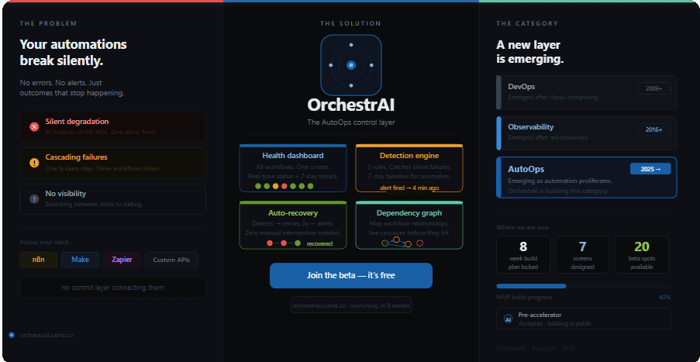
After my first post got some good questions in the comments, I wanted to share something visual that explains the full picture at a glance.
The image breaks into three panels:
Left — the problem. Silent degradation, cascading failures, zero visibility. These aren't edge cases — they're what every automation engineer I've spoken to describes as their biggest operational headache. The tools (n8n, Make, Zapier, custom APIs) don't talk to each other. Nobody's watching the whole stack.
Centre — what OrchestrAI does. Four things, nothing more: a unified health dashboard, a 5-rule detection engine (including silent degradation via 7-day baseline), auto-recovery that retries and logs, and a dependency graph that maps what depends on what.
Right — why this is a category, not a feature. DevOps came after cloud. Observability came after microservices. AutoOps comes after automation proliferation. Every company is becoming an automation company. The operational layer for that doesn't exist yet. We're building it.
Progress since last post:
- Full PRD written and triple-checked (data model, API spec, Firestore security rules + indexes, detection logic, sprint tasks)
- All 7 screens designed in dark mode with interactive mockups
- Google Stitch build prompt guide created — one prompt per screen ready to paste
- Pre-accelerator: accepted
- Entering MVP build phase this week
Still looking for:
20 beta testers — specifically automation agencies or founders running production n8n / Make stacks. Free access, direct roadmap input, I onboard you personally.
Also still looking for a technical co-founder (Node.js + Firebase). If you're a builder who sees the gap I'm describing and wants to own the technical architecture of a new product category, let's talk.
Drop a comment or reach out directly.
Waitlist: orchestraii.carrd.co
