Product-Led Growth for SaaS: Definition, Steps + Examples
We’re seeing more and more companies ditching old growth strategies just to become part of the popular PLG club. And the SaaS industry is by no means an exception to this trend.
The question is why.
Why is the product led growth strategy (PLG) trending? We think we might have an idea!
- 58% of B2B companies have a product led strategy in place.
- 77% of companies with $250 million to $1 billion ARR use the product led growth model.
- 70% of clients are more likely to recommend a PLG company to others.
So, apart from increasing software sales, improving customer experiences, achieving customer success, or encouraging external investments, the product led strategy makes sense. It’s that simple.
So, let’s dive into the PLG strategy, looking at:
- What is PLG (Product-Led Growth)?
- How Does PLG Work In SaaS?
- 5 PLG Benefits For SaaS Businesses
- PLG Vs. Other Growth Strategies
- 8 Metrics To Measure PLG Success
- 4 Examples of PLG Products
What Is PLG (Product-Led Growth)?
The product led growth model is a go-to-market strategy that places the product at its very core, using it to achieve revenue growth at all its stages. Instead of relying on traditional sales outreach or marketing campaigns, the product itself becomes the engine of customer acquisition, retention, and expansion.
How Does PLG Work In SaaS?
PLG companies have a greater potential to go viral, which obviously leads to more customers and lower acquisition costs if the model is correctly applied.
There are certain rules that SaaS companies need to consider when going full product-led. So, let’s discover what they are and understand if they match your business.
1. Develop a Self-Serve Buying Process
In this scenario, the product is the lead magnet, pulling customers closer and allowing them to discover your solution without the need for assistance. So, you first need to ensure your target audience has an intuitive purchasing experience.
Create a website that conveys the product value you bring by:
- communicating your value propositions
- displaying your pricing plans and everything they stand for
- creating a simple product sign-up and setup process.
At the end of the day, you need to make sure that you can gain new users and generate business growth without requiring the significant assistance of marketing and sales teams.
2. Harness the Power of Free Trials Or Freemium
In the PLG model, a nice website with smart copy won’t be enough to drive exponential growth.
You’ll definitely need something extra to sweeten the deal.
The freemium model or free trial implementation can give you the push you need when it comes to obtaining users. If you choose the freemium product approach, you need to make sure that potential users have complete access to your product’s core features.
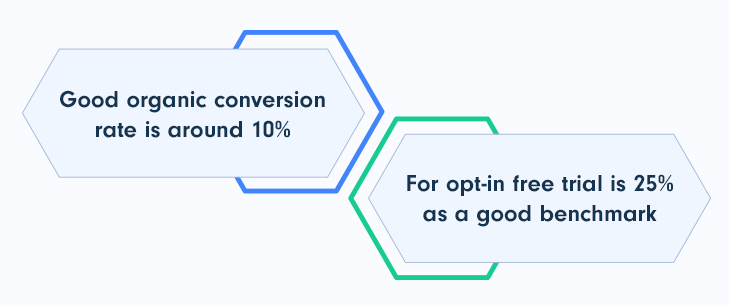
As a matter of fact, these pricing tactics are one of the pillars of the product-led model because they are all about giving users a taste of your product’s value and gaining PQL (product-qualified leads).
3. Offer More Product-Focused Onboarding
Product led businesses are product-focused all the way, and this, of course, includes the onboarding process. But what do we mean by this exactly?
Considering that seamless onboarding can lead to faster product adoption and value delivery, it’s crucial that you invest time in making this process easy to follow, user-friendly, and self-serve.
The traditional software company introduces its solution with the help of human agents, emphasizing hyper-personalizing the interaction. While this method has its own benefits, the PLG self-serve option is a much better option when it comes to achieving user satisfaction.
Not only are you able to track user behavior, understand where your product is losing, and then make further improvements, but users feel better about the product when discovering what the solution can do for them all on their own.
In-app guidance, simplified workflow, and video assistance are some ideas you can use to put your product to work during the onboarding process.
However, keep in mind that PLG onboardings require a lot of ongoing work and improvement.
4. Fix Your Pricing
Pricing is just as crucial for the SaaS business as it is for its customers. And finding the balance between the parts is not a simple thing to achieve. You want to price your product high enough to drive growth, but you can’t go too high to miss aligning it with customer demand.
So what do you do?
You experiment.
Apart from using the freemium or free trial, which is a must of the PLG flywheel, you can orient yourself towards the usage-based model. Of course, flat-rate or per-user are just as good.
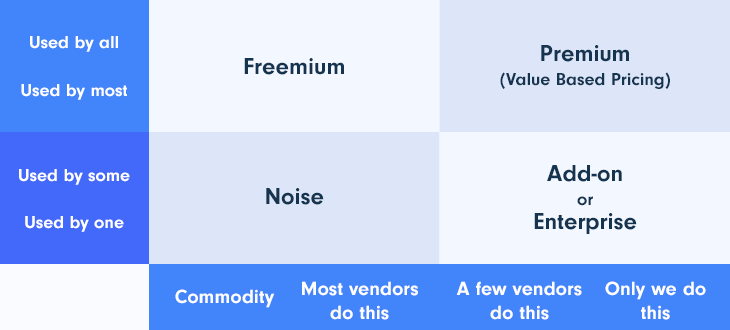
Consider your target audiences, collect historical data, and, most importantly, your product features, responsible for providing users with value.
Lastly, consider the tiered pricing technique, as it does wonders for customer segmentation. And don’t worry if you have an endless number of plans. Look at Hubspot’s pricing frenzy, because you can’t deny it’s giving excellent results.
5. Collect Data and User Feedback. Always.
The product led growth business strategy might be responsible for lower user acquisition costs or significant revenue growth, but only when it’s implemented by the book.
Without consistently collecting product usage data through a dedicated analytics tool to check how your customers enjoy your solution, it is very difficult to decide what product development changes you should make. Plus, offering smooth user experiences would not be possible in this example.
Thus, this growth strategy relies heavily on gathering as much data and feedback as possible.
One should use heatmaps, session recordings, or user paths to find out:
- User progress and actions
- Areas with the highest engagement
- Frustration points
Feedback is highly relevant here, and we say this not just for product-led businesses but all SaaS companies. However, the great thing about this strategy is that it can award you with product insights early in the process, allowing you to spot churn potential quickly.
So, make sure you implement:
- In-app surveys focused on specific areas or product features
- NPS surveys
6. Turn Your Product Into An Essential Tool
Customer lifetime values and user retention are just as important in boosting your average revenue as lowering customer acquisition process costs or diminishing operational resources.
This can only be done by going from a nice-to-have to a must-have solution, which, as you know, might be particularly challenging in the competitive SaaS industry. Not impossible, though.
By constantly providing value to your users through new features, updates, and incentives to convince them to continue using your product, you can boost your monthly recurring revenue.
Bottom line: your product needs to become and remain indispensable for your users.
Read on PayPro Global's Blog:
- 5 PLG Benefits For SaaS Businesses
- PLG Vs. Other Growth Strategies
- 8 Metrics To Measure PLG Success
- 4 Examples of PLG Products
