Reddit writing AI that simulates how the subreddit will react before you submit.
Most AI writing tools for Reddit work like this. You give them a topic. They give you a generic post that reads like AI wrote it. You post it. The subreddit smells it from a mile away and downvotes it or flags it as low-quality. Or worse, you don't even know your post is weak - you just see it die at four upvotes and conclude that Reddit doesn't work for your niche.
The problem isn't that AI can't write good Reddit posts. The problem is that "good" depends entirely on which subreddit you're posting in, and most tools have zero awareness of that.
Achiv writes posts differently. Here's the actual flow.
You open Achiv on Reddit's submit page. The first thing it shows you is a list of topics that people in this specific subreddit are talking about right now — each one labeled as a NEED or a FEAR, with how many users in the community are engaging with it. You pick the one closest to what your product addresses. That becomes the angle for your post.
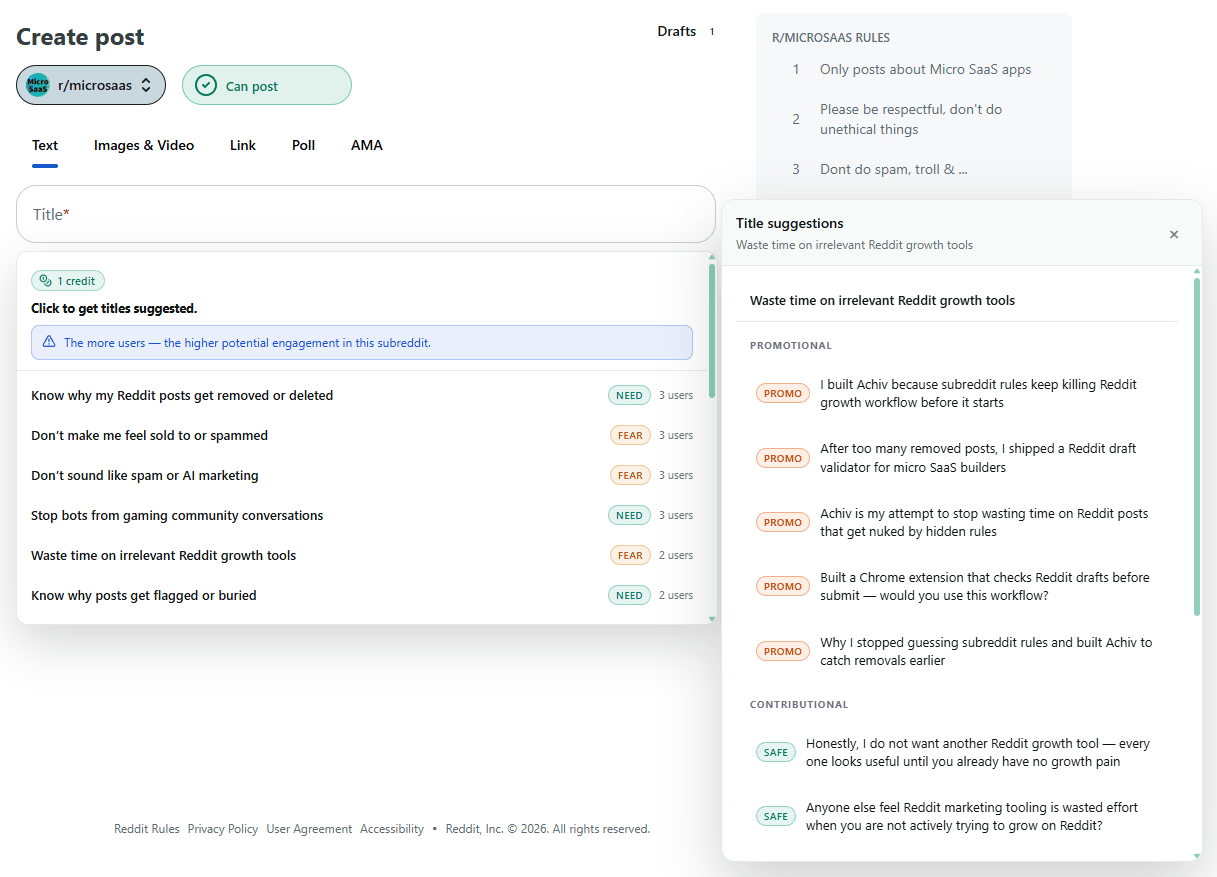
Then Achiv generates titles. Two categories, side by side. Promotional titles, which directly mention your product. And contributional titles, which approach the same topic by asking the community a question or sharing a related observation. Same angle, two different ways into the conversation.
The honest bit is that if the subreddit's rules ban self-promotion, the promotional titles get flagged with a SPAM tag instead. Not blocked, just flagged. You see immediately that this title will probably trip automod or get removed by a moderator, before you've written a single line of body text. You either pick a contributional title that fits the community's rules, or you accept the risk knowingly.
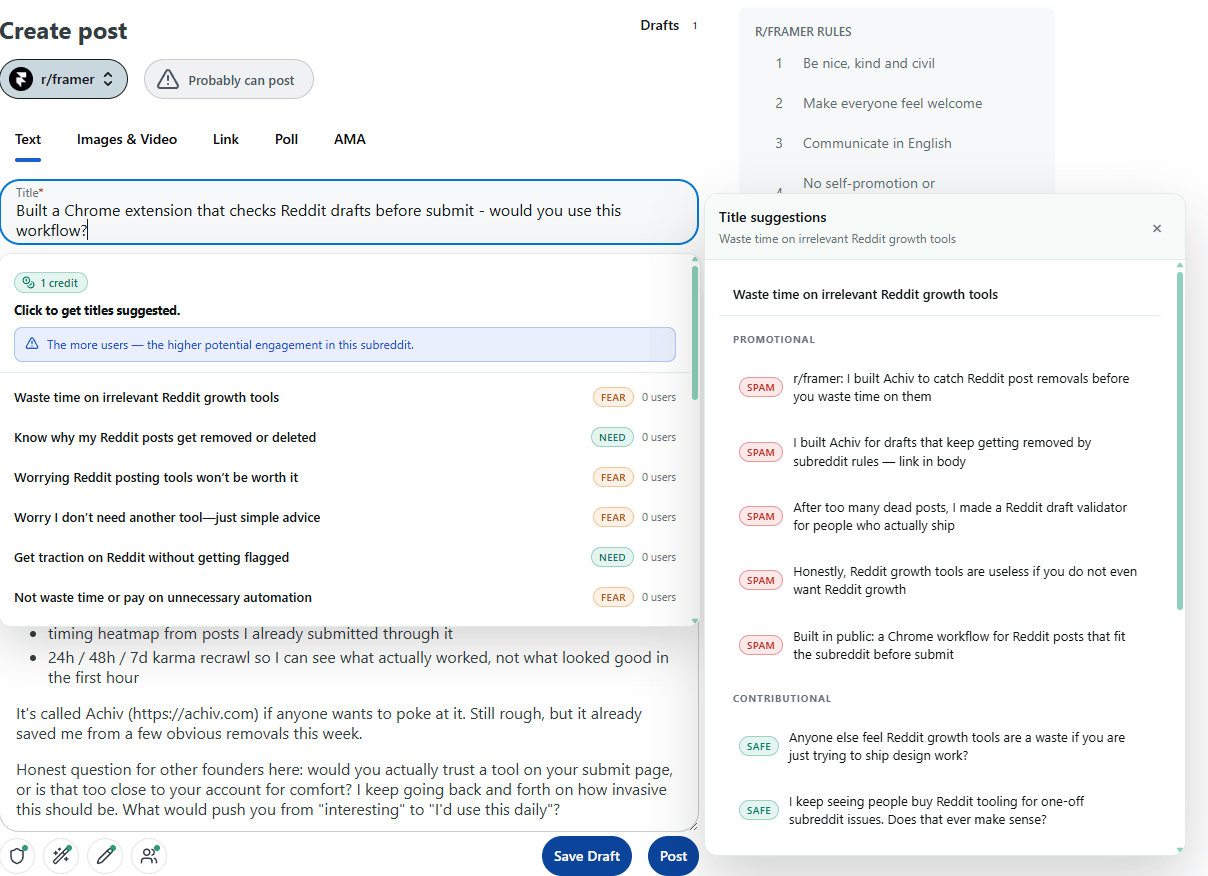
Once you've picked a title, the draft tool generates a full post under the composer. The draft is built from three inputs at once. The subreddit's writing strategy - everything Achiv has learned from the top-performing posts in that community: format, tone, structure, length, the unwritten patterns that nobody explains in the sidebar. The subreddit's written rules, which constrain what you can and can't include. And your project context - product description, key facts, links - so the post is grounded in your real work, not generic AI filler.
The draft is generated by Claude Opus 4.7. And even though - It is NOT a finished post. It needs your edits. Your real numbers, your specific examples, more your voice. Achiv builds the scaffold. You bring the substance.
The part I'm proudest of is what happens before you submit. AI Review reads your final draft and simulates how an average member of that subreddit would react to it. You see a fit score for the community. You see a list of predicted reactions with percentages - what a chance the simulated readers would downvote, dismiss it as promo, push back in comments, or refuse to trust whatever you're pitching. You see the top objections the community is likely to raise, and concrete recommendations for what to add or change to address them.
I spent around 1 month in total devloping only the core of this feature. It not like "Here is post, whad do you think Claude?". The AI review pipeline is based on countless tests and evals with real posts. I literally went to a subreddit, took downvoted/upvoted posts and passed through this feature to ensure it surfaces the right forecasts. So, be sure - if you got score less than 45, it's likely to be ignored/downvoted or even deleted for posting a low-effort/quality posts.
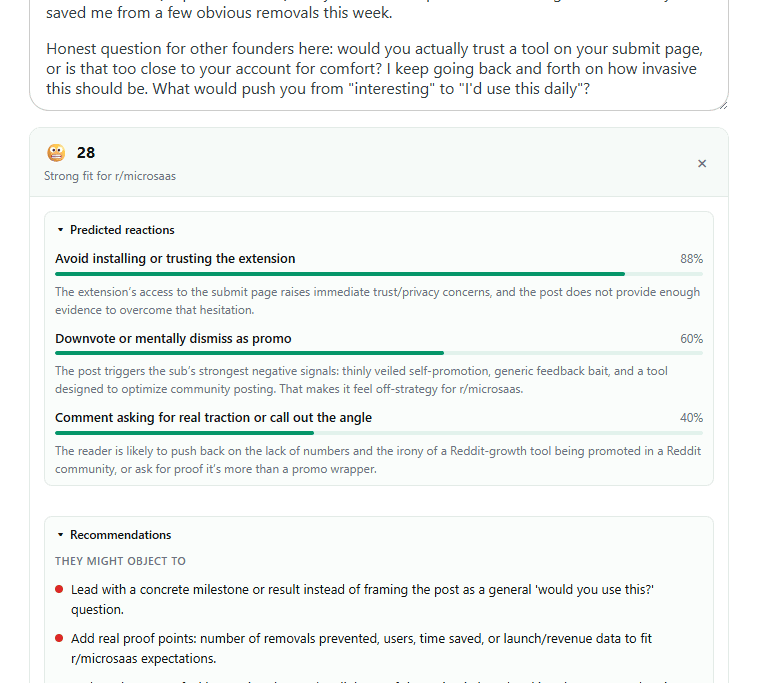
This is the moment that makes the rest of the tool useful. Generating a draft is easy, but it MUST be grounded to a real community-voice writing style. Auditing your draft against the actual community before you commit is hard, and it's the difference between a post that quietly dies and a post that gets read. You stop guessing whether your post will land. You see the simulated downvotes before the real ones.
Achiv is live on the Chrome Web Store. Free tier available with, 50 credits a month, no credit card. Paid plans from $29 a month when you want to scale.


Great insight. The difference between AI-generated content and pain-driven content is often the real-world context behind it. I've noticed similar results on niche content sites like https://portillos-menu.us/ where specific user problems outperform broad, generic topics.
The pre-submit simulation is the right place to put
the feedback loop. Most tools optimize for generation,
but the actual failure point is always post-submit
when you can't do anything about it.
Curious how the score handles posts that are genuinely
useful but happen to mention a product — does it
penalize the mention regardless of context, or does
it read intent?
The “promotional vs contributional title” split is a smart product decision. It teaches the user why a post will fail before they burn the account reputation. I’d be curious if the review score changes based on where the link appears, since a URL in the first paragraph often feels totally different from a link after a useful story.
Exactly. And yes the link inside affects the score.
I thought about this idea yesterday, and found this post just now, wow! It'll be very helpful
The key was to find a right model capable to understand the context. Will never tell anyone more than this. So much effort to make it working well.