Residual and Unaided-Memory Clauses in NDAs - Did you know this existed?
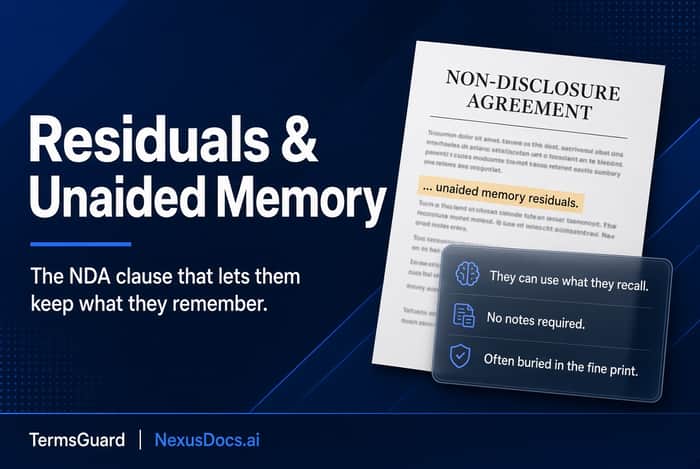
Most people worry about “don’t tell anyone.” The clause that often matters later is quieter: what you are allowed to keep using after the project ends — including what you still remember.
NDAs are supposed to protect secrets. They are not supposed to erase your career. Residual and unaided-memory language sits right on that line. This is not legal advice. It is a plain-English map of language that shows up in freelance, consulting, and employment NDAs.
What “residuals” usually means
A residual clause says you may keep using information that stays in your memory after the work is over — without looking at the company’s files, notes, or systems. Companies add it because people cannot unlearn a method they used for six months. You add it because your next client should not be blocked by everything you touched here.
In practice it is a permission slip for general skills, not a license to reuse the customer list, the unreleased product name, or the pricing spreadsheet.
What “unaided memory” usually means
Unaided memory is the test: can you recall it without opening a document, Slack thread, or export? If yes, some NDAs treat that residue as usable. If you have to look it up, it is still confidential.
That sounds fair until the clause is written backwards. Some drafts say you may not use anything in unaided memory. That version is much harder to live with. Almost every useful thing you learned would stay locked.
Why companies want it
They do not want you walking out with files, decks, or source code.
They do want you able to work in the same industry without a fight over “you saw our process.”
A clear residual clause can reduce later arguments about what is “general knowledge.”
Where it goes wrong
Watch for these patterns:
No residual clause at all plus a broad definition of confidential information. Everything you learned can be treated as theirs.
Residuals allowed — except anything valuable. If the exceptions swallow product ideas, methods, customers, and pricing, the permission is empty.
Unaided memory banned. That fights how people actually work.
Residuals that assign your memory to them. Some drafts say leftover ideas in your head belong to the company. That is closer to an invention assignment than an NDA.
Tied to a long non-compete. A residual clause does not help if a separate restriction still blocks the same work.
How this differs from a non-compete
A residual clause is about information. A non-compete is about who you can work for. You can have permission to use remembered skills and still be barred from a competitor. Read both. Do not assume one cancels the other.
What to ask before you sign
You do not need legal theater. You need a yes or no on a few points:
-
May I use general skills and knowledge retained in unaided memory after the engagement ends?
-
Does that exclude only specific secrets — customer lists, source code, unpublished products — rather than “anything I worked on”?
-
Does anything I remember become the company’s property?
-
Is there a separate non-compete or non-solicit that lasts after the NDA?
-
How long does confidentiality last for information that is not a trade secret?
If they will not allow unaided-memory use of general skills, treat that as a decision, not fine print.
A remedies clause is a different question
Search traffic also hits “NDA remedies.” That section is about what happens if someone breaches: injunctions, damages, who pays legal fees. It does not define what you may remember. Read residuals for what you can use. Read remedies for what they can do if you guess wrong.
How to check a real NDA
Search the PDF for “residual,” “residuals,” “unaided,” “memory,” “general skills,” and “independently developed.” If none of those words appear, the NDA may still cover the same idea under “confidential information” and “use.” That silence is worth a question.
