Role-Based Copilot for Indie SaaS Makers
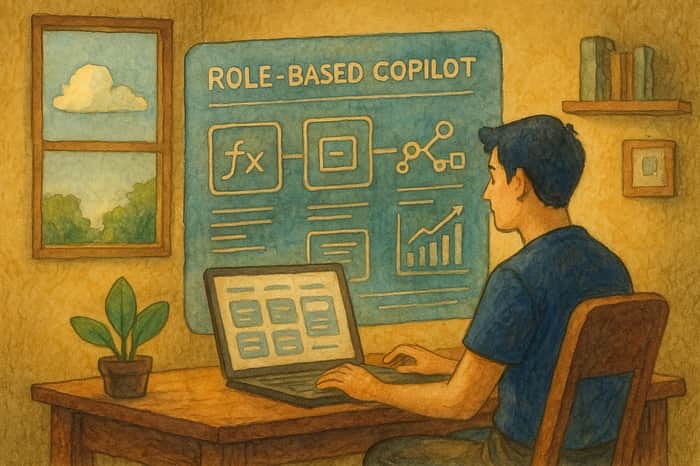
Microsoft’s Role-Based Copilot helps indie SaaS makers save time, build dashboards, and focus on real growth instead of repetitive tasks.
How Microsoft’s Role-Based Copilot Can Help Indie SaaS Makers
If you’re building a SaaS on your own—or with a tiny team—you know how much time gets eaten up by setting up dashboards, formulas, and workflows. Every hour spent debugging or dragging data around is an hour not spent improving features or talking to users.
That’s why Microsoft’s Role-Based Copilot in Power Platform is worth checking out. It adapts to your role and helps you build, automate, and analyze faster—without making you wrestle with spreadsheets or code you barely understand.
How It Works for Different Roles
For makers: Copilot can suggest formulas, create screens, and set up filters for dashboards. Basically, it handles repetitive setup so you can focus on improving your product.
For admins: It can spot slow points or gaps in your internal tools before they turn into bigger problems.
For non-technical teammates: Copilot summarizes your data in plain language, so anyone on your team can understand what’s happening without asking you to explain it.
Applying Copilot in a Real Indie SaaS
Say you’re building a freelance job-tracking SaaS. You need a dashboard that shows:
Which clients are active
Which invoices are still unpaid
Project status by priority and due date
Normally, creating this dashboard takes hours—writing formulas, adding galleries, and setting up filters. With Copilot, you just tell it what you need:
“Show all active projects with overdue invoices and filter by priority.”
Copilot suggests the layout, formulas, and filters. You save time, avoid mistakes, and can spend those extra hours building features your users actually care about.
Why Indie Hackers Should Care
Save time: Automate tedious setup work that normally drags you down.
Reduce mistakes: Get dashboards and workflows right the first time.
Focus on growth: Spend your energy on features, experiments, and talking to customers.
Think of it as having a helper who knows your tools and can handle the boring parts—without meetings, pushback, or equity.
Your Turn:
What’s the first repetitive task in your SaaS you’d hand off to Copilot? Drop a comment—I’d love to see how other indie hackers are using AI to build smarter, faster products.

This sounds interesting — a copilot tailored for indie makers could solve a lot of context-switching pain. One question: how would you scope the “roles” (e.g., founder, marketer, developer)? Each has very different needs, and narrowing focus early might help adoption. Have you thought about testing it with a small group of solo founders first?
exactly — starting with solo founders makes sense, since they juggle everything. roles could be scoped by primary task focus: founder (growth & product), marketer (campaigns & analytics), developer (dashboards & workflows). test small, iterate fast
Scoping by primary task focus keeps it practical without overwhelming early users. Curious—when you say “test small,” are you thinking closed beta with a few founders you already know, or an open waitlist to see who resonates? The rollout approach could shape the kind of feedback you get.
From my experience, even solo founders don’t always follow “ideal” workflows—they skip features, improvise, or ignore dashboards you’d expect them to use. That’s why a tight closed beta with 5–10 real solo founders works best: you catch actual usage patterns, friction points, and workarounds that reveal which roles and automations truly matter, instead of relying on assumptions or broad waitlist feedback.
That’s exactly why I’d go for a slightly more complete stack long-term. I’m a full-stack developer, so I’d lean toward replacing Lovable gradually with a custom setup—probably Next.js or Remix on the front end, Supabase/FastAPI on the backend, and a clear modular structure for scaling features later.
Makes sense—gradually swapping in a full-stack setup is practical. Keeps things flexible now while giving you a solid foundation to scale features properly later.
Exactly — modular design gives you breathing room to evolve without breaking what works. Once the MVP stabilizes, you can decouple key services.
I came across your Indie Hackers profile ... really like your approach to building fast MVPs. When you take on websites or apps for clients, what’s your process like, and what do you do differently to get things done efficiently?