SaaS Pricing Models: How Top 1% Founders Lock In Pricing Power Before AI Commoditizes SaaS (POST-AI SaaS PRICING STRATEGY
There is a conversation happening inside your company right now. A renewal came in lower than expected. A sales cycle stretched longer than it should have. A competitor showed up offering something comparable at a fraction of your price. A board member asked about net revenue retention and nobody answered with real conviction.
It's tempting to write these off as isolated incidents — a rough quarter, a noisy market, an aggressive competitor. They are not isolated. According to Robert Moment, SaaS advisor and author of SaaS Pricing Models, these are the earliest signals of a pricing model built for a world that artificial intelligence has already restructured.
"The founder who controls their pricing controls their destiny. The founder who copies someone else's pricing model inherits someone else's ceiling."
This is the premise behind SaaS Pricing Models, the book veteran SaaS advisor Robert Moment wrote for founders, boards, and investors navigating a pricing landscape that changed faster than most companies' pricing pages did. AI has not simply introduced new competitors into the SaaS market. It has commoditized the value layer that most SaaS pricing was originally built on top of. If your price is anchored to a feature an AI tool can now replicate, you are no longer competing on product — you are competing on perception, and perception is a battle that erodes quietly, long before the revenue line admits it.
Why Your Dashboard Won't Warn You in Time
The uncomfortable truth at the center of Moment's work is that pricing decay rarely shows up where founders are trained to look. ARR can still be climbing while pricing power is dissolving underneath it. Renewals can still be closing while champions quietly disengage. Sales can still be hitting quota while every deal requires a larger concession than the one before it.
Moment calls this the gap between what your dashboard shows and what is actually happening to your pricing power — and closing that gap before the board meeting forces the conversation is the entire purpose of the book. Rather than offering another generic pricing philosophy, SaaS Pricing Models hands founders six proprietary diagnostic and prescriptive frameworks built from eleven years of pattern recognition inside SaaS companies at every ARR stage.
The Six Frameworks Inside SaaS Pricing Models
Each framework in the book answers a different question. Together, they form a complete diagnostic-to-rebuild sequence: find the decay, measure its severity, locate where it lives in your product, and then build the architecture that makes your pricing durable again.
-
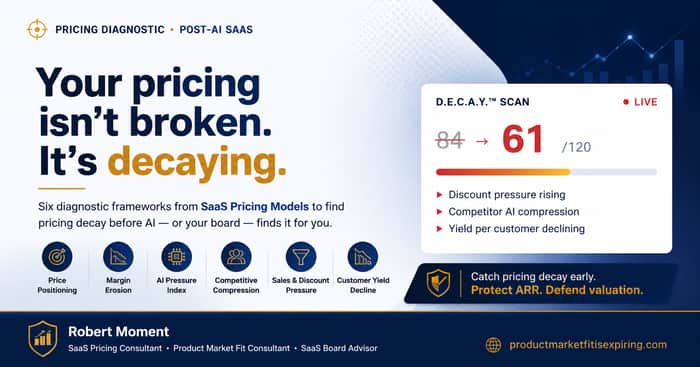
The D.E.C.A.Y.™ Model — The Five Silent Signs
D.E.C.A.Y.™ is the earliest-warning diagnostic in the suite, designed to reveal pricing erosion months before it reaches the revenue line. It tracks five signals:
— Discount Pressure Rising — Customers negotiate harder and discounts that used to be exceptions become the default.
— Expansion Revenue Slowing — Existing accounts stop growing because a usage ceiling has been hit or value delivery is in question.
— Competitor AI Compression — A competitor or AI tool offers a comparable outcome at a fraction of the price, and your differentiation story starts losing deals.
— Acquisition Costs Increasing — Customer acquisition costs climb as your differentiation blurs in the eyes of the buyer.
— Yield Per Customer Declining — Average contract value shrinks at renewal as discounting becomes structural rather than occasional.
Moment recommends running a D.E.C.A.Y.™ scan quarterly, and always before a repricing decision or an investor conversation that touches pricing. It takes about fifteen minutes and can be worth millions in recovered revenue — or in avoiding a repricing move the data doesn't actually support. -
The A.I.R.™ Score — AI Irreplaceability Rating
The A.I.R.™ Score answers a single, board-ready question: how defensible is your product against AI, really? It scores six dimensions — proprietary data advantage, workflow integration depth, switching friction, network effects, human dependency, and embedded operational complexity — each worth up to 20 points, for a total possible score of 120.
A score above 85 signals genuine defensibility. Between 65 and 84 means real but addressable vulnerabilities. Between 45 and 64 suggests AI compression is likely already underway in your customer base, even if your renewal numbers haven't confirmed it yet. Below 45 is a critical finding — one that calls for a redesigned pricing model, not a patch. Moment recommends running the score before any board presentation involving competitive positioning, before a growth round, and any time a lower-priced AI-driven competitor enters your category. -
The Revenue Illusion Gap™
This framework is built for companies whose top-line metrics look healthy while their strategic position quietly deteriorates underneath. It measures six variables — hidden churn risk, renewal quality, discount dependence, PMF drift signals, AI exposure, and pricing fragility — to reveal the space between what your dashboard reports and what's structurally true. It is especially relevant for growth-stage companies heading into a Series B or C, where investor diligence will surface this gap whether or not the founder has measured it first. -
The AI Compression Map™
Where the D.E.C.A.Y.™ Model tracks decay over time, the AI Compression Map™ shows where AI is attacking your pricing architecture right now. It sorts every product module into one of five zones, from Zone 1 (deep integration, low risk, pricing power intact) to Zone 5 (an AI wrapper with no proprietary moat, where pricing redesign is urgent). Each zone carries a different timeline: Zone 3 products typically have twelve to eighteen months before drift accelerates; Zone 4 and 5 products require immediate architectural response, not incremental fixes. -
The PMF Drift Index™
Product-market fit is not a milestone you hit once — it is a condition that can degrade. The PMF Drift Index™ tracks pricing resistance frequency, sales friction, lost-deal patterns, feature usage decline, AI feature overlap, and customer urgency to measure how far a company has drifted from the value customers originally paid for. Because revenue is often the last metric to reveal this drift, by the time ARR confirms the problem, pricing power is already gone and the eventual rebuild costs far more than an early correction would have. -
The V.A.U.L.T.™ Framework — Rebuilding Pricing Power
V.A.U.L.T.™ is the only prescriptive framework of the six — the architectural response once the first five diagnostics have identified what's broken and how severely. Its five pillars:
— Value Anchoring at Renewal — Every renewal is preceded by documented, quantified value delivery, so price is only ever challenged when value has become invisible.
— AI Differentiation Layer — A proprietary AI capability built on your own data moat, one that improves with every customer interaction and can't be replicated without your training data.
— Usage-Based Expansion Path — Pricing that scales automatically with customer success rather than capping revenue at the point of signing.
— Lock-In Through Operational Depth — Your product embedded in the workflows and institutional habits that make switching costly in consequence, not just in contract terms.
— Trust Compounding Over Time — Pricing power at renewal is built starting in month one — every interaction either deposits into or withdraws from the trust account that determines whether a renewal requires negotiation at all.
Moment is direct about sequencing: V.A.U.L.T.™ applied without the diagnostic foundation of the first five frameworks is renovation without a structural survey. It might help. It might also miss the load-bearing wall entirely.
Why This Matters More Than Ever
The founders winning in the current environment are not necessarily the ones with the strongest technology. They are the ones who understood — before their customers started questioning it — what they were actually selling. SaaS Pricing Models exists to give founders, executives, and boards that understanding before the next renewal, board meeting, or funding round forces the issue into the open.
Moment's companion volume, SaaS Pricing Strategy, extends this work with the G.O.L.D.S.T.A.N.D.A.R.D.™ Pricing Model — a twelve-step system for building, defending, and compounding pricing power as AI accelerates every form of competitive pressure a SaaS business faces. Together, the two books form a diagnostic-to-execution playbook for pricing in the post-AI SaaS market.
Five Reasons to Have a SaaS Pricing Conversation with Robert Moment
Robert Moment works directly with SaaS founders, executives, and boards to diagnose and rebuild pricing architecture before it becomes a board-level crisis. Here are five reasons founders reach out to him.
-
Your product-market fit may be expiring, and you haven't seen it yet. Product-market fit is not a one-time milestone — it is a living condition that degrades as markets shift and AI redefines what "good enough" looks like in your category. The signals are usually already in your data: longer sales cycles, softening net revenue retention, renewal conversations that now need a discount script where value used to sell itself. Most founders Moment works with are further along this degradation curve than they realized.
-
Your pricing is set, but the defense architecture around it is missing. A number on a pricing page is not a pricing strategy. What's usually missing is the value narrative your team delivers consistently, the packaging that guides buyers to the right tier, and the renewal framework that makes discounting unnecessary. Moment has seen every version of the internal excuse — a market problem, a messaging problem, a timing problem — when the real issue is systemic. He builds the system, and the organizational capability to run it.
-
AI has entered your category, and your response is tactical where the threat is structural. When a competitor offers a fraction of your functionality at a fraction of your price, feature upgrades and price concessions treat the wrong layer of the problem. Moment's AI Pricing Defensibility work identifies your switching-cost gaps, your proprietary data advantages, and your value augmentation opportunities — then builds the architecture that makes displacement economically irrational for your buyer before your next competitive evaluation.
-
Your enterprise deals keep closing below your initial ask. A strong product and a credible demo too often end in a final contract 20 to 30 percent below where the conversation started — and that gap compounds into every future renewal. This is a negotiation architecture failure, and it's correctable. Moment builds the pre-deal positioning, the minimum contract value governance, and the ROI case that changes what happens in the room before procurement opens the discount conversation.
-
You're preparing to scale, and the pricing architecture needs to be in place before the sales team is. The most expensive pricing mistake in SaaS is building a sales team on top of pricing assumptions that were set in an afternoon and never tested against real buyer behavior. Every rep who joins inherits those assumptions; every manager who trains them reinforces them. Moment builds the pricing architecture before the headcount arrives, so the team compounds the business instead of amplifying its weakest assumptions.
As Moment puts it: seventeen years of coaching, eleven years inside SaaS specifically, and one question worth asking — what would it cost your business to leave your current pricing architecture in place for another year? If that number makes you uncomfortable, the conversation is worth having.
About Robert Moment
Robert Moment is a SaaS Pricing Advisor, Product-Market Fit Consultant, and SaaS Board Advisor with seventeen years of coaching and consulting experience, eleven of them spent exclusively inside the SaaS industry. He has advised founders at every ARR stage — from the $1M-ARR company losing enterprise deals it should be closing, to the $10M-ARR company whose pricing has quietly stopped working before the board says so out loud.
His practice sits at the intersection of three disciplines most consultants treat separately: product-market fit, pricing architecture, and go-to-market execution. Robert is the author of eight books on SaaS growth and pricing, including SaaS Pricing Models and his most recent work, SaaS Pricing Strategy, which introduces the twelve-step G.O.L.D.S.T.A.N.D.A.R.D.™ Pricing Model. Founders who work with him leave with a pricing architecture they can defend in any board meeting, a value narrative their sales team can deliver consistently, and a renewal base that expands rather than negotiates.
Ready to Diagnose Your Pricing Power?
The right time to diagnose a pricing problem is before your customers diagnose it for you. If any part of this article sounded familiar — a renewal that came in soft, a competitor undercutting you with an AI-powered alternative, enterprise deals closing below your ask — the conversation is worth having now, not after the next board meeting.
Robert Moment
SaaS Pricing Advisor | Product-Market Fit Consultant | SaaS Board Advisor
Author of SaaS Pricing Models and SaaS Pricing Strategy
Email: Robert@productmarketfitisexpiring.com
Website: productmarketfitisexpiring.com
