SaaS Product-Market Fit: The 10-Minute Test Every Founder Should Run
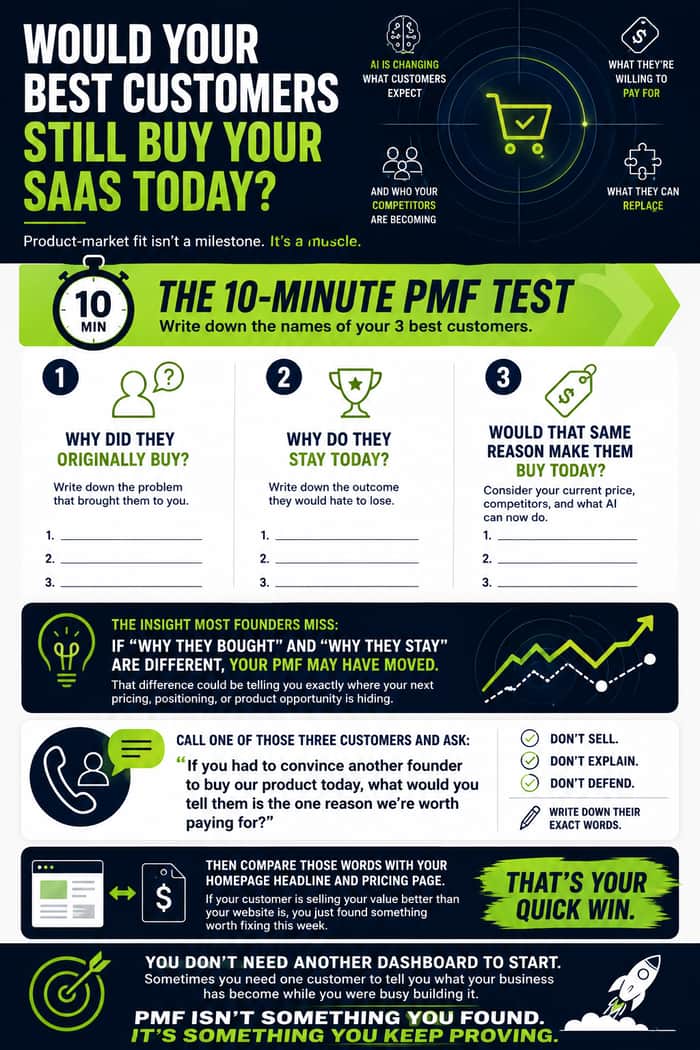
Here’s a question I think every SaaS founder should ask:
If you launched your exact product, at your exact price, into today’s market—would your best customers still buy it?
Not when you first found product-market fit.
Today.
AI is changing what customers expect, what they’re willing to pay for, and what they can replace.
So instead of guessing whether your PMF is still strong, try this.
The 10-Minute PMF Quick Win
Write down the names of your 3 best customers.
Next to each one, answer these three questions:
- Why did they originally buy?
Write down the problem that brought them to you. - Why do they stay today?
Write down the outcome they would hate to lose. - Would that same reason make them buy today?
Consider your current price, competitors, and what AI can now do.
Now compare your answers.
Here’s the insight most founders miss:
If “why they bought” and “why they stay” are different, your PMF may have moved.
And that difference could be telling you exactly where your next pricing, positioning, or product opportunity is hiding.
Before building another feature, changing your pricing, or spending more on acquisition, call one of those three customers and ask:
“If you had to convince another founder to buy our product today, what would you tell them is the one reason we're worth paying for?”
Don't sell.
Don't explain.
Don't defend.
Write down their exact words.
Then compare those words with your homepage headline and pricing page.
If your customer is selling your value better than your website is, you just found something worth fixing this week.
That’s your quick win.
You don't need another dashboard to start.
Sometimes you need one customer to tell you what your business has become while you were busy building it.
PMF isn’t something you found. It’s something you keep proving.

The best part of this test is that it forces founders to use the customer's current language, not the founder's original thesis. I would add one more comparison: look at the last support request or cancellation reason from that customer. If the words they use when buying, staying, and struggling are all different, the homepage probably should not be optimized around the oldest version of the problem.
The “why they bought vs. why they stay” distinction is a useful one. Those two answers drifting apart seems like a much stronger PMF signal than simply looking at retention in isolation.