Show IH: Hizzr - Anonymous messaging app that actually lets you chat back (and why we prioritized moderation over features)
Hey IH,
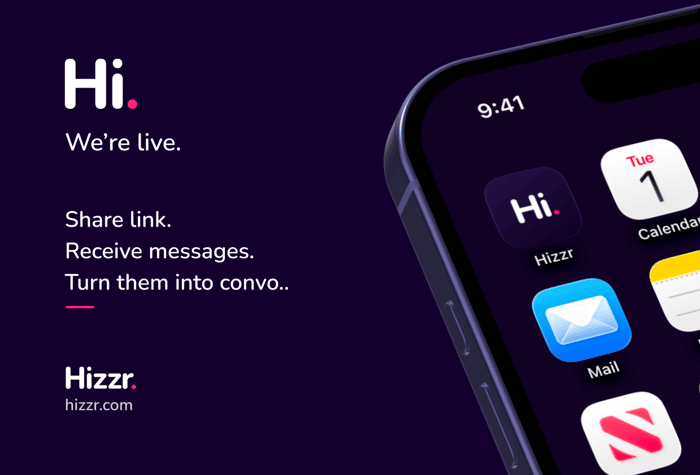
I'm one of the co-founders of Hizzr.com, an anonymous messaging app we launched this week on both iOS and Android, built out of Dubai.
The idea isn’t new. The execution is. You share your link. Someone sends you an anonymous message. Instead of it being a dead end like every other anonymous app, you can actually chat back. The sender stays anonymous the whole time. You never find out who they are unless they choose to tell you.
We built this in 4 months as a side project alongside full time jobs. Three co-founders, bootstrapped.
Why we built it:
NGL just got acquired after a $5M FTC fine for sending fake messages to its own users. Sendit is facing a DOJ lawsuit for the same reason. Sarahah got 300 million users and made almost no money because they never built monetization. Every anonymous app either died from fraud or died from lack of business model.
We think the category keeps coming back because the human need is real. People have things to say that they can't say with their name attached. We just wanted to build the version that's actually honest about what it is.
What makes it different:
Most anonymous apps are one-way. You get a message, feel a rush, and it ends there. We extended that moment into a real conversation. The sender stays hidden but the dialogue continues. That's the feature every competitor stopped short of building.
How we approached safety:
This was non-negotiable from day one. We've seen what happens when anonymous apps treat moderation as an afterthought. FTC fines, DOJ lawsuits, app store removals. We built AI powered moderation into the core of the product before we wrote a single line of UI code. Every message is screened in real time. Harmful content gets flagged before it reaches the recipient. We also have human review for edge cases and a straightforward reporting flow built into every conversation.
We're not naive. We know moderation in anonymous social is an ongoing battle not a solved problem. But we'd rather be slow and clean than fast and sued.
What we're trying to figure out:
Retention is our biggest unknown right now. Anonymous apps historically spike hard and drop off fast. We've built streaks, notifications, and a feed mechanic to create reasons to return but we genuinely don't know yet if it's enough.
Would love honest feedback on:
1. The cold start problem. How do you make the app feel alive for new users who haven't received any messages yet?
2. Monetization. We have regional pricing from $1.19/month (India) to $4.99/month (US). Does that feel right for this category?
3. Safety. We have AI moderation live from day one. What are we probably not thinking about?
Live on iOS and Android now.
hizzr.com

Interesting take on a category that’s honestly been through a lot of cycles already.
What stands out here is less the “anonymous messaging” idea (which we’ve seen before) and more the decision to make it two-way by default. That actually changes the dynamic in a meaningful way.
The moderation-first approach is also the right instinct in this space. A lot of apps learned too late that anonymity without strong safeguards just doesn’t scale.
The real challenge you’re pointing at — retention after the novelty spike — is probably the hardest problem in the category, not just for you but historically for all similar products.
Curious to see if the “ongoing conversation” mechanic is enough to create repeat intent, or if anonymity naturally caps long-term engagement 👏
Thanks. The two-way mechanic was the founding insight, but you’re right; it doesn’t automatically solve retention. It extends the interaction, but doesn’t guarantee habit formation.
Our current bet is that ongoing anonymous conversations create a different kind of attachment compared to one-shot messages - more like a pen-pal dynamic than a quick dopamine hit. But we’re only 4 days in, so that’s still a hypothesis we’re stress-testing in real time.
The question of whether anonymity naturally caps long-term engagement is something we don’t have a clear answer to yet. What we do think is that almost every app in this category died before finding out - either because of fraud, moderation issues, or no viable business model. We’d at least like to survive long enough to get a real answer to that question.
Will share retention numbers once we have a meaningful enough window to look at.
The moderation-first stance is the right call given what the category did to itself. The bigger question worth wrestling with is the monetization tension. Anonymous messaging is a category where the obvious revenue models (ads against chats, paid reveal, lead-gen on the recipient side) all push against the trust layer you're trying to build. Sarahah dying from no business model and NGL dying from a fake-message business model are two sides of the same problem. Curious how you're drawing the line on what you'll be willing to charge for, because that one decision will shape every other product call you make.
You’re right that most of the obvious revenue levers in this category are trust-destroying by design. Where we landed is - charge the receiver, not the sender. the person with the audience has the most reason to pay. Our subscription unlocks the ability to receive more messages and manage conversations at scale. The honest answer is we still don’t know if that’s enough to build a real business. We’d rather discover the business model is smaller than expected than discover we broke the product trying to make it bigger.
Hizzr has the right product hook, but the name adds friction.
For anonymous messaging, trust and recall matter more than novelty. “Hizzr” feels a bit app-store/viral, but the product is trying to position itself as the safer, cleaner version of a risky category.
That mismatch matters.
If you’re serious about making this more durable than NGL/Sendit-style apps, the brand needs to feel less like a quick social app and more like a trusted conversation layer.
Xevoa.com would fit this much better.
Short, cleaner, modern, and broad enough if Hizzr grows beyond anonymous messages into private social/chat infrastructure.