Show IH: Web3 Verifier Agent – Conversational scam checker built for the Algolia Agent Studio
Hey Indie Hackers,
Just wrapped up an entry for the Algolia Agent Studio Challenge on dev.to: Web3 Verifier Agent 🔍
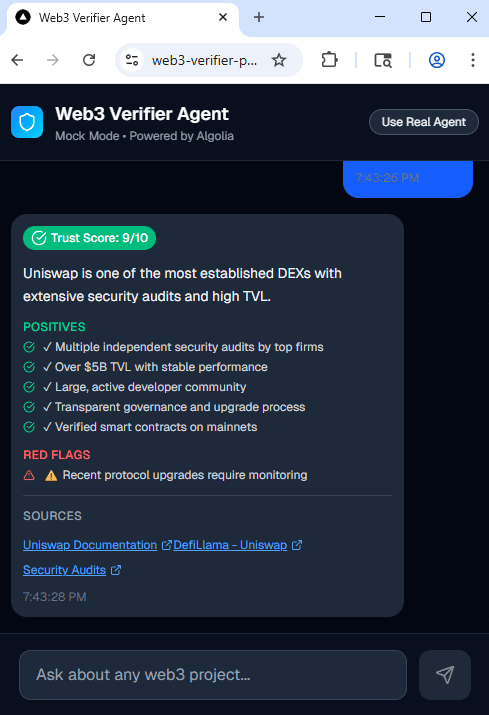
It’s a chat-based tool that lets you ask things like:
"Is this Solana memecoin safe?"
"Any red flags on this DeFi protocol?"
"Check audit status and community trust for Aave"
The agent replies with:
Trust score (1–10)
Evidence summary (audits, TVL stability, verified contracts, recent sentiment)
Clear positives first, then red flags
Sources/citations so you can verify
Why? Rug pulls and scams have stolen billions — I wanted something conversational and grounded in real data instead of generic LLM guesses.
How it works
Frontend: Next.js 15 + Tailwind (dark-mode chat UI)
Backend brain: Algolia Agent Studio (natural-language flows + retrieval from a small index of ~100 projects)
Data: Mocked from public sources (DefiLlama, Etherscan, etc.) for MVP
Prompt: Tuned to be neutral, evidence-based, and transparent ("Retrieve top matches, compute score, cite everything")
Repo: https://github.com/datadr1ven/Web3Verifier (code + setup notes)
Full write-up + demo on dev.to: https://dev.to/datadr1ven/web3-verifier-agent-fight-rug-pulls-with-ai-powered-due-diligence-2c0n
What I learned
Agent Studio is surprisingly powerful for low-code retrieval + dialogue — most of the agent logic is just good prompt engineering.
Retrieval makes a huge difference vs. pure LLM — no hallucinations on TVL or audits.
Conversational trust tools feel more human than static scanners.
Would love your thoughts:
Useful in real life or too niche?
Any red-flag signals I should weight more heavily?
Does the chat UX feel intuitive?
Roast away — is this just reinventing a scanner?
Thanks for reading! Open to feedback, ideas, or just "why bother" comments 😄

Web3 desperately needs better scam checkers. But in a space full of rugs, the verifiers own identity is the biggest hurdle. Have you considered how a high trust anchor like SafeAIy would affect your conversion rate compared to a standard .ai or .io?