Signs Your Company Needs a Custom Software Solution
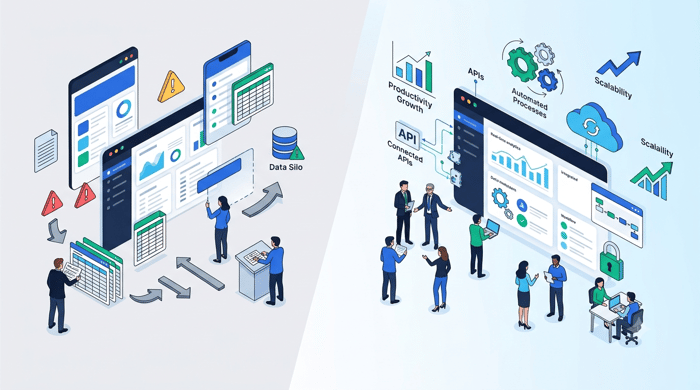
A Quick Overview
Customer expectations are increasing day in, day out; all thanks to rapid digital change! Work has never been so complicated for business professionals, and above all, competition is extremely high - does this ring a bell? All you need to do is adapt and evolve. Let’s be real: the market conditions are changing at a breathtaking pace; customers can no longer be easily satisfied as earlier; and, above all, there are evolving technological advancements. There was a time when generic tools or off-the-shelf software gave some relief; however, this doesn’t seem to be the case anymore, especially after the inception of custom software development.
Pick any industry vertical you want, be it retail, healthcare, education, finance, real estate - every business will be found depending heavily on different softwares to manage operations, serve customers, and grow slowly and steadily. However, you will come across a wide range of off-the-shelf solutions including ERP systems, CRMs, project management tools, and so more. The problem is these generic software and these systems don’t always fit in a perfect manner.
Now, before we begin with prominent or obvious signs your company needs a custom software solution, let’s take a bit of a detour and focus on off-the-shelf solutions.
Understanding the off-the-shelf solutions
What is an off-the-shelf solution? Often known as commercial-off-the-shelf (COTS) software, these are pre-packaged software solutions which are available for purchase and used by the general public or specific industries. These solutions are designed to cater for a wide range of users and offer a wide range of functionalities.
- COTS software is available in the ready-to-use format, and there is no need for extensive development.
- These kinds of softwares are designed to meet the needs of a broad user base, offering standard features and functionalities.
- These softwares can be commercially purchased, licensed, and implemented in no time, and it doesn’t require to conduct custom development.
- These softwares are maintained by the vendors, which means you will be able to notice regular improvements and bug fixes.
- In addition, these softwares are extremely cost-effective, deployed quickly, supported by vendors, and always adhere to current industry standards and regulations.
So where does the problem lie?
- Lack of customization
- Businesses have to make workflow adjustments to fit the capabilities of the software.
- Numerous COTs softwares have often been targeted for cyberattacks; lots and lots of data have been put at risk.
- Additional costs are often associated with premium features and upgrades.
- COTs software might not scale effectively with the ever-growing business needs. And upgrading them can be quite costly and complex.
In addition to all these concerns, a one-size-fits-all approach doesn’t work well, especially in today’s time where things keep on changing every now and then. So of course, you can consider using commercial off-the-shelf software packages; it can definitely get your business off the ground, but later on, it might not scale well.
You see, no two businesses are the same; each one has a unique goal and plans which these off-the-shelf generic softwares might not give a proper boost. So what is the cookie-cutter approach? Simple, think of some well-tailored solutions. Time to take a bit of a detour and switch to custom software development solutions.
What is custom software?
The world seems to be craving for more and more apps; from businesses to individuals, everyone wants to make it big! The moment you decide to conduct a software development project, time to make a choice regarding whether to choose custom software and an off-the-shelf-software. Well, custom software is developed to meet the unique needs of a business. After having a better understanding of workflow goals, and challenges, these softwares are created. On the contrary, when we talk about off-the-shelf software, they are developed for a wider audience and offer a standard set of features which are intended to suit several businesses at once; however, this is not at all guaranteed.
Now, as we all know, every small or large business operates at a different pace; conducting custom software development projects means it is possible for organisations to incorporate features which are extremely important, and each one of these, even the minor ones, is created on the basis of pre-defined requirements. This approach certainly assists well in improving productivity and lessens lots and lots of confusion or misinterpretations, since there are no unnecessary options.
Above all, the level of customisation and personalisation is lower with off-the-shelf solutions, since they are developed to adhere to general use cases instead of specific business goals.
Why must businesses invest in custom software right away?
By now, you have realised the fact that off-the-shelf software works when the need is basic; if you want anything personalised, custom software is your one-stop solution. Can you call a successful business basic? Of course not! A successful business can never be basic, and each has its own set of challenges and complexities to address, such as ensuring a unique customer journey, complex approval procedures, protecting a sensitive bunch of data, and more. This is where you need a custom software development approach.
As mentioned earlier, this kind of software is solely made to address your business needs and goals in particular, so in very many ways they are different from packaged softwares.
Further, I would like to mention a few signs stating that your business requires custom software.
Signs Your Company Needs a Custom Software Solution Right Away!
1. Manual processes are slowing down.
One of the obvious signs to consider is that manual procedures are slowing down growth now and then. There are businesses which are found heavily relying on spreadsheets, emails and handwritten records, due to which the growth becomes pretty limited.
Manual work usually causes delays, errors and definitely hinders overall productivity; however, this is a huge concern even if you want to survive in the current fast-paced industry. Custom development solutions are meant to automate workflows and definitely lessen human errors. As a result, whatever you do will be the best outcome. In addition to an increase in productivity and efficiency, scalability is pretty important when it comes to custom software development. And if you are willing to grow further, this is supposed to be your best bet!
2. Your current tools aren’t meant to address unique business challenges anymore.
There is something I can guarantee you: your off-the-shelf tool cannot fully support every process of the business. Every business is unique, and so are their procedures, such as different customer onboarding journeys. There might be times when you require different compliance needs, especially during times when generic platforms are restrictive, slow and need endless workarounds. This is it! It’s time to make a decision and consult a reputable custom software development company. Make sure you develop a system which adjusts in accordance with your business and not the other way around.
3. The Operational costs keep on increasing.
The next sign to take into account is the operational costs. Every business runs on a proper budget, and if the operational costs keep on increasing now and then, you end up overspending unnecessarily. Have you given a thought to the cost of commercialising, subscription renewals and integrations? And since we are talking about running a business, it means investing in tools and systems, which can drain finances in no time.
Commencing a business is no easy task; you might need to buy a lot more features than are actually required. Also, off-the-shelf solutions tend to have higher up-front costs, and as far as custom software is concerned, you are no longer linked with recurring licenses, additional add-ons, and platforms which teams do not even use properly. As a result, opting for bespoke software solutions is the best route to consider.
4. You are still managing with the help of spreadsheets
Well, there is nothing wrong with managing the business using spreadsheets, but they are outdated. Spreadsheets are pretty useful, but do not confuse them with business systems.
Let’s say you are running a business which is heavily focused on Excel or Google Sheets; it means you need to choose custom software right away. Common issues that arise when using spreadsheets include:
- Version conflicts
- Manual data entry errors
- No real-time collaboration control
- Limited automation
- Security risks
So in a way, spreadsheets are no longer of much help! In fact, several brands are found facing issues when it comes to spreadsheets. When exactly does a company need to stop relying on spreadsheets and consider custom software? When you find that data is driving almost every decision. Custom software centralises workflows and eliminates manual tracking.
5. Your systems no longer seem to be in sync.
Much like your employees, it is very important for systems to be in sync with each other. Right from marketing tools to CRM, accounting tools, and inventory systems, each works on an independent basis.
As a result, data silos, duplicate entries can be taken care of, conflicting reports, and poor customer visibility can be taken care of. Integration limitations are classic business software limitations, solutions, and challenges. All you need is custom software which connects systems via APIs and centralised databases. The entire team is united in one place.
So employees no longer have to keep switching tabs all day; they can work on a unified ecosystem. Since all the systems become well-integrated, your business operations are bound to run 35% faster, and you can gain clear insight into real-time stock and sales.
6. You cannot get accurate reports.
Since all the systems aren’t much in sync, you are bound to face issues such as inconsistent or delayed reporting. Believe it or not, this one is a complete red flag. Now, do you know what happens when you are unable to have a clear vision of what is going on among sales, finance and operations? Simply, you are no longer able to make data-driven decisions.
On the contrary, when you use custom softwares, you are bound to receive real-time dashboards featuring several important metrics which are pretty relevant and worth considering. Overall, decision-making becomes faster and more accurate, and it is possible to spot relevant opportunities or issues way before your competitors do.
7. Losing customers
Everything is related, be it directly or indirectly. If the systems don’t work well in sync, they will not give proper results, or proper decisions won’t be made. In the end, all this will certainly lead to a loss of leads and customer requests.
Some of the worst outcomes include missed inquiries, lost follow-ups, and delayed responses, a major turn-off for any and every customer. Here you need a tailored CRM or customer management tool that ensures every lead, quote, or service ticket is handled on time. That consistency improves customer satisfaction and keeps revenue flowing.
8. Data security and compliance are becoming a major concern
With the increase in cybersecurity breaches, every business, irrespective of size and industry vertical, is supposed to keep up with current industry compliance and security standards.
Right from healthcare to BFSI, government, logistics, HR, Real estate, and more, data security and compliance have become a must. Also, there are a set of strict guidelines which are supposed to be maintained. Using off-the-shelf-solutions here, which cannot comply seamlessly or cater to all the rules and regulations of the industry, means the business is lacking in terms of several advanced features. So what exactly happens when you opt for a custom software development project?
- Role-based permissions
- Secure authentication
- Audit trials
- Encryption
- Compliance configurations
- Automated reporting
Overall, this lowers risk, works well by enhancing data privacy and definitely increases customer trust in the long run.
9. Off-the-Shelf Software Is Limiting Your Growth
There is no denying the fact that off-the-shelf software offers very little flexibility and scalability in comparison to custom-made software. Reputable and reliable web development companies are hired to create solutions for a wide range of clients, and appropriate features and functionalities are developed,d which can definitely give an instant boost to the organisation. Not to mention, one decision to opt for custom software development can lead to an instant competitive advantage.
It’s not that off-the-shelf software doesn’t offer customisation at all; it does, but upto some extent. Here, customisation is pretty limited in terms of adding the logo, choosing visual themes, and rearranging different fields. The only concern is that as soon as you think you have been acquainted with the tool completely, the tool has already reached its limits.
10. You are willing to gain a competitive edge.
Every business is willing to gain a competitive edge. Tell me, who doesn’t want to stay relevant or ride the wave of digital transformation? And in today’s time it has become pretty necessary and mandatory. According to Statista, those brands which are bound to spend over $3.4 trillion in 2026 have succeeded in conducting proper digital transformation.
If you are willing to modernise, it is extremely important to have a solid foundation built with the help of a trusted software development company which understands scalable digital infrastructure.
Custom software offers seamless AI integrations, scalable architecture, advanced analytics, and workflow automation. So it’s high time to switch to custom software.
When is the right time to switch to custom software?
- When you find your employees relying heavily on spreadsheets
- When reporting takes hours and hours instead of a few minutes daily
- When manual tasks dominate workflows
- When software subscriptions keep on increasing
- When systems lack in terms of integration
- When everything feels operationally difficult, and there is no further scope for growth.
However, you can stick to off-the-shelf softwares when you know all procedures are standard, team size isn’t big, budget is limited and growth complexity is low. And choose custom software solutions when operations are unique, scaling is rapid, integration is critical, and automation drives growth.
It is very important to understand that timing matters the most. Waiting for too long can definitely increase operational debt. Companies measure software cost but often ignore the fact that in saving a few bucks, they are losing productivity and efficiency. In addition, switching tools tends to lose focus on a repeated basis, small delays can cost a great amount of money, choosing a custom software solution can remove all the friction points, and businesses can successfully deliver massive value.
Here you need to invest once and benefit for a longer period of time. Always keep this in mind: conducting a custom software solution isn’t about replacing the software entirely, but more or less it's about developing software or a solution which aligns perfectly with the way the business operates.
Conclusion
On and all, it is extremely important to spot the proper signs regarding why your business needs custom software. One small change in decision can definitely make all the trains run smoothly and assist in avoiding bottlenecks as much as you can. It has been observed that businesses, no matter how big, small or mid-size they are, or whatever industry vertical they are in, have gained a competitive edge by simply surpassing generic software solutions.
Now all you have to do is pick a reputable and reliable software development company which has enough experience and expertise in assisting their valuable clients who are gearing towards growth, automation, and digital transformation. Make sure they have the potential to develop custom-based software which aligns seamlessly with your current business operations. Good luck with your upcoming project venture, and lastly, always follow your guts; if you feel generic tools no longer work, a custom software solution is your next move.
I hope you did find the following post worth taking into account. In case if you still have any further doubts or queries, feel free to mention them in the comment section below.

The signal I'd add to this list: when your team is spending more time building workarounds for the tool's limits than actually using it. That's usually the tell that customization has hit its ceiling, well before anyone explicitly decides "we need custom software." At 6senseHQ we see this pattern a lot with mid-market companies — they've outgrown the SaaS tool but aren't sure if that means a full custom build or just a smaller integration layer on top of what they have. Worth stress-testing that question before committing to either path, since "custom software" can mean a $15k integration or a $300k platform depending on how far the gap actually goes.