Staying Compliant: Four Payment Regulations For Recurring Transactions
One of the key concepts in payments that has completely revolutionized the eCommerce market is the subscription business model.
Over the past decade, recurring payments, especially for streaming services, gym memberships, or magazine subscriptions, have made it clear that this is the model for the future.
And let’s not forget that major corporations like Adobe or Microsoft are moving to the recurring automatic billing rather than relying on one-time purchases for their products.
Due to the appeal of recurring revenue streams along with the push from the COVID-19 global pandemic, the subscription economy is no longer a theoretical concept but an economic reality.
If you don’t believe us, take a look at the results, which speak for themselves.
- The subscription economy is expected to reach $1.5 trillion by 2025.
- 69% of households have at least one subscription to a video streaming service.
- The average subscription business is growing 30%–50% annually.
But along with the accelerated adoption of recurring payments came the need to regulate the new landscape to ensure proper operational standardization and security.
So, how do you handle compliance effectively without losing your focus on what matters most, your product?
Well, here's a friendly suggestion: consider teaming up with a Merchant of Record.
Once we explore the payment regulations your subscription business needs to follow, you'll quickly see why a partnership with an MOR makes all the difference:
- The 4 Recurring Billing Regulations To Follow
- Is The Merchant of Record a Solution?
- How Can PayPro Global Help?
4 Recurring Billing Regulations To Follow
One of the major problems subscription businesses face is the rise of chargebacks.
Customers are issuing these disputes on their subscriptions for a number of reasons. While card schemes cannot directly influence consumer behavior, they can regulate the recurring billing landscape and set universal guidelines merchants must follow.
These rules prioritize consumer protection, emphasize the need to directly manage disputes, and maintain clear documentation on recurring automatic payments, which is vital in order for merchants to win chargebacks.
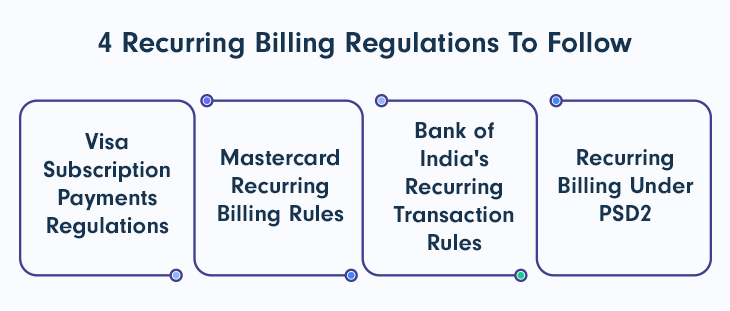
1. Visa Subscription Payments Regulations
Visa initially rolled out its guidelines in 2011, but key updates focused primarily on improving communication between businesses and customers came in 2020.
Keep in mind that these rules affect merchants accepting Visa cards and practicing free trials, upselling, and negative option billing (the cardholder has the right to cancel a subscription upon a specific point, as mentioned in the agreement, and should they fail to do so, implies their agreement to be billed for the product or service).
Now, let’s examine Visa’s regulations for subscription based services:
-> Detailed Disclosures
The new Visa free trial billing rules require merchants to offer enhanced disclosures that ensure informed consent, which consequently leads to reduced chargeback rates.
Additionally, Visa regulations require that you offer:
- Merchant details: name, address, phone, website, and billing information
- Customer information: payment data used to pay for the subscription service
- Payment currency
- Enhanced and accurate product description
- Trial period length, start, and end date
- End trial notice, clarifying and confirming in writing that the cardholder will be charged once the trial period ends.
- Initial transaction date and amount
- Future payment dates and amounts
- Cancelation rules and any helpful links
- Written notification of account changes for existing subscribers
- Written notification of how stored customer data will be used
Obtaining and storing informed consent from your customer is mandated for subscription businesses under Visa regulations.
-> Simplified Cancellation
It is crucial to provide cardholders with a straightforward subscription cancellation process.
This allows you to uphold the image of a legitimate operation, and cardholders will trust your services, thereby preventing chargebacks caused by suspicious merchant activity.
Therefore, subscription businesses are encouraged to offer customers simple unsubscription methods, such as SMS or email, and cancellation links provided in all communications.
-> Transaction Receipts
Once the cardholder has agreed to your subscription’s terms and conditions, even before a charge has been made, you must send transaction receipts, which should be electronically signed and sent via SMS or email.
The transaction receipts should contain the above-mentioned payment details, cancellation links, and instructions, as well as any changes or updates in the subscription terms.
-> Clearer Dispute Processes
In the Visa Claim Resolution Initiative released in 2018, the card scheme presented its list of chargeback reason codes.
To limit chargebacks, however, Visa implemented the following rules for subscription businesses:
- In free trial recurring charges, merchants are required to use unique billing descriptions that allow the cardholder to distinguish the transaction correctly.
- Once the trial ends, the merchant must use the phrasing “ongoing payment, recurring, or subscriptions” for clarification.
- Customers can file a chargeback if they have not been appropriately informed further billing will take place upon the trial's end.
- Businesses can fight chargebacks by providing compelling evidence to support their claims. This includes the cardholder's signature on associated legal and payment agreements, as well as evidence that notification has been sent to the cardholder at least seven days before the trial’s end.
Visa’s Compelling Evidence 3.0 (or “CE3.0”) initiative was created to help merchants solve the chargeback issue. Thanks to this initiative, merchants have a specific evidence to present through streamlined protocols.
-> Ongoing Monitoring
Visa will conduct ongoing monitoring to ensure compliance is achieved.
The card scheme will analyze your recurring indicator and statement descriptor to keep fraud and chargeback levels low.
Read more about recurring billing regulations on PPG Blog.
