Stop Flying Blind: How Trial Hook Helps Bootstrapped Founders Know Who's Actually Interested
You've got a landing page live. Maybe you threw it together in an evening just to see if anyone would bite. Then one morning, a notification appears - someone signed up. That moment feels electric.
But then you look at what you've got: an email address. Just an email address. And suddenly you're wondering - is this person a potential paying customer, or someone who'll never open another message from you?
This post is about closing that gap: getting real context behind every signup, without letting it eat your time.
The Landing Page Is Still Your Best First Move
There's a reason Y Combinator has been preaching "launch early" for years. You don't need a finished product to find out if anyone cares. A landing page with a clear value proposition and a single call-to-action tells you more about market fit than months of building in isolation.
Some of the most well-known companies - Dropbox, Robinhood - started exactly this way. A page, a promise, and a form. As one the fellow Indie Hackers contributors put it:
"The tried-and-true way of validating an idea is with a landing page… Dropbox, Robinhood, and others started this way."
Indie Hackers
Webflow, Carrd, Squarespace, Tally - you can have something live tonight. No backend, no production environment, no stress. Just a signal detector.
Keep the Form Short. Seriously.
Once people start arriving at your page, it's tempting to extract as much information as possible. Name, company, role, use case - all of it feels useful. It isn't. Not at this stage.
Research from CXL and Omnisend consistently shows that form length is one of the biggest killers of conversion. Every extra field is another reason to bounce. And even the people who do fill out long forms often just type whatever gets them through it fastest - leaving you with garbage data anyway.
Founders on Makerlog and Hacker News have shared the same lesson the hard way:
"I asked for too much up front and saw 70% fewer sign-ups."
"Shortened it to just email - and conversions jumped overnight."
One field. Email only. You're not trying to run a census. You're trying to find out who cares enough to raise their hand.
The Slack Ping That Means Something
Most bootstrapped founders aren't staring at dashboards. They're in Slack. So a real-time alert every time someone signs up is a natural fit - it's instant, it's visible, and it gives you a window to reach out while someone's interest is still fresh.
The problem is, an alert that just says new signup: alex@gmail.com doesn't actually help you do anything. You don't know whether to DM them immediately, add them to a nurture sequence, or politely ignore them. You're still guessing.
The people worth reaching out to right now are buried in the noise, and without context, you can't find them.
The DIY Workaround (and Why It Usually Falls Apart)
The natural response is to hack something together:
Landing page form → Make/n8n → Slack

That gets you the notification, but still no context. So you add enrichment:
Form → Make/n8n → Clearbit → Parse → Slack
Now you've got something. Until it breaks. Or an API changes. Or your credits run out. Suddenly, you're debugging workflows at 11pm when you should be building features. Every additional service is another thing that can go wrong, and the mental overhead adds up fast.
You can build this stack. The question is whether you should.
What Happens When You Skip Validation
The lessons here aren't theoretical. Founders share them all the time:
"Built a gorgeous landing page, ran ads, got 500 email sign-ups… but when the product launched, only three people actually used it."
Indie Hackers
Sign-ups aren't the finish line for validation. They're the starting gun. What happens next - who you talk to, what you learn, what you decide to build - depends entirely on understanding who those people are.
The Tool That Used to Solve This (Until It Didn't)
Clearbit's Slack Notifier was the go-to solution for enriched sign-up alerts. Founders loved it. Simple to set up, gave you company, title, and location right in the notification.

Then HubSpot acquired Clearbit. The free plan disappeared. The Slack Notifier was discontinued. What's left is a GitHub repo you'd have to self-host - not exactly what you want to be maintaining when you're heads-down building a product.
Trial Hook: The Same Outcome, Without the Overhead
That gap is exactly what Trial Hook fills. For FREE!
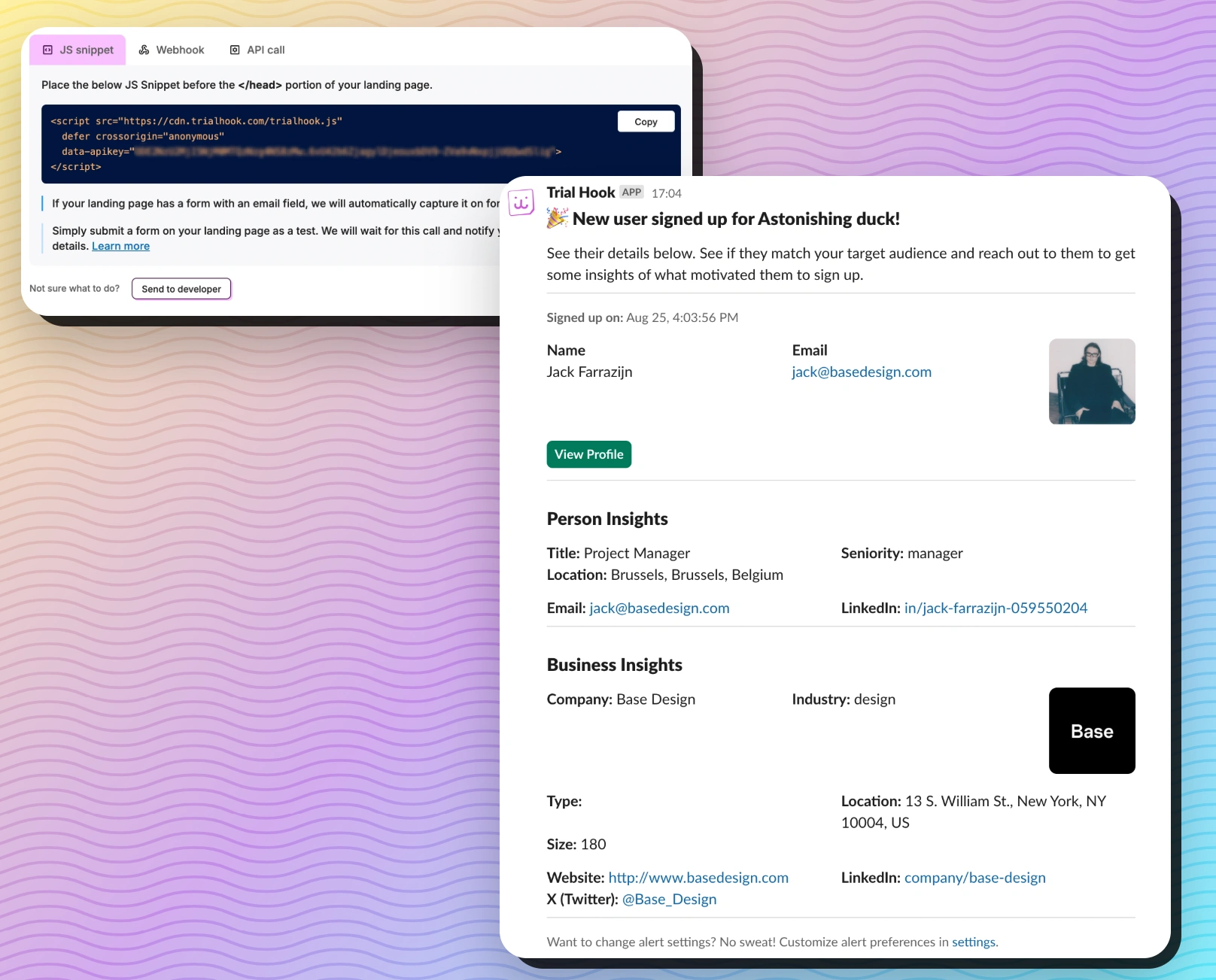
It connects to whatever form you're already using - Webflow, Tally, Typeform, Squarespace, or a custom build - and the moment someone signs up, it enriches that email with job title, company, LinkedIn profile, location, and more. Then it fires a real-time alert to Slack, Teams, or email.
No automation tool. No API stitching. No self-hosted infrastructure.
Your Time Is the Scarcest Resource You Have
Early-stage building is a constant triage of what deserves your attention. A custom enrichment pipeline might take a weekend to set up properly and another evening every few weeks to maintain. That's time you could spend on onboarding, on customer interviews, on shipping.
The goal isn't to have the most sophisticated tool stack. It's to have the clearest picture of who's interested in what you're building, with the least friction possible.
The Signal That Keeps You Going
There's something genuinely motivating about seeing "Head of Product at Notion just signed up" appear in your Slack channel. It's not vanity. It's confirmation that real people at real companies have the problem you're solving. That kind of signal keeps you moving on the days when everything feels uncertain.
The Short Version
Ship a landing page before you write a line of code
Ask for email only - nothing else
Get enriched alerts, so you know who's signing up, not just that someone did
Reach out fast, while interest is warm
Build only what the people who signed up actually need
You don't need more complexity. You need a cleaner signal. If you're validating right now, Trial Hook is worth five minutes of your time.

