Stripe has the numbers. I’m testing whether founders want the diagnosis.
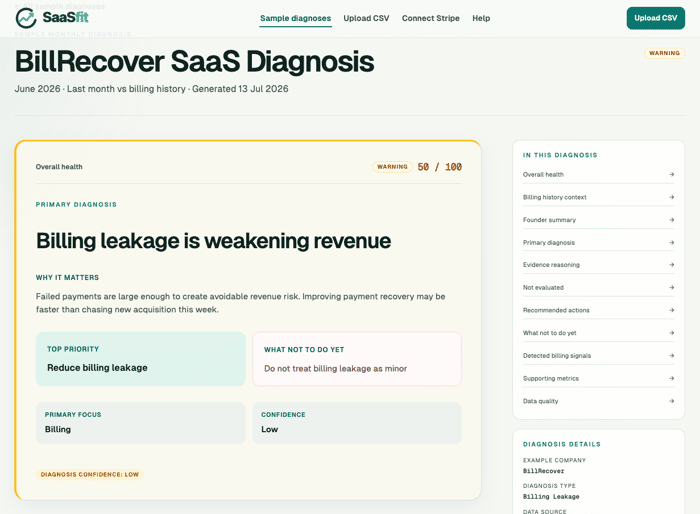
I’m building an early MVP for SaaS founders and would love honest feedback.
The problem I’m exploring is simple:
Stripe shows what happened.
But it does not really tell you what it means, what matters most, or what you should do next.
As a founder, you can see things like MRR, churn, failed payments, refunds, new customers, subscriptions, expansion, and contraction.
But the harder questions are usually:
- Is the business actually getting healthier?
- Which change should I care about most?
- Is one good metric hiding a bigger problem?
- Am I focusing on churn when acquisition is the real issue?
- Are failed payments becoming a quiet revenue leak?
- What should I do next?
- What should I avoid doing?
So I’m building SaaSfit.
It turns Stripe billing data into a short diagnosis report for SaaS founders.
Not another analytics dashboard.
More like a founder-facing explanation of:
- what changed
- what looks risky
- what matters most
- what to focus on next
- what not to do
For example, instead of only showing:
“MRR increased 4%”
SaaSfit might say:
“MRR is still growing, but new customer revenue and new customers are slowing. Growth may be relying too much on expansion from existing customers.”
That kind of diagnosis is what I’m trying to validate.
I have an early MVP here:
https://saasfit.up.railway.app/reports/scenario_billing_leakage
It opens directly to a sample diagnosis report, so you can review it without connecting Stripe.
I’m not trying to validate the landing page yet. I’m trying to validate the report itself.
For SaaS founders:
Would this kind of Stripe-based diagnosis help you make better decisions?
I’d especially appreciate feedback on:
- Does the sample report feel useful?
- Does it feel clear enough?
- Does it feel trustworthy?
- What feels missing, confusing, or unnecessary?
- Would you ever connect Stripe for this if the diagnosis was good enough?
Critical feedback is very welcome.

Trust needs an audit trail. For every diagnosis, show the input window, calculation, confidence, alternative explanation, and one event that would falsify the recommendation. “New-logo growth slowed despite expansion” should link to the exact cohort and define what next month would reverse the warning. Then it feels like analysis, not plausible prose.
This is very useful feedback. I agree that a diagnosis should be inspectable, not just sound plausible.
SaaSfit already tracks the analysis period, supporting signals, confidence, and the signals suppressed in favor of the primary diagnosis, but the current report does not expose enough of that reasoning.
I especially like the idea of showing what future result would weaken or reverse the warning. I’m considering an expandable “Why this diagnosis?” section with the input window, supporting calculations, competing explanations, and reversal condition.
Would that give you enough confidence without making the main report too dense?
I like that you're separating diagnosis from analytics.
Most founders don't lack numbers—they lack confidence about which numbers have actually earned their attention. Prioritizing the evidence into a single explanation feels much closer to how founders make decisions than another dashboard.
Thanks — this is really helpful.
That distinction is exactly what I’m trying to validate: founders usually already have the numbers, but not enough clarity about which ones actually deserve attention and what they mean together.
The goal with SaaSfit is to prioritize the evidence into a single explanation, then turn that into clear next-step guidance.
I'm glad it resonated.
Reading your reply gave me one thought about how founders decide whether to trust that explanation in the first place. I'd rather explain it with SaaSfit as the context than try to squeeze it into a few comments.
If you're interested, what's the best email to reach you on?
Yes, I’d be interested — trust is one of the biggest questions I’m trying to validate with SaaSfit. Could you share the main idea here or in an Indie Hackers message first? Then we can move to email if a longer discussion would be useful.
Happy to.
The short version is that I don't think trust comes from the explanation being detailed. I think it comes from founders feeling they understand why this evidence deserved their attention over everything else.
There's a broader implication of that for SaaSfit that I'd rather explain properly than reduce to a few messages.
If that resonates, I'm happy to continue over email.
Quick clarification: you don’t need to connect Stripe or upload anything to check the MVP.
The link opens directly to a sample SaaSfit diagnosis report using demo data.
At this stage I’m only trying to learn whether the report itself is useful enough for SaaS founders — especially the diagnosis, recommended actions, and “what not to do” parts.