Building a $2M ARR product after his $8M ARR product failed overnight
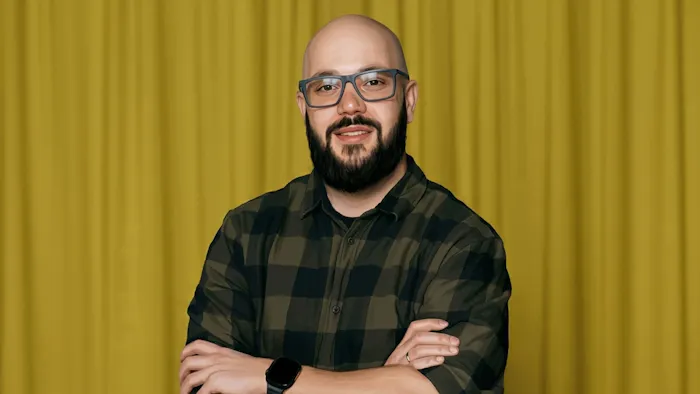
Ruslan Leteyski built an $8M ARR business, but had to shut it down overnight. Now, he's building Zipchat, an AI sales agent for e-commerce stores. It's a very crowded market, but he's just about to cross $2M ARR.
Here's Ruslan on how he's doing it. 👇
Killing an $8M ARR business
I'm Ruslan, Bulgarian, based in Sofia. I started as a UI/UX designer and taught myself to code because I couldn't afford to hire anyone. In 2017, I built Checkout X, an alternative checkout for Shopify stores. I bootstrapped it to $8M ARR. Then, Shopify changed its platform, locked down the checkout, and the product died. Years of work vanished because someone else changed their mind.
I then built and micro-exited another Shopify app, Vanga AI. And in 2024, I cofounded Zipchat.
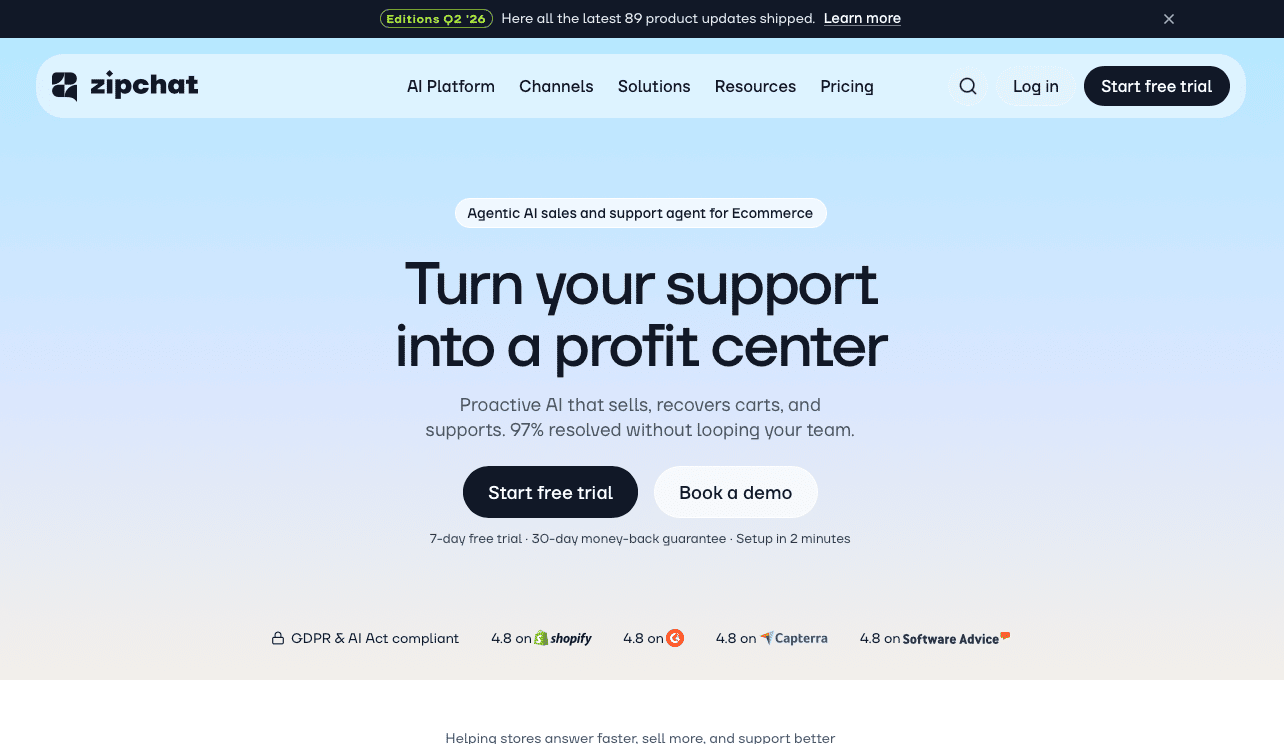
Zipchat is an AI sales agent for e-commerce stores. It handles any conversation between a brand and a customer — on any channel. We combine all your conversations into one place, and ONE agent handles them, an agent you train only ONCE.
We currently handle 700k conversations a month, growing about 10% week over week, and we are about to cross $2M ARR.
Experiments over epiphanies
This is my fourth business, so it wasn't some epiphany that started it. I wanted to start something new, I had experience in ecom, ChatGPT had become all the rage, and I thought: "Let's build a ChatGPT wrapper, learn about AI, and hopefully make some money."
The building process was straightforward. We built the most minimal product version, launched it, started running ads on the Shopify App Store, gathered feedback, and gained momentum.
We run on Ruby on Rails / Hotwire / Postgres, and we leverage RubyLLM for our AI implementation. Regarding AI, we started with OpenAI, then moved to Anthropic, and now we're working with all the major labs.
The stack didn't change that much, but our development process did. Nobody writes any code anymore, so we're changing our development philosophy to reflect this change. We no longer do peer reviews, and we don't enforce readability/maintainability as we did before. And instead of having a Head of Engineering who supervises our developers, each developer now acts as the "Head of Engineering" for their own agents.
Bootstrapping at a loss
At the time, I didn't realize "building a wrapper" would be much harder than it sounds. Nor did I realize that AI would completely disrupt the shopping experience.
Financially, I was fortunate that I didn't have to worry about money for a while, so I could focus on building something interesting. But our costs were significant. My partners required small salaries, we paid for GPT-4 (which was super expensive at the time), and we ran ads. The result was that we ran at a loss of about $20k per month for almost a year.
Thankfully, we ground through and began breaking even. Eventually, we secured revenue-based financing (loans based on your MRR), which helped us significantly.
We stayed super lean until we hit 50k MRR. I built the product, Carlo did sales and support, and Luca ran ads. We were reluctant to hire ANYONE until we could break even and afford it.
Usage-based plans
As far as our business model, we sell plans based on AI replies. The more usage a merchant has, the more our revenue grows. If they go over their limit, we also charge them additional usage fees.
To expand customer revenue, we need merchants to grow their usage. So, we employ a land-and-expand model. Merchants start using us for their website chat and, over time, they add us to their search, product page, social media, emails, and so on.
We haven't iterated much on our business model until now — we're starting to run A/B tests to see what works best.
There are no growth hacks
As far as growth, there's no story here. No growth hack, no viral moment, no single channel that cracked it open. It's a slow grind, and we keep grinding.
Here are our marketing assets — long-term plays where every action compounds over time:
YouTube - We don't push the brand; we just make stuff that's genuinely interesting for ecom folks.
Social media - All the founders are building personal brands on X and LinkedIn.
SEO / GEO - We optimize specifically to get cited by LLMs.
App partnerships - We're building an ecosystem of Zipchat "skills" inside other apps.
Shopify app store - We're working with an ASO consultant and pushing for reviews.
Cold outreach via emails, calls, and conferences has been good for awareness. We buy data from Store Leads, Similarweb, etc., and send 1M+ emails per month. And if you're doing the awareness work, you can also have some success with AppSumo, Facebook ads, and Google ads.
If it might work, we test it. Most of it doesn't. Some of it does, and we double down on that until it stops working; then we go find the next thing.
The only real "strategy" is to never stop shipping and selling. Work on your product and talk to your customers.
Too much competition
The biggest challenge we still face is having the least creative business idea of our time!
Over 100 new competitors have launched in the Shopify App Store alone, probably thousands worldwide. Even if we're better than everyone else, each competitor only needs to acquire two customers, and that will still compound to hurt us.
That being said, I picked this business because I wanted to learn, and it's a great space to be in. All of e-commerce is experiencing disruption, and we get to be among those figuring out how it should happen.
Cofounders for the win
My greatest advantage is having great cofounders who are as obsessed with winning as I am.
In all of my previous businesses, I was a solo founder. I had to figure out everything by myself. I didn't want to do that again, so I found people who are 1000x better than me in their fields.
Besides that, my advantage has been talking to our customers and solving their problems. Ignore startup advice, books, and the competition — all that matters is your team and your customers.
Pick an idea space and get started
Here's my advice:
Pick an "idea-space," not an idea — do something you are interested in and want to learn about. Even if it fails, you'll get inspiration for your next attempt.
Don't think — just do! Launch your product, try to sell it to someone, and repeat. If you can't sell it, why not? If you sold it to someone, great! How do you sell it to ten people? 100? It is that simple. And the best way to learn is to do.
All it takes is a bit of luck. My previous business was more successful than this one, even though my execution was much "worse." You might get lucky on the first try, even though you're not experienced. Or you might not get lucky for a long time. But the only way to get "lucky" is to keep playing.
What's next?
I want to build something that makes a "real impact". Something people across the world use at scale. Something that makes the world tick. I don't have clear criteria for what this means, but I guess a billion AI conversations would suffice.
You can follow along on X and LinkedIn. And check out Zipchat!

Leave a Comment
The biggest takeaway for me is “pick an idea-space, not an idea.”
You can lose a product, but the customer knowledge and domain experience you build along the way can stay with you. That’s a much more powerful advantage than most people realize.
Shutting down an $8M ARR business overnight takes a lot of guts.
Makes Shadow Fight 2 stand out as an action Its smooth combat, challenging enemies, and weapon upgrades give players plenty to enjoy.
The marketing section is something I can relate to, especially "most of it doesn't, some of it does, and we double down."
I've found the hard part isn't coming up with things to test. It's deciding when the evidence is strong enough to say something is actually working, especially when several things are running at the same time.
With YouTube, SEO/GEO, partnerships, the Shopify App Store, outbound, conferences, and paid channels all contributing in different ways, how do you decide which one has earned more investment? Are you looking mainly at attributable customers/revenue, or do you have different signals depending on the channel?
This is a long long topic but in general.
First question is how big is the channel, can it potentially move the needle for us at this stage - which disqualifies most of the channels.
On the big ones, there are two types of channels - the ones that build awareness vs the ones that bring customers today.
---
On the awareness side, we only track "vanity" metrics - subscribers / watch hours / engagement etc - the purpose is to get in front as many eyeballs as possible.
On the performance channels, we track CPA.
We try to invest into multiple channels at once as it takes us 1-2 years to get a channel to bring results ( a lot of trial and error ). So the channel that will move the needle for us next year, is one that we're just starting to figure out.
We now have a bit more leeway to be able to hire leads for different channels that work independently. Before, our CMO and CRO were just doing everything at the same time.
That's helpful. I hadn't thought much about channel size before deciding where to spend time. The difference between awareness and performance channels makes sense too. Thanks for taking the time to explain it, Ruslan.
The part that stood out to me is “pick an idea-space, not an idea.”
That feels underrated. A failed product inside the right space can still leave you with customer knowledge, distribution, and insights that compound into the next one.
Pick an idea-space, not an idea" is the line I keep coming back to too. I'm a
PM by day, taught myself to code on the side, and my earlier attempts mostly
failed because I picked ideas I was emotionally attached to — not spaces I
could learn in, so the failure taught me almost nothing durable. Rebuilding now
with that lesson in mind.
How long do you let yourself test a space before you know it deserves a real
doubling-down? I'm still trying to tell "this will compound" apart from "this
is just familiar.
Thank you for sharing you story, Ruslan!
Thanks for sharing this - love the honesty and also appreciate the focus on your marketing assets. Trying to optimize for distribution is a huge challenge rn and its cool how you guys have done it with perserverance.
I can't imagine the amount of grit it takes to get back up and start something again after losing a $8M ARR business. I had failed multiple businesses in the past where I lost all my savings. It took everything I had and more to get back up and it wasn't even on this scale.
So much respect for you man.
Biggest takeaway from this should be: If you could do it once, you can do it again. You might lose the money, but you won't lose the skills and knowledge you gained from all your previous attempts.
The most underrated part of this interview is how you pivoted back to a high-intent vertical immediately after such a massive loss, rather than letting the burnout from the $8M failure dictate your next move.
What stands out to me is the resilience. Losing an $8M ARR business because of a platform change must have been brutal, but starting again and reaching $2M ARR shows how much experience carries forward. The shift to AI driven development is interesting too.
That is a great story!
Really inspiring journey, Ruslan. The biggest lesson here is that building a successful business isn’t just about reaching $8M ARR — it’s also about being able to adapt when the platform or market changes.
Love the focus on building again instead of giving up. Wishing you and the Zipchat team continued growth! 🚀
I’m also working on a site focused on simple ideas and recommendations for birthdays, family activities, gifts, and celebrations:
The part about there being “no growth hacks” stood out to me. The slow, compounding approach you described feels much more realistic than trying to find one channel that suddenly changes everything.
I also liked the point about testing channels, doubling down when something works, and moving on when it stops working. That seems especially important when there are so many possible acquisition channels today.
The customer feedback point is probably the biggest lesson for me: shipping and selling continuously seems to create much better feedback loops than spending too much time trying to perfect a strategy before taking action. Great write-up.
Losing an $8M ARR business overnight because a platform suddenly locked down its ecosystem is the ultimate bootstrapping nightmare. Flying solo right now means absorbing every bit of that strategic stress alone, so seeing how you transitioned to leaning on co-founders to stomach a $20k/month burn is a huge reality check. After building your previous projects entirely by yourself, what specific green flags told you these were the exact right partners to bring into the trenches for Zipchat?
Man, reading your story is such a reality check—pure battlefield experience from someone who’s really been in the trenches!
Honestly, taking an $8M ARR hit overnight just because Shopify decided to change the platform rules is every platform-dependent SaaS founder’s absolute worst nightmare. But seeing how you bounced back, sucked it up, and grinded through a $20k/month burn rate for nearly a year with Zipchat shows what true grit actually looks like in this game.
A few points that really hit home for me:
The AI-era dev mindset: Having every dev act as the "Head of Engineering" for their own AI agents sounds wild on paper, but it’s brutally practical. Axing traditional peer reviews to hyper-focus on shipping speed is the exact shift modern tech stacks demand right now.
No magic growth hacks: So refreshing to hear this. There’s no silver bullet—just the unglamorous compound effect of firing off 1M emails a month, grinding ASO, building personal brands, and testing everything until something sticks.
Picking an "idea-space": Focusing on a domain you actually want to master rather than falling in love with a rigid feature makes taking the inevitable punches so much easier.
Even though the AI sales agent space is insanely crowded with thousands of wrappers launching daily, reaching 700k monthly conversations with a 10% WoW growth rate speaks for itself.
This is really smart. I like how you’re not betting everything on one “growth hack” and instead keep testing channels, doubling down on what works, and adapting as things change. The long-term compounding approach is especially interesting.
Losing an $8M ARR business like that must have been brutal, so building Zipchat back up to nearly $2M ARR is an incredible comeback. I work in ML, and I’m really curious to see how the product improves as it learns from more real customer conversations. Great story, Ruslan.
That change in your development philosophy is really something to read about: 'No one writes code anymore no peer reviews and each developer acts as the Head of Engineering for their agents.'
Switching from Symfony and Rails maintainability rules to handling independent coding agents is a big change in thinking.. When you are creating in a space with 100 or more new competitors on the Shopify App Store, the speed of making changes completely beats the need for perfect architecture. Amazing change, from the Checkout X days!
What a crazy resilient journey. Going from $8M ARR back to zero is most founders' worst nightmare, but coming back to hit $2M ARR proves the outcome wasn't a fluke—the execution playbook was real.
I’m curious about your risk mitigation strategy for this second product: What specific architecture or distribution choices did you make differently with the $2M product to ensure you aren't vulnerable to another "overnight platform change"?
The failure after reaching $8M ARR is probably the most valuable part of this story.
It’s easy to study companies only when they’re winning, but understanding why a seemingly successful business breaks down can reveal much more about market timing, distribution, product complexity, and founder decision-making.
Would be especially interested in what they would deliberately avoid repeating this time.
Love the resilience — bouncing back from an $8M ARR shutdown to $2M ARR is huge. I’m building Finsight AI, and I’ve found early lessons often come from setbacks. Curious, what was the biggest mindset shift that helped you rebuild? — Francisca @ Finsight AI
The “experiments over epiphanies” stood out to me because if you had an $8M ARR business that you lost, you would have been tempted to chase some sort of home-run strategy.
Testing little things and letting them build your confidence is way better.
The best response to the feeling that you were doing everything right and it still went wrong is to learn to trust the process.
the idea space point is probably the biggest takeaway here
you learn way more by shipping 10 small experiments than thinking about one perfect idea
Watching an $8M business vanish overnight is a brutal lesson, but bouncing back to $2M ARR with Zipchat is incredible.
How has your team's development philosophy changed now that AI writes most of the code?
Really inspiring story — especially the part about staying super lean until 50k MRR. I'm working on an AI product myself, so this is super helpful.
"Congrats to Sergiu! The 'build for yourself first' path saves so much time on initial validation because you're literally Customer Zero. Submitting to directories manually is such a massive timesaver to automate. Thanks for sharing the breakdown, James!
Really valuable story. As a solo founder, the biggest takeaway for me is reducing single point of failure risk early. If you had to pick 1 thing thaat mattered most in the second product, what was it, channel ownership, retention focus, or pricing discipline?
Building a niche site is such a grind, but the long-term payoff for trust is huge. One thing I've learned is that you have to prioritize utility over revenue early on. If your primary goal is just to drive clicks, users smell it immediately and bounce. Being the person who saves someone from a bad decision is how you build a loyal audience. Keep pushing!
$2M ARR with zipchat is insane. your journey is a masterclass in not giving up. huge respect.
man Shopify killing your business is like a landlord changing the locks overnight lol. but you bounced back like a phoenix. $2M ARR with zipchat is insane. your journey is a masterclass in not giving up. huge respect.
The most important thing is that it works and the result always comes
The biggest lesson here isn’t simply “keep going after failure.” It’s that your accumulated knowledge compounds when you stay in an idea space you understand. Shopify’s platform changes killed Checkout X overnight, but the e-commerce experience clearly carried over into Zipchat.
Exactly. The accumulated domain knowledge seems like the real unfair advantage here. Even when a product fails, the customer insights and understanding of the market can make the next attempt much faster and more focused.
Incredible story and resilience, Ruslan! Transitioning from an $8M ARR platform dependency shift with Checkout X to building Zipchat to $2M ARR is a masterclass in founder perseverance.
Also fascinating to hear how your dev philosophy shifted to Ruby on Rails + Hotwire with developers acting as "Heads of Engineering" for their agents.
Wishing you continued massive growth with Zipchat! 🚀
I really resonated with the point that "experiments are more important than flashes of inspiration." Many people waste too much time trying to come up with the perfect startup idea, but I realized that the true benefit comes from choosing a field you know well, launching a product, and learning from actual customers.
It was also interesting to see how the engineering process changed with the introduction of AI. I believe that each developer taking on the role of "Chief Engineer" responsible for their own agent represents a significant change in how small teams operate.
In particular, the candid story about the $20k monthly loss and the lack of a magical secret to growth was impressive.
Respect for rebuilding after that. I'm early-stage myself (a free calculator tools site) and the hardest part right now isn't building
The Checkout X story is rough, years of work gone because a platform changed its rules. Respect for coming back and building again instead of walking away from the game entirely. The $20k/month loss for nearly a year part is also just real, most people don't share that kind of detail. Wishing Zipchat continued momentum toward that $2M ARR mark..🙌👍
Respect for rebuilding after that. I'm early-stage myself (a free calculator tools site) and the hardest part right now isn't building — it's getting the first real trust signals as a brand new domain. Did the second build get easier because you already knew "what works," or did you have to relearn distribution from scratch too?
Really inspiring journey! 🚀 The biggest takeaway for me is how you turned a major setback into an opportunity to rebuild smarter. Love the focus on experimentation, staying lean, and adapting with AI. Keep going—excited to see where Zipchat goes next!
Really enjoyed this story—especially the honesty around shutting down an $8M ARR business and still having the mindset to start again. 👏 The “experiments over epiphanies” approach and focus on customers over growth hacks really stood out.
With so many AI sales agents entering e-commerce, what do you think will become the biggest long-term differentiator for Zipchat: the product, distribution, or the depth of customer relationships?
The most valuable lesson here isn’t simply that you rebuilt from $8M ARR to nearly $2M ARR. It’s that the failure seems to have changed the way you design the company.
Checkout X exposed the danger of letting one platform control too much of your product surface and distribution. Zipchat’s “train once, deploy across channels” model feels like a deliberate response: keeping the merchant relationship at the center while making the AI layer portable across channels and providers.
The same pattern appears operationally too—complementary cofounders instead of doing everything solo, staying lean until break-even, usage-based pricing tied to customer value, and a portfolio of marketing channels instead of waiting for one growth hack.
So the comeback wasn’t just persistence. It was turning a painful failure into a set of design principles.
One question I’m curious about: as Zipchat expands across channels and model providers, what do you see as its most durable asset—the integrations, conversation data, merchant workflow, or the learning loop from 700k monthly conversations?
Hi,
What impressed me most is not only the business recovery, but the psychological side of it.
After losing an $8M ARR product overnight, how did you find the energy and clarity to start again instead of walking away from the space completely?
Also, looking back, how did you separate the external platform risk from the mistakes or assumptions that were within your control? And have you built any specific “control points” into Zipchat this time to avoid ending up in a similar situation?
The part that stood out to me most is the “slow grind” approach. With so much focus on growth hacks and viral moments, it’s refreshing to see a business built around continuously shipping, selling, testing channels, and doubling down on what actually works.
The Shopify story also highlights an important lesson: even an $8M ARR business can be vulnerable when you depend heavily on someone else’s platform. Building on top of an ecosystem can accelerate growth, but it also creates a strategic risk that’s easy to underestimate.
Incredible story, building up to $2M after an $8M failure takes serious resilience. Thanks for sharing the breakdown!
His journey shows that setbacks can become a foundation for building something stronger and more sustainable.
After losing an $8M ARR product, he rebuilt from the ground up and reached $2M ARR again through persistence and adaptability.
"Surviving an $8M ARR platform platform-risk wipeout with Checkout X and pivoting into a $2M ARR AI sales agent with Zipchat is a legendary bounce-back. Shifting the dev philosophy from code readability to having developers act as 'Heads of Engineering' for their own agents is a wild glimpse into the modern AI-native dev workflow.
Optimizing for GEO (Generative Engine Optimization) to get cited directly inside LLMs is such a smart forward-looking strategy for e-commerce tools. How are you measuring attribution on LLM citations versus traditional SEO?
Incredible story, Ruslan! Taking on the financial risk of a $20k/month burn rate for nearly a year to reach breakeven and $2M ARR takes serious conviction.
Having cofounders who complement your strengths after years of going solo is such a game-changer when fighting against 100+ Shopify app store competitors. Loving the land-and-expand model across multi-channel support
I think having cofounder as passionate as you is win
Losing an $8M ARR business to a platform update is a nightmare scenario. I love how you pivoted back into the e-commerce space but completely changed the distribution model to be channel-agnostic. The advice to 'pick an idea-space, not an idea' is gold. As someone currently analyzing raw e-commerce data to build transparency tools, this reminds me to stay focused on the broader problem rather than getting too attached to the first version of the solution. Great read!
Love the honesty and also appreciate the focus on your marketing assets. Great Read; highlights incredible resilience and adaptability
The part I keep turning over is that Checkout X died to Shopify platform risk and Zipchat is being built substantially on the Shopify app store again. Not a criticism, it reads as a bet that owning the merchant relationship across channels changes the exposure, and I would want to hear whether Ruslan sees it that way. Separately, running at 20K a month in losses for a year on revenue-based financing is the funding path almost nobody writes about, and it enforces a very different discipline than a seed round.
"The first B2B product failed overnight" — this is the story I needed today. Building ThumbRank and terrified of exactly this. But your $2M ARR proves the failure was data, not destiny.
The comeback is more interesting than the revenue number to me. Building one successful company is difficult enough, but starting again after losing something that large must completely change how you approach risk and decision-making
Losing an $8M ARR business and then having enough energy to build again is probably the most interesting part of this story. It’s easy to study successful founders when everything is going up, but the decisions they make after something collapses usually teach much more
Really appreciate the transparency. Stories about failed products are often more valuable than success stories because they show the decision-making process. What was the biggest thing you'd do differently if you were starting from zero today?
"The part that stood out to me is 'pick an idea-space, not an idea.' That feels underrated."
The "pick an idea-space, not an idea" line hit me harder than any of the
numbers here. I'm a PM by day and taught myself to code on the side, and I've
had a few attempts that flopped before this one. Looking back, the common
thread in my failures was picking ideas I was emotionally attached to — not
spaces I could learn in. So each failure taught me almost nothing durable.
Reading about Checkout X made me re-examine why I built my current product
the way I did. It's 100% client-side — everything runs in the browser, nothing
ever uploads to a server. I always told myself it was a privacy stance. Now I
wonder if part of it was quietly de-risking against the exact thing that killed
Checkout X: someone else's platform deciding my fate overnight.
My question for you: when you're "testing things that might work," how do you
stop yourself from polishing too early? I keep catching myself adding features
instead of talking to the handful of users I have. What's your signal that a
channel or a feature has earned more investment — versus quietly moving on?
The most useful lesson here is not the $2M ARR milestone, but the platform-risk reset that preceded it. Checkout X showed how dangerous it is when one platform controls your distribution and product surface. Zipchat's move toward multiple channels and model providers looks like a deliberate resilience strategy, not just feature expansion. Founders should map which external dependency could shut them down overnight before they celebrate growth.
Losing an $8M ARR business overnight and still having the energy to build again is wild. I’d be curious what he did differently the second time around, especially around risk and diversification.
“Failed overnight” is the phrase that jumps out — that usually means something was fragile underneath that wasn’t visible from the outside (a platform dependency, a customer concentration issue, a policy change). Curious what you found once you looked back at it: was there a warning sign in the numbers before the collapse, or did it really come out of nowhere?
The Checkout X story is the most important part of this interview, and most readers will focus on the comeback rather than what actually happened structurally.
Platform risk didn't just kill revenue. It killed a business where every asset — users, distribution, trust — lived inside someone else's infrastructure. The fix Ruslan landed on with Zipchat is architecturally correct: train the agent once, deploy it across every channel. The customer relationship belongs to the merchant, not to the channel it came through.
The 1M+ emails a month detail is easy to gloss over, but that's the real engine underneath the growth. One channel running volume while four or five others build compounding awareness is a distribution strategy most early-stage founders never reach because they're still hoping a single channel breaks through first.
The thing I'd push on: the 10% week-over-week growth at 700k conversations is impressive, but the land-and-expand model only works if the usage data tells you which merchants are ready to expand before they're already looking at alternatives. What's the trigger for a proactive expansion conversation — is it usage rate, channel count, or something else?
Two things here feel especially diagnostic: platform risk turned an $8M ARR business into zero overnight, while staying lean and refusing to hire until break-even gave Zipchat time to find a repeatable engine. I’d make the channel-versus-awareness split operational by assigning each channel one job and one lagging metric: qualified pipeline for performance, branded search or assisted pipeline for awareness. The 1M emails a month detail is huge, but the useful question is how many conversations become qualified stores after the first touch and how long that takes. What early signal tells you a channel deserves another quarter before revenue attribution catches up?
What you learn can always help with the next project you start knowledge is power.
I built a company on Microsoft's platform for 20 years, and we survived platform risk by making ourselves valuable to the platform, not just on it. Shopify killed Checkout X because it competed with their roadmap; Zipchat being channel-agnostic is the right correction, since no single platform can pull the rug. The 1M emails a month detail is the part most readers will skip, but that awareness engine is probably worth more than any single organic channel right now.
that's awesome
The Checkout X story is exactly why platform risk keeps me up at night. Wild that you came back from that to hit 700k conversations/month. What was the biggest mindset shift between the first build and Zipchat?
The Checkout X story is a masterclass in founder vulnerability and the hidden lessons of platform risk. You didn't just lose $8M ARR - you lost the founding insight that comes from building something customers demand, not something a platform decides to allow.
That shift to Zipchat feels like the deeper win. You moved from "optimize what the platform allows" to "own the customer problem." Zipchat solves conversation fragmentation for e-commerce stores - a problem that exists independent of any platform's roadmap.
The boring details are powerful too: $20k monthly losses you could absorb, cofounders who freed you from being solo, refusing to hire until 50k MRR. These constraints weren't sacrifices - they were your measurement system. They forced you to optimize for real customer value, not vanity metrics.
Your closing advice nails it: "all that matters is your team and your customers." Most founders spend energy on startup dogma and competition analysis when they could just be talking to customers. The bounce-back from losing an $8M business to building a $2M product in a crowded space proves that execution + customer obsession outlasts any platform advantage.
Thanks for sharing my story 🙏
Insane, Thanks for sharing your incredible story.
This comment was deleted 15 days ago
This comment was deleted 13 days ago
This comment was deleted 13 days ago
This comment was deleted 17 days ago