Hitting $15k/mo by purchasing defunct domains and building for pre-existing demand

Erik Aronesty finds defunct companies with existing demand, buys the domain, and builds the product — no marketing required. He currently has about 30 projects bringing in a total of $15k/mo.
Here's Erik on how he's doing it. 👇
Getting into weekend projects
I'm a software engineer with 30 years of experience. I developed the first online prime brokerage. Then, I built and sold ZoneEdit.com and MoonCostumes. After that, I took a break for bioinformatics research, published a paper, and helped cure my dad's cancer.
From there, I worked on NLP for Bloomberg and published a patent and paper in cryptography. Then I got a job building AI-native agentic accounting for puzzle.io. I'm still there — these projects are all "weekend" projects and honestly, thy run themselves. Usually, Hermes+Gpt5.6 makes all the decisions.
But now, AI has lowered the barrier to building. For 20 years, a zillion ideas remained ideas only in my head. Now, I can talk into my phone to launch a beta. I have monthly revenue from over 30 websites; some generate only $60/month, but that's a long tail. AI manages all my sites, monitors logs (Logtura), and acts on feedback.
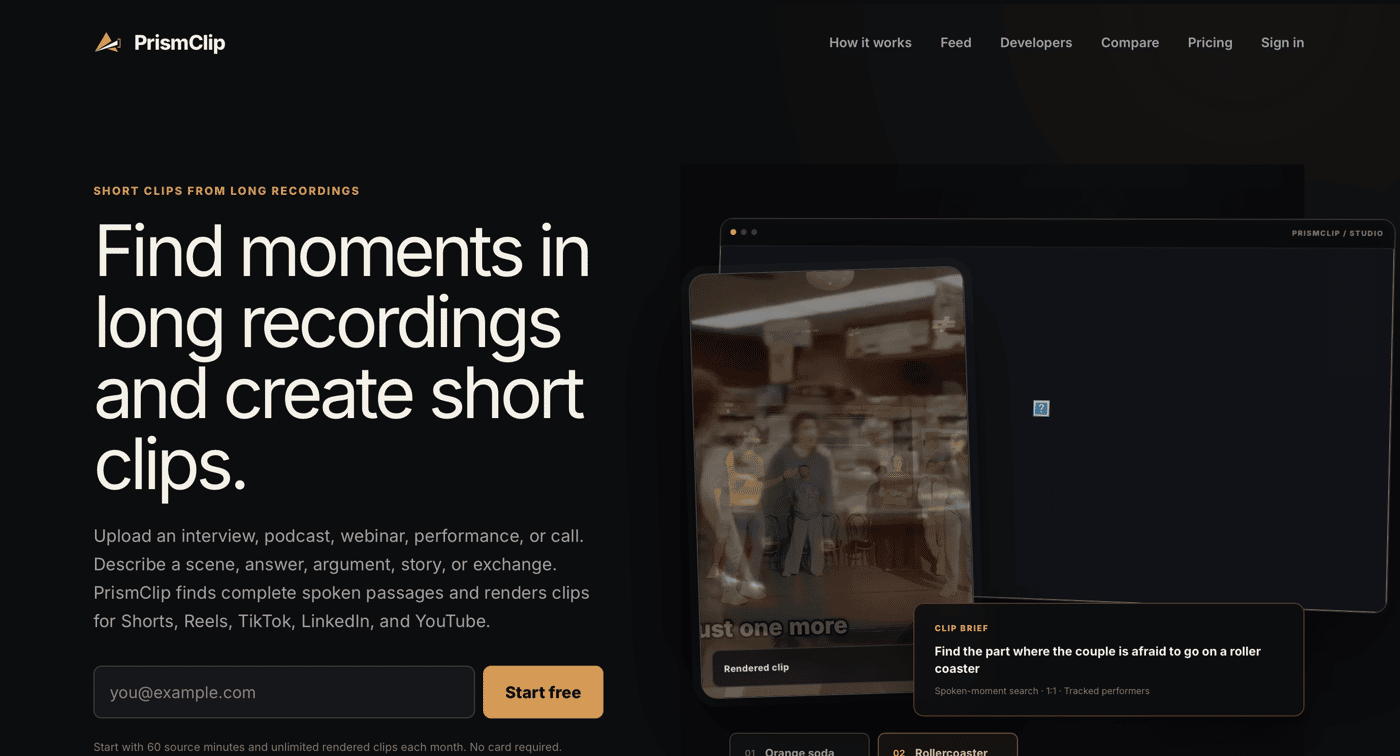
The two projects people are paying the most for are DirtSignal.com and OnwardTravel. And my latest project — which is a bit more of a labor of love — is PrismClip.com.
OnwardTravel is a "dummy ticket" site that books a Passenger Name Record (PNR) on an airline and issues an itinerary and a verifiable hold. DirtSignal.com web-scrapes about 200 municipal code enforcement and magistrate hearing portals, and sells access to the data. Our value-add includes managing Freedom of Information Act requests in many places, which require substantial handholding to get started.
We currently generate approximately $15k in monthly revenue. Most of that is not recurring. Travel-related systems never are.
Onward accounts for about 70% of our revenue.
DirtSignal is about 20%.
A long tail of one-shot projects contributes the remaining 10%.
Prism is pre-revenue, but I hope it eclipses the rest.
Sniping ideas
As far as the concepts, I used BizSnipe.com; it told me what to buy, and I did it.
Sniped names are expensive, but worth it. The key is to build what people expect. Don't build some "new idea." Build what people are already looking for and visiting. Something that's broken. Then, fix it.
Like I mentioned, I work at a startup accounting company (Puzzle). Accounting. Boring, right? Nope. Find a thing people are already paying for and compete there. Don't try to be too clever.
Building the products
I worked weekends and nights for the last four months, spending probably 30 hours a week on top of my 40-hour job. The biggest challenge was not being able to focus on family.
In the old days (six months ago), my tech stack meant React vs Hono or Python vs Rust. Now, that doesn't matter. Systems matter more. I built and deployed a Cloudflare-friendly web proxy in Rust to prevent edge workers from getting blocked. I don't even know Rust, but I knew performance was key to running dozens of these things cheaply in low-memory environments. I open-sourced that one — GitHub/q32llc.
The key tech I use is:
Codex
Claude
Cloudflare
DigitalOcean managed Postgres
BoxPDF + LakeQL.
LakeQL and lower-cost managed Postgres were crucial for reducing costs and avoiding burning savings. Cloudflare's D1 fees can destroy a business if you store too much data in it.
As a result, there weren't many costs; I invested maybe $2k in the sniped domain and another $2k for more advanced AI tooling, hosting, and one-off outreach.
Business models are dead
People don't understand how the world is changing.
Fixed product definitions are becoming obsolete.
Companies used to have target markets. Why?
I have a new experimental site that automatically adapts how it functions and what it offers to the customer as they arrive at the site. What is that business model? Do what the customer wants. What if the customer asks for something you don't provide? An agent will build it in 20 minutes and then provide it.
No need for marketing
Since I buy pre-existing demand and build into it, there's very little need for marketing.
It identifies defunct companies with pre-existing demand. Many of these companies have highly cited, highly ranked, but parked domains. It then tells you which ones are easiest to develop into a new service, how to build that service, what it should do, and how to price it.
Then, you buy the domain before it drops or is auctioned, and build exactly what people expect. Google will de-rank a site if you don't build what people expect. You have to be careful about that.
If you don't snipe a name, you must build traffic slowly. This means waiting up to a year for search engines to notice you without triggering spam filters or getting banned from social media for promotion. There's no good way to promote a new business right now, and the market is designed to keep new players out.
Avoid spending money on ads
I did experiment with ads. It was a waste. The cost of acquisition is insane right now, and spending money leaves you with nothing.
Also, 90% of the leads Google and Facebook generate are fake, from companies milking the algorithm.
I wasted a lot of cash on askthe.bot, a bot-building site. It's a fun site with 2000 users, but about 1900 are fake, designed to milk my ad dollars with fake leads. Google and Meta, from what I've seen, cannot stop this. Bot traffic is incredibly sophisticated now.
CAPTCHAs help a little, but not much. To ensure someone isn't a bot, we charge them a dollar. Bots won't pay. They'll log in, check emails, fill out forms, and put in fake addresses. But they won't pay because they usually generate only 10 cents in ad payments.
DMing bloggers
The only other thing I've tried, growth-wise, was DMs on Reddit and twitter. Those have been pretty useful. Once people realize you're a real person just trying stuff out, they respond better.
From those DMs, I've gotten bloggers to write articles about my products.
Don't be too clever
My advice? Don't try to be too clever or unique. Find your distribution channel first. Find 10 newsletters to tell people about your product and 10 users to use it — before you even build it.
Otherwise:
Build where demand already exists.
Automate everything.
Don't abandon weak properties. Allow time to nurture them. Real Estate is slow, Travel is fast; that doesn't mean travel is better. I expect DirtSignal to beat OnwardTravel in 2-3 months.
Make your media look pretty. If your site is ugly, media people won't click on it no matter how well it works.
And stick around. Persistence and patience are more important than any other quality.
What's next?
From here, I plan to focus on my open-source projects. Boxpdf and lakeql have proven their worth.
A whole industry exists for "PDF handling". Boxpdf is a memory-bounded box-model PDF generator and HTML->PDF generator. I'm adding forms, form handling, and signing. Each layer stacks on box.
LakeQL is insane. I can put a 10GB database on R2 for a penny per month. I can deploy a worker using LakeQL, allowing people to query it for free at 10ms latency. That's 10GB of valuable intel, with paid access, for a penny.
Both were massive unlocks for me, and I'd love to see other people innovate with them.
You can learn more at my site-of-site, q32.com. And check out boxpdf.dev and lakeql.com — tell your bot to look at those two open source projects and come up with business ideas! It will start generating revenue in the first month, not kidding.

Leave a Comment
It should be noted that Erik owns BizSnipe.com. If you attempt to sign up the Stripe page lists q32, llc as the company and as noted in the article that is his company. He conveniently leaves BizSnipe off the list of ventures on his website.
Cool. I am impressed.
The de-ranking point is the part nobody talks about. How do you reverse-engineer what the old visitors actually expected — Wayback snapshots, backlink anchor text, or the queries the domain still ranks for? Curious how much of that BizSnipe hands you versus how much is manual archaeology
good
What caught my attention was buying distribution instead of trying to create it from scratch. That feels like a different way of thinking about product validation. I am curious though. Have you ever bought a domain that looked promising but turned out to have demand that was impossible to monetize?
100% man. Intercepting existing traffic is brilliant, but turning cold domain visitors into actual paying users feels like a totally different beast. Would love to know if Erik's hit a wall with traffic that just refused to convert!
This is such a smart approach—rather than starting from zero, you’re tapping into demand that already exists and building something useful around it. The key seems to be finding the right domain + validating the existing intent before investing heavily. 🚀
I’ve been seeing interesting examples of this strategy with projects like EmojiVista. Small, focused utilities can be surprisingly powerful when they match an existing search need. 🔥
30 years and still shipping weekend projects — that's the dream. The long tail revenue model is underrated; people obsess over one big win but 30 sites at $60/month adds up and diversifies risk.
I'm in a much earlier stage — been running Tasbazi, a real-time multiplayer game platform (Backgammon, Hokm, Domino) since 2016. Built with Node.js and Socket IO The ops side is what kills you at scale — curious how you handle monitoring and incident response across 30+ sites without it becoming a full-time job. Is Logtura something you built yourself?
Interesting read. I think the biggest lesson isn't just buying expired domains it's validating demand before building. Recreating a product people are already searching for can be much easier than inventing something new from scratch. I'd also be cautious about the claim that marketing isn't needed; for most founders, a mix of SEO, partnerships, and community engagement is still important for long-term growth.
The transferable part of this, for anyone who can't or shouldn't buy domains, is the sentence "find your distribution channel before you build." I'm on the opposite setup to you. Courses for people who don't code (I'm building kambolab), where trust can't be inherited from a domain, it has to be earned in person. But the principle maps cleanly. My version of a defunct domain with residual traffic is the hundreds of existing "can I build this myself without a developer?" threads. The demand is already sitting there in question form, someone just has to show up with a real answer.
One thing I'd push on, your model works because a visitor landing on a rebuilt utility site wants a transaction and wants it now. How much of the $15k do you think survives on products where the buyer needs to trust a person, not just find a working tool? Curious whether you've tried the strategy on anything with a longer consideration cycle and watched it fail.
The "avoid spending money on ads" section is reassuring — I'm bootstrapping a $0 budget launch (Facebook groups, Reddit, word of mouth) and constantly second-guessing whether I should be paying for traffic instead. Good to hear it wasted your money too, even with way more experience than me. The "buy pre-existing demand" domain-sniping approach is a genuinely new idea to me — never thought about targeting expired sites with existing SEO equity instead of building an audience from zero. Definitely digging into BizSnipe after reading this.
This is genuinely clever!
Yes, a new building model is becoming more common. I’m also starting to use Codex, Cloudflare, and GitHub, and I hope this new stack brings me some good luck!I've used travelonward a bunch of times. Cool to know you're the one behind it.
Thanks for the article. It's amazing that the barrier to entry has come down and so many more people are able to create and explore their ideas!
You're spot on that the market is unfriendly to newcomers, and I appreciate your candid advice with regarding to SEO and marketing. It can be a rude awakening.
Erik's strategy of buying pre-existing demand is brilliant. It completely flips the usual 'build and pray' approach that most indie hackers fall into.
His final advice hits hard: 'Find your distribution channel first... before you even build it.' I am currently living the consequences of doing the exact opposite. As a software engineer, I spent months building an enterprise-grade Next.js template (HadiKits) with 446 automated tests and full security, assuming the quality would speak for itself. I have 9 more templates in the pipeline, but zero distribution channels.
That is exactly why I am currently looking for a marketing partner to handle the go-to-market side. Engineers love the 'building' phase, but without a sniped domain or an existing audience, you are fighting an uphill battle against algorithms.
Quick question regarding the technical side: When you revive these defunct domains, do you try to match the exact old site architecture so Google doesn't drop the ranking, or do you just rebuild the core functionality with a modern stack and let the domain authority carry the SEO?
buying pre-existing demand instead of fighting for attention from zero is such a smart shortcut. Skips the whole "why should I trust a brand new site" problem that kills most launches.
Also really like the framing that fixed business models are becoming obsolete — building a site that adapts to what the visitor actually wants instead of a rigid product definition feels like where things are heading with agents doing the building in real time.
Smart model, Honestly The most impressive thing isnt the Income Its the hustle and Adaptability
Smart model - buying demand instead of creating it from zero. How do you evaluate a defunct domain before buying (traffic quality, brand risk, trademark issues)? And roughly how long from purchase to first revenue on a typical one?
The "agent builds the feature in 20 minutes" bit is a real glimpse forward, but worth separating two things: agents streamlining existing fuss (already happening) versus inventing a whole new capability on the fly (still mostly aspirational for anything complex).
build where demand already exists is the one that stings. every idea i run through bunzee with no competitor turns out to have no market either. how do you check a parked domain still has traffic?
Impressive implementation of a great idea. Hope it keeps working for you.
Clever idea to purhase a domain and take the existing traffic, as you said is really expensive to pay ADS and get traffic from it (starting or not from scratch), even considering is pretty easy to place a wrong campaign for ADS, ROI could be really low. I dind't know about Google's de-rank system, you teached me a new thing. Really congrats for your success.
The $1 charge to filter bot leads was a clever takeaway. Building around proven demand instead of trying to create it from scratch is a smart and practical approach.
Two things in this post hit uncomfortably close to home.
First, the mindset shift. My biggest problem isn't building or shipping — it's rewiring myself away from "what unique thing can I make?" toward "what are people already looking for that I can just serve?" I know copying what works is the smarter path, but I keep catching myself reaching for the novel angle instead.
Second, the ads trap. I've only tried them a couple of times, they never worked, and yet there's this small voice in my head every time saying "maybe this time it'll be different." Reading you call it a waste in plain terms is the reminder I needed.
How much he ended up spending acquiring these domains? Generally, if there was some business validated but the company went out of business the domain provider sit on it with heft fees. Also, everything looks a little fabricated because Q32 his company seems to own BizSnipe as well.
Interesting way to look at the market, its like a headstart on seo acquisition and demand, but of course one needs to be better than the incumbents to get meaningful lead imo, which I agree has become way more possible for all the thinkers with AI as the execution engine
The part that stuck with me is the distinction between inherited traffic and durable demand — you touched on it in the replies but it's the whole game. Buying a domain with backlinks buys you a head start on ranking, but not on retention. The traffic shows up because Google still trusts the old authority; whether it converts and comes back depends on something the previous owner never proved.
The signal I'd watch is repeat visits and direct/branded search in the first 90 days. Inherited SEO traffic is cold — it arrives, bounces, and tells you nothing about intent. But if people start typing the name in, or coming back without a search, that's demand you actually own rather than demand you rented. Curious whether you've seen a reliable early tell for which acquisitions have that second layer versus the ones that decay the moment rankings slip.
After building products in feedback, automation, and content, I’m dipping my toes into visual collaboration with Whitebo—a lightweight onlineboard for teams. What’s your go-to tool for real-time brainstorming right now? Would love you to check this out
One of the more genuinely original playbooks posted here, and the core insight is worth pulling out for anyone reading: Erik inverted the hardest part of building. Most founders build a product then hunt for demand. He finds proven demand first (a dead company's still-ranking domain) and builds into it. That inversion is why he needs no marketing. The distribution problem that kills most startups is solved before he writes a line of code.
The part worth studying is what he's actually buying, because it's subtle. It isn't the domain. It's inherited SEO authority and pre-validated intent. Google sends traffic there because it earned rank over years, and searchers arrive already wanting the thing. He's renting a dead company's accumulated trust. Brilliant, and also exactly where the model is fragile: that authority decays if the new site doesn't match what people expect (he names it himself, Google de-ranks a mismatch), and inherited rank isn't a moat, it's a head start. Someone can snipe the next domain the same way.
So the real lesson for anyone copying this: sniping gets you traffic on day one, not defensibility. The projects that compound are where Erik uses the free inherited traffic to build something the domain alone can't provide. DirtSignal's FOIA handholding is the tell, a service moat layered on scraped data, and it's why he predicts it'll overtake the travel site. The data is copyable; the operational handholding isn't. Inherited demand is the wedge; what you build on top is the business.
The transferable pattern: buying demand solves distribution, but you still have to answer why you win once competitors notice the same open niche. Erik's real skill isn't sniping, it's picking gaps where he can add an unclonable operational layer fast.
For anyone building on found demand rather than created demand, that wedge-to-moat question is the kind of positioning problem I spend my time on, part of the team building Hivemind, an AI strategy copilot.
Wow, this was so cool to read.
Really interesting breakdown — the “build for existing demand” angle is 🔥
What stood out to me is how you’re essentially skipping the hardest part of startups: validation. Instead of guessing ideas, you’re buying into proven intent and just fixing what’s broken. That alone removes months (or years) of uncertainty.
I’ve seen a similar pattern while working with businesses — the ones that grow fastest aren’t always the most innovative, but the ones that align tightly with what people are already searching for.
One thing I’m curious about:
How do you evaluate whether a defunct domain still has real demand vs just leftover SEO traffic?
Also, for anyone exploring this model — having a solid landing page + conversion-focused design becomes critical when you're inheriting traffic. We’ve worked on similar setups where just improving UX/UI significantly increased conversions from existing traffic (happy to share examples if anyone’s interested).
Love this approach overall — simple, practical, and very scalable.
Who decides the post distribution per se?
Point intéressant concernant la distribution. Je développe également un petit projet parallèle et je constate qu'obtenir des retours rapides est plus difficile que de créer le MVP lui-même.
This is such a smart play — buying pre-existing demand instead of building it from zero. Curious how you evaluated the domains before buying — did you look much at historical traffic quality/consistency, or was it more instinct once you saw the demand signal? I look at similar questions on the business-acquisition side and the “is this demand real and durable” question is always the hard one.
The layered approach on top of boxpdf is spot on!
This was a really interesting read. The biggest takeaway for me was the idea of solving problems where demand already exists instead of trying to invent something completely new. I also liked the point about keeping projects simple, automating repetitive work, and being patient rather than expecting instant growth. Thanks for sharing the practical lessons and the honest breakdown of what has and hasn't worked for you.
Point intéressant concernant la distribution. Je développe également un petit projet parallèle et je constate qu'obtenir des retours rapides est plus difficile que de créer le MVP lui-même.
Never head of LakeQL before. Pretty cool.
are you the founder of bizsnipe?
How did you validate that the existing traffic had a real need before building the product?
One idea that really resonated with me is that early feedback is often harder to get than building the product itself. I've found that building is usually the easy part; finding the right people to test, challenge your assumptions, and give honest feedback is what takes the most effort.
I'm starting to think distribution and customer conversations should begin alongside development, not after launch. It seems to reduce the risk of spending months building something nobody actually wants.
Interesting point about distribution. I’m also building a small side project and discovering that getting early feedback is harder than building the MVP itself.
A lot of unconventional ideas here <3. I agree with solving problems people are already actively looking to solve, instead of trying to create demand from scratch. That's a refreshing way to think about building products. Thanks for sharing.
Thats a good idea, i need to try... but even to buy distri it might cost more!
This is one of the most practical, no-nonsense breakdowns of modern solo-building I’ve read in a long time.
A few things here really stand out:
The "Sniped Demand" Strategy: Most people waste years building a solution in search of a problem, then burn their savings on Meta ads trying to force-feed it to people. Buying expired/parked domains with existing search intent and just fixing the broken promise on the other side of the link is brilliant execution. It bypasses the coldest, hardest part of the flywheel.
The $1 Gatekeeper for Bot Traffic: Your observation about ad networks and fake leads is spot on. Charging $1 to filter out automated friction is a simple, lethal filter that more builders should adopt instead of relying on broken CAPTCHAs.
Adaptive UI/Services: The idea of a site dynamically morphing to fulfill whatever the incoming user asks for via an background agent is fascinating—and frankly, where software is heading.
A question on the $15k/mo split: With OnwardTravel doing 70% of the heavy lifting right now, how are you handling the operational edge cases with airlines/PNRs when things inevitably glitch? Is that fully autonomous through Hermes+GPT-5.6, or does that still hit your phone when a hold fails to generate?
Respect for pulling 30-hour weekend sprints on top of a day job and 30 years in the trenches. Keep shipping!
Really interesting approach. AI makes it much cheaper to build and test, but managing 30 projects still seems hard to prioritize. How do you decide whether a weak property needs more time or isn’t worth pursuing? Do you use a fixed timeframe or revenue threshold to make that call?
This is M&A thinking applied at the domain level: you're not buying a name, you're buying a customer base that doesn't know the company died. I've advised companies through sales to both strategics and PE, and the same rule applies at $2K as at $50M: the asset is only worth what the demand does after the transition, which makes Erik's "build what people expect" line the entire playbook. The 30-project portfolio structure is the other smart part, it turns each domain into a cheap option instead of a bet.
Great to see Erik's name again.
The domain + existing demand angle is underrated. I’ve seen similar with niche tools. The hard part is matching what people expect, not just building fast.
Awesome strategy—building on existing demand can definitely shorten the path to traction. I'm curious though: how do you evaluate whether a defunct domain still has valuable SEO traffic and not just expired backlinks before buying it?
I am also trying my luck with old expired domains to build a fortune, lets see how it goes.
The line about having to build traffic slowly if you don't snipe a name is the
one I'd underline for anyone reading this.
I'm on the other side of that trade. New domain, built the thing, no purchased
authority. Three months in: just under 500 queries pulling impressions, average
position 56.7, and 18 total clicks. Google clearly understands what the site is
about. It just has no reason to trust it yet.
What surprised me is how much that looks like progress if you're not paying
attention. My impressions went from 1.4K to 2K over that stretch while clicks
barely moved. Wider, not higher. Easy to feel busy for months on that.
Your point about Google de-ranking you if you don't build what people expect
landed too, though I arrived at it backwards. I built an invoice tool and assumed
invoices were the demand. Almost all my actual clicks come from one narrow thing
I'd treated as an afterthought: cash receipts. The demand was there, just not
where I'd aimed the product.
Curious about the blogger DMs. Were you reaching out once the product was live
and showing some traction, or cold before there was much to point at? That's the
step I keep stalling on.
Nice idea.!I like that you started with one clear user problem instead of building too many features first.
Great insights, thanks for sharing!
Отличная стратегия, работа с уже существующим органическим трафиком — это всегда сильный рычаг. Вместо того чтобы тратить месяцы на SEO и залив бюджета в рекламу, ты просто заходишь туда, где люди уже ищут решение. Интересно, как у тебя устроена техническая часть оценки доменов перед покупкой? Ты автоматизировал парсинг метрик через Ahrefs/Similarweb API или анализируешь отвалившиеся домены вручную перед тем, как поднимать на них минимальный сервис?
Interesting seeing Claude and Codex listed alongside Cloudflare and Postgres as 'key tech' rather than just dev tools — I've been running an entire site ( still pre-revenue) almost entirely through Claude this month, and it changes what 'weekend project' capacity even means. Question on the sniped domains: how much of the existing traffic actually converts once people realize it's a rebuilt product rather than the original, versus just bouncing on nostalgia? Assuming that intent transfers seems like the riskiest part of the strategy to me.
The interesting part is that the bottleneck seems to have shifted. A few years ago the challenge was "can you build this?" Now with AI lowering the building cost, the harder question becomes "can you maintain focus across all the things you’ve built?"
Curious how you decide what deserves human attention versus what gets automated or delegated?
nice work
An interesting and timely solution.
Especially considering that many interesting and relevant domain names are already taken, this could be the basis for an entire business.
Absolutely inspiring. Turning defunct domains and existing demand into profitable products is such a smart approach. I’m genuinely impressed by the vision, persistence, and ability to execute across so many projects!
Actually, Its a SEO trick in the same time :)
https://dqmenuusa.com/
This was a really interesting read. The biggest takeaway for me is that it's often better to solve an existing problem than to chase a completely new idea. AI has definitely made building products faster, but understanding what users are already searching for is still the key to long-term success. Persistence, automation, and focusing on real demand are valuable lessons for anyone building online.
I'm following a similar approach with TikMate , where we focus on providing a simple tool to download TikTok videos without a watermark. Building something genuinely useful for users always seems to work better than relying only on advertising.
This is a clever approach. The key insight here is that buying an existing domain with SEO equity and brand recognition eliminates the hardest part of building a product: getting those first users. For mobile apps specifically, the equivalent might be acquiring an existing app with a solid download base and ASO ranking, then rebuilding the product underneath. Have you found that the domain authority transfers directly, or is there a drop-off period before Google recognizes the new site?
This made me realize i was thinking a bit odd while building products! Hmm thnx manh!
I really enjoyed this post. It genuinely changed the way I think about building products. I've launched a few projects before, built the product first, then sat back hoping people would eventually find it. Unsurprisingly, that approach barely worked. What really resonated with me is that you started with an existing market and focused on serving it better instead of trying to create demand from scratch. It's a subtle shift in mindset, but an incredibly powerful one. Thanks for sharing your process!
Really enjoyed this. The biggest takeaway for me wasn't the AI tooling—it was the idea of buying into existing demand instead of trying to create demand from scratch.
The "don't be too clever" point really stuck with me. A lot of us spend months chasing original ideas, when people are often already searching for products that disappeared or stopped improving.
I also liked the reminder that distribution comes first. Finding users before building is simple advice, but it's surprisingly easy to ignore.
I'm curious though—have you ever bought a domain with strong existing demand and later realised the demand wasn't worth pursuing? I'd love to know what signals made you walk away.
Buying defunct domains to leverage pre-existing traffic and built-in demand is absolute genius. Bypassing the cold-start problem while keeping infrastructure costs minimal with efficient edge setups and low-cost databases is top-tier indie hacking. Congrats on hitting $15k/mo!
Buying defunct domains for pre-existing SEO & built-in demand is absolute genius. Bypassing the cold start problem and letting an array of automated micro-utilities generate long-tail cash flow is the ultimate indie hacker leverage. Respect for building a $15k/mo portfolio on pure utility!
Erik, this is a masterclass in bypassing the hardest part of SaaS: distribution.
I recently transitioned from engineering a fully automated 44-channel YouTube factory to building my first solo SaaS, and I’m currently staring at exactly $0 MRR. My biggest bottleneck? Trying to conjure demand out of thin air instead of intercepting it like you do with BizSnipe. Buying pre-existing broken traffic and fixing the endpoint is a brutal but brilliant paradigm shift.
Your point about 90% of Google/Meta ad leads being bots hits incredibly close to home. I used to battle headless browser shadowbans all day, but ad-fraud bots are a completely different level of parasitic. Charging $1 just to verify human intent is such a beautifully simple filter.
Also, as a backend guy obsessing over keeping costs down (I currently use a split-brain local-workstation-to-cloud tunnel to keep my server fees at $0), your LakeQL architecture—putting a 10GB database on R2 for a penny—is blowing my mind right now.
Thanks for the reality check. I need to stop trying to be "clever" and start looking at where the traffic already is.
The shift from building something technically impressive to finding existing demand is probably one of the hardest transitions for engineers.
Out of curiosity, now that you're focusing on SaaS, what's taking more of your time right now building the product itself or all the things around it (research, marketing, feedback, operations)?
Impressive journey. One thing that really stood out is your focus on solving existing demand instead of chasing completely new ideas. "Fix what's already broken" is a timeless lesson. Thanks for sharing.
Thats a really neat idea! It cuts out the marketing side almost entirely - something I find to be very difficult to master...and not too much fun either (subjective, I know...).
Well done boy
Really enjoyed this. Managing multiple small projects instead of relying on one is an interesting strategy.
The clever part isn’t buying expired domains, it’s acquiring evidence that people already want something before building it. The risk is mistaking inherited traffic for durable demand, so I’d want to see how much revenue survives after rankings, backlinks, and brand recognition begin to decay.
That's a really interesting point. A lot of founders can build quickly now, but figuring out whether the demand is durable seems like the harder problem.
Have you found any reliable signals that help separate temporary traffic from real customer intent?
The cleanest signal is whether demand survives after the inherited advantage weakens.
I’d watch branded/direct traffic, repeat visits, referrals, and, most importantly, paid conversions from users who return without another Google click. You can also stop publishing for a while or let a few rankings slip and compare the cohorts.
If revenue collapses with search position, you bought traffic. If customers return, refer others, and start searching for the product by name, you acquired durable demand.
Exactly. I think the biggest trap is confusing "attention" with "demand". A spike in traffic can look impressive, but the stronger signal is when people take actions that require intent coming back, signing up, paying, or recommending it without being pushed.
It’s why I’m interested in the systems behind finding and validating opportunities, not just building faster.
Thats a really neat idea! It cuts out the marketing side almost entirely - something I find to be very difficult to master...and not too much fun either (subjective, I know...).
Marketing seems to be becoming the bottleneck for a lot of technical founders. Building has become much easier, but getting attention and converting it is still the hard part.
What part of marketing has been the biggest challenge for you so far distribution, content, outreach, or something else?
Actually it is very clever idea, you don't need to do anything with the hustle of SEO, DR and etc. just creating you own application.
This comment was deleted a month ago